Archives for category: Breast cancer

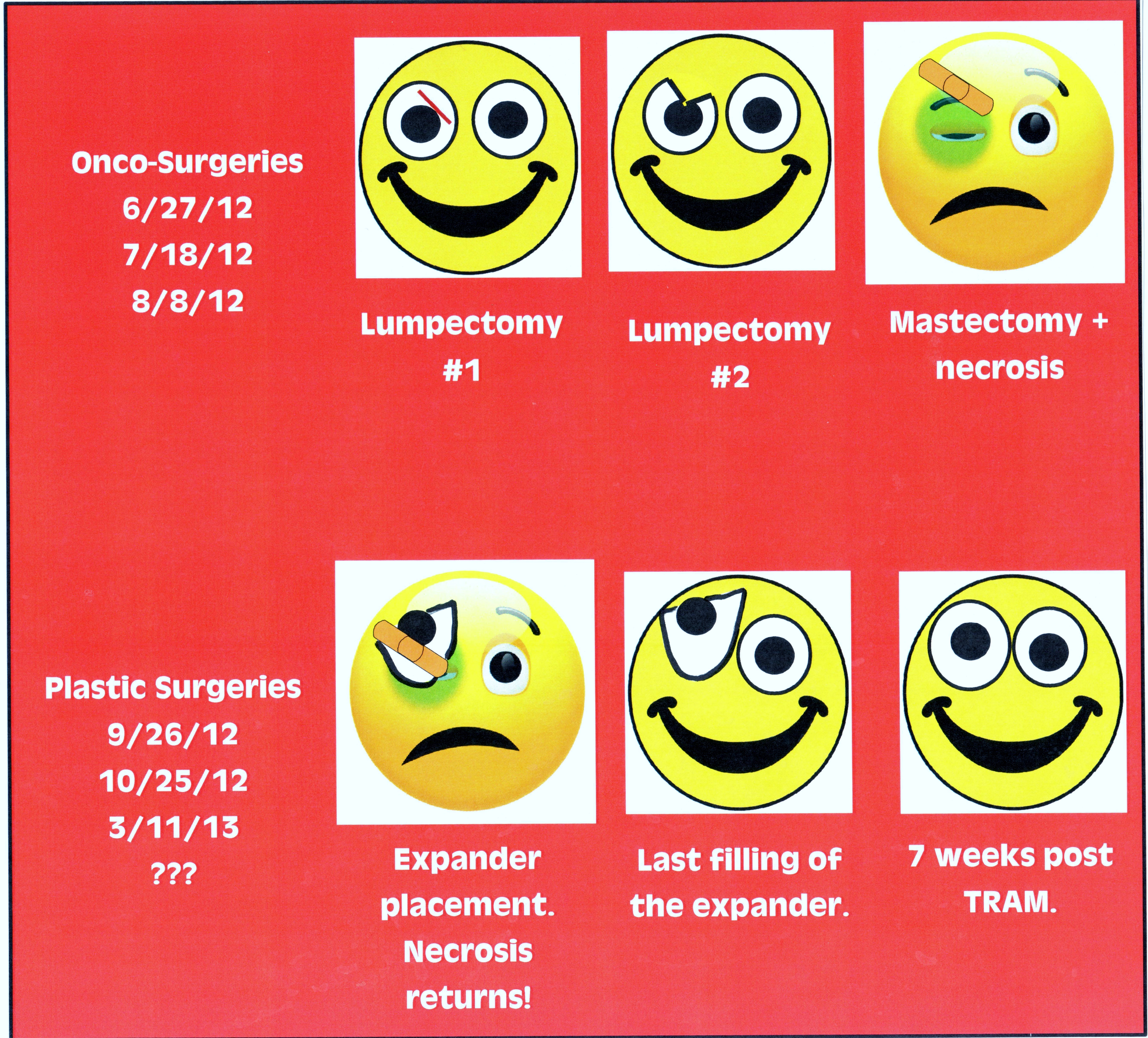
My last surgery, TRAM reconstruction, was on March 11th, 2013. It was the day after my 23rd wedding anniversary. I’d had quite a number of surgeries in a small number of months, which I chronicled in my humorous salute to women who post actual photos of the stages of their surgery:

smiley3

The last smiley was smiley represents healing at seven weeks post TRAM. Although the right googly eye is slightly smaller than it was, the overall effect is the same. And if you ask the reasonable question as to why a surgeon would purposely make a reconstructed breast bigger than the natural breast, my understanding is that they do that in case there is tissue necrosis and they need to remove some of the tissue. I had no difficulty with necrosis following the TRAM leaving me with the current va va VOOM effect.

I met with my plastic surgeon last Thursday. We discussed the next possible options for my reconstruction. I decided to go ahead with two procedures, to be done on the same day (March 19th) in an office visit. “VOOM” will get a little reduction and “va va” will get a 200 cc fat injection harvested from my thighs via liposuction. If, like me, you don’t think in terms of cubic centimeters, here is a beaker filled with 200 cc of milk. (Yes, I own a set of small beakers.)

20140223_143927

200 cc’s is not a lot so I am hoping I’ll heal quickly from the surgery. But, who knows? This will be my 8th (technically 8th and 9th) surgery so I know that whatever happens will happen and I’ll deal with whatever comes my way.

There are no other planned surgeries after this. I have no crystal ball but these could be my last breast surgeries. That’s kind of a nice thought.

A large part of my training as a Ph.D. student in clinical psychology at the University of North Carolina-Chapel Hill was completed at a state psychiatric hospital in Butner, NC. The hospital, which has been since closed down was located amid tobacco fields, a federal prison, two orphanages (segregated by race even in the 90’s), a “training school” (jail for kids), a residential center for people with severe developmental disabilities, and a drug and alcohol treatment center. It was like this small tobacco town had taken up the industry of institutionalization. It was odd.

The hospital building had previously belonged to the federal government as World War II Army barracks. The federal government sold the buildings to the state of NC for $1. There were no interior signs in the hospital. All of the walls were blank. I have a poor sense of direction. I felt a great deal of empathy for the patients in the hospital, many of whom had trouble getting through the simplest of daily tasks.

I spent five semesters, spread over four years in that hospital. For an entire school year, I spent 16 hours a week there. I remember before I first started training there in the spring of my first year of graduate school, worrying about accidentally hurting someone there emotionally because I was unsure of what I was doing. I thought of psychiatric patients as extremely fragile and vulnerable people.

But then I had a thought. I realized that I would try my best to be kind and compassionate, to try to understand and to listen. I thought of all of the things these individuals had been through. Most of the patients had been farmers. Most of them were dirt poor. Most of them had been subjected to some of the worst imaginable life circumstances. If they had survived their lives up to this point, I figured that they could survive me, a sincere but inexperienced first year graduate student.

We all survived. It was not easy. The hospital environment itself was somewhat of a trial. Smoking in hospitals was still legal in NC during my first years there and then became illegal. During the first couple of years, the hospital was veiled in cigarette smoke (not great for my asthma, by the way) and always smelled at least lightly of urine. When I worked full days at the hospital, I noted that as the day wore on, I was more likely to encounter patients emerging naked from the showers. Many of us who have spent time in hospitals know that privacy is in short supply. Someone is always peering, prodding, or poking at us. But some psychiatric patients lost their boundaries around privacy. They don’t make sure that they are dressed before entering a public area. For many, there is a general disorientation either due to a general numbing or a disconnect with what most of us call real life.

The life stories of many of these patients were those that made soap operas plots sound like the dictionary. I mostly did assessments. But I did have one long term psychotherapy patient. She was 58 years old and it was her 30th hospitalization in as many years. My job was to help her interact in a somewhat normal way. When I first met her, she kept asking me if she was dying and tried to take all of her clothes off. I brought her tea and a deck of cards twice a week. I engaged her in conversation. She told me about being a mother. She was proud of herself as a mom. I knew from her background history that she had been a horrible mother. She shared a bed with her husband while he raped their daughter, night after night and year after year. I knew that this patient, as low functioning as she was would never be able to appreciate the horrors that they inflicted on their now adult daughter. So I just tried to help her interact in a pleasant fashion with another adult and that adult was me.

One would think that this hospital was an extremely depressing place. And yes, the hospital itself was kind of a downer. And the patients, by and large, were very very ill. But I was perpetually amazed by their resilience. The fact that even thought they were in the hospital because they could not care for themselves and many were suicidal, most days they wanted to live. This to me was a testament to the resilience of the human spirit. I found it both humbling and inspiring.

As you know, I often take walks in the forest. Yesterday, I walked in nearby Fauntleroy Park and I was reminded of the resilience of life. Stately maple trees have bulges, also known as galls, looking like tumors along their trunks. They are caused by a number of factors including fungi and injury. They ultimately, shorten the life of the tree. I see trees that have been nearly uprooted by storms continue to grow at unbelievable angles.

People, like trees can be very resilient. They can adapt to severe diseases at times and continue to live. But what I am reminded of in the woods is that there are degrees of resilience ranging from the barest of survival to lush and abundant thriving. But for all resilience does not mean unmarked or unaffected.

I took a couple of films in the woods of examples of resilience in the woods. I find it helpful to make these comparisons. If you do also, you might appreciate the films. Also, the trees are PRETTY.


Today I wrote the following letter to the English newspaper, The Guardian. It was my response to an online article about whether it is appropriate or ethical for people with stage IV cancer to use social media to communicate about their illness. Lisa Bonchek Adams, a well known breast cancer blogger and communicator through other social media, was used as an example. I was angered by the article, the singling out of Lisa, and the many criticisms Lisa received in the comments section. The article can be found here. (Update: the article was removed by The Guardian who upon investigation removed it.) Lisa Bonchek Adams’ blog can be found here. Also see Nancy’s excellent essay at the Pink Underbelly. If you’d like to send your own letter it can be emailed to letters@theguardian.com.

My letter follows. I am skipping the use of block quotes because it makes the letter harder to read.

Dear Editor,

I am writing in response to Emma Keller’s article, which was published by you on 1/8/2014. The author used Lisa Bonchek Adams, who uses social media to communicate about her life with stage IV breast cancer, as an example of a possible unethical use of social media. I am angry about the journalist’s position as well as how the article stimulated a number of negative comments toward someone who needs no more negativity in her life. I have many objections to this piece and I will delineate a few of them here.

First, I believe in freedom of speech. I also believe in personal and professional responsibility. With all of the corruption and violence in the world, why target a mother of three with stage IV breast cancer, just for using social media to communicate about her experience with a horrible disease? This tact makes no sense at all to me.

I object to the characterization of Ms. Adams’ communication as “TMI”. Journalists cover natural disasters all of the time. They cover earthquakes, famine, hurricanes, and more.  The photos and the written stories describe the devastation that people suffer. They describe the resilience and the heroism. Although not everyone is comfortable with the sadness of these stories, the stories are sympathetic and not considered TMI. Cancer is a kind of natural disaster. It is a disease that ravages and impacts countless numbers of people. Is it TMI because Ms. Adams is reporting on herself instead of being interviewed and photographed by “proper” journalists? If a hurricane survivor decided to get support and communicate about his/her experiences in dealing with a natural disaster, would we call this TMI? Would we as fellow human beings make so many negative comments about this person? I think not.

As a psychologist, I understand that distancing ourselves from an illness that can strike anyone, especially a young mother of three children, is a way we deal with the realities we don’t want to consider. They are too close. We can’t think about potential personal disaster every second of every day and function as healthy people. But it is also true that we can’t constantly deny the possibility of disaster and be healthy people. We have to incorporate potential malady into our lives. Understanding and accepting that bad things happen to good people is a building block of compassion. Without it, we let our own fear lead to unfairly assigning negative qualities to people, who are ill through no fault of their own, and doing their very best to manage under truly difficult circumstances.

As a breast cancer survivor, I understand how cancer has changed my life and my relationship with the outside world. I don’t know why I got breast cancer. I am a responsible person, a loving wife and mother, and a professional dedicated to improving the lives of children. I don’t know that I will have a recurrence. I am doing my best to live a healthy life but there is no guarantee that cancer, some other disease, violence, or an accident will end my life. I could say that it’s not fair that I got breast cancer and have had to endure its treatment, which even in this day and age, is brutal. Breast cancer, like a hurricane, is not fair. It is a natural disaster. People afflicted deserve compassion. We live with cancer and its threats in one way or another, every day.

I am also an active blogger about my own breast cancer experience. In doing so, I have enriched my life immeasurably in having made connections with wonderful people such as Ms. Adams. Having cancer is very isolating. It creates a juxtaposition of grief with a deep appreciation of the gift of life, which many people don’t understand. And there are aspects of breast cancer that make it particularly isolating. The breast cancer social media community is a very powerful network of women and men. I have drawn strength through the true friendships that I have made as well as the support of an amazing group of people, who live all over the world.

We will all die. Most of us do not know precisely when or how this will occur. People with stage IV cancer know that they are likely relatively near the end of their lives and that further they are likely to die from cancer. So many people with terminal disease spend their last years in isolation, even if when they are still able to work and carry out many daily responsibilities. Many of them don’t even “look sick” until much later in their disease progression. But their lives can be lonely and arduous. Social media can serve as a way for people to connect with others who understand. I have friends with stage IV breast cancer. I don’t know how much longer they will live or how much longer I will live. But I know that I will stay with them even through the cybersphere until our dying days. I so appreciate learning how to be a better friend to someone who is losing abilities while respecting their humanity and resilience. It is scary to know that I will likely lose more friends than I would have as a function of being part of the breast cancer community. But it is worse to think of us not having each other; there is real joy, love, and shared grief over the Internet. I consider it an honor to be trusted as a friend and to be relied upon to be there during the darkest times.

There are a lot of problems with our electronic age. Many products aimed at children, in particular, are harmful. There is nothing “virtual” about the breast cancer community. It is very real. Lisa Bonchek Adams is a real woman with real connections. This community is one of the very best and real things about our virtual age.

Thank you for your kind attention to my concerns.

Sincerely,

Elizabeth P. MacKenzie, Ph.D.

Yesterday, I was reading through my posts for 2013 as a review. I’d had a good and productive day. I was happy all day. And then I came to my post from August when I was hit with grief over the anniversaries of my mastectomy as well as the death of my friend, Gina. I remember that day in August. I cried for hours, which is something I have done less than a handful of times in my life outside of the two times I had clinical depression.

Yesterday I cried for about 20 minutes and then I actually felt good again. I’m not one of those people who usually feels better after crying. I mean I know that it is necessary to express grief but I still usually feel exhausted and cotton headed after I cry. The grief startled me because I found instantly found myself loudly and sloppily crying. The intensity of my grief felt like the day Gina died. And my worries about my own mortality, especially the prospect of dying before my daughter is grown, only intensified it.

I’m of the opinion that life is complex and there’s usually not one reason why something happens. But I will say that viewing a series of black and white photos of a husband and wife over the course of the wife’s treatment and later death from breast cancer, likely was a catalyst for this latest crying jag. One of the photos is a head shot of the pair in bed, holding each other, each with a look of utter bliss. It’s a beautiful and happy image. And it reminds me of my husband and I. John is a very affectionate man. He hugs me in his sleep and if I awaken in the middle of the night and put my arm around him, he makes a sigh of contentment and holds my hand. And I don’t mean that he sometimes does this. He always reaches for my hand, every time over the past 23 years. So I looked at that photo and immediately inserted myself into the image. And this woman who was born in the 70’s died. And you can see the progression of her illness in the photos with each photo showing loves and losses in the most poignant way. I found myself thinking, “That could have been me. That still could be me.” I didn’t dwell on the thoughts but I had them nonetheless.

I had nightmares that night. (People, when you wonder why I am careful about watching intense, violent, and/or scary films. This is why. They have given me nightmares since I was about 6 years old.) In one, I was at a parade that included some past beauty queens, women who were now middle-aged. They were beautifully dressed but instead of being on a parade float, they were lying in open caskets on wheels! Even in the dream I thought, “What on Earth? What is this supposed to symbolize about women, beauty, and aging?” And then later in the dream, I was at the funeral of a relative. I don’t remember anything except she was a woman in my family. I remember having grief during the dream about missing my grandmother who died in 1993. In the final part of the dream, my daughter was acting completely and utterly out of control. As rebellious and angry as she could be. It was terrifying.

I am a genuinely happy person. One who has been through a lot. And lots of people have been through a lot in their lives with different impacts and different ways of coping. I am a person who feels things deeply but I am also a deep thinker. And I feel both positive and negative emotions as well as having positive and negative thoughts. I feel happy and calm most of the time. I think part of these intense moments I have of sadness and fear come from the enormity of what I have to lose, my family, my friends, my independence, my capacity to help others as a psychologist.

Today’s New Year’s Eve resolution is to remind myself of the strength of my connections, my connections to myself through my own self-awareness and the purposeful way in which I try to lead my life. My connection to my daughter who is doing so well and so happy right now. My connection to my husband who loves me so dearly that he reaches out to me even when he is fast asleep. Who trusts me so deeply that he allows me to be very open about the ups and downs of our relationship as well as our own personal shortcomings. My connection to my parents; I can’t imagine how hard it must be as older people, to worry about your child’s health and mortality. When my friend, Preben got cancer over five years ago, while still in his 30’s, I noticed that his parents started visiting him much more frequently. I told him half jokingly, “That’s what you get for getting cancer and scaring your parents.” My connections with my extended family have also strengthened. I have some wonderful cousins and sister-in-laws and my brothers have actually nudged themselves out of their comfort zone a little to be a bit more affectionate with their sister.

My friendship connections over the past year and a half have seen the most change. I have made a number of new friends who have startled me with their intense and generous kindness. I know that some of them will come and go but I think that a good number of them will be lifelong friends. I have had old friendships that have evolved into something much deeper than they were in the past. But I have also experienced some lost friendships and some that have been made weaker by my cancer. This mixture of bitter and sweet, of gains and losses, is somewhat dizzying to a person like me who craves consistency and solidity. But I have learned to cope with chaos in my life. I want to be happy and I know chaos happens no matter what I do. So what is my choice other than to try to make peace with it, live along side of it, and accept that I sometimes lose my footing.

Finally, today I remind myself of my reconnection with nature. I spend time outside every day. I have been able to travel to the mountains and to the sea. I am outdoors during good weather and in bad. Even in the most exposed and vulnerable parts of nature, there is beauty. I feel a strong spiritual connection to everything when I walk. It is both intensely personal and beautifully communal.

That is today’s resolution. Tomorrow is a new day and a new year. I wish all of you good things in 2014: moments of joy, moments of peace, and fortitude among the suffering and chaos. Thank you for your connection and support. Xoxoxoxo.

20131120_131015

John Gottmann, a psychologist at the University of Washington wrote a book called, “The Relationship Cure.” In it are strategies for strengthening marriages and other relationships. But Dr. Gottmann is a well known expert on marriage so that emphasis of the book is there. I have read a number of his books and know that one of the things he talks about quite frequently are perpetual problems. 69% of marital arguments are never resolved. And it’s not so much that happy couples need to resolve them as they need to cope with them together.

My maternal grandparents had a long marriage of 60 years. I wish I could say that it was a happy one but it was not. They had a number of perpetual conflicts but one I distinctly remember is the fight they had about a photo that my grandmother had taken with the Hawaiian entertainer, Don Ho. They took separate vacations by the time they were in their 60’s. My grandmother would frequently visit Hawaii to see their daughter, Judy and her family. My grandmother loved Don Ho’s shows. Apparently, he used to invite the grandmothers in the audience to take a photo with him. My grandmother, who was one of the most star struck people I’ve known, of course got the photo op. But she wouldn’t show the photo to my grandfather. I don’t know how many times I heard them yell at each other over some stupid photo. Like my grandmother would have an affair with Don Ho! But the argument was not about the photo. It was about some deeper issue that they were not able to manage. But because they were of a generation, a social class, and a religion that didn’t divorce, they stayed together for many unhappy years.

John and I have been together for nearly 27 years and we have our share of perpetual arguments. And conflict is part of any close relationship. It is to be expected and to be dealt with. But never in a million years would I expect to have a perpetual argument about a plant part, more specifically soursop leaves. Soursop is a fruting tree indigenous to Mexico, Central America, and the Caribbean. I first became aware of the soursop when I was visiting one of my best friends, Cheryl, for her mother’s funeral. Cheryl’s parents were both immigrants from Trinidad. Cheryl’s Uncle Norbert, a retired ichthyologist with more than a passing visual and vocal resemblance to Harry Belafonte, first told me about soursop ice cream. It is as I understand, an acquired taste.

Many years passed and I didn’t think again about soursop. Then I was diagnosed with cancer in late May of 2012. I had my first surgery scheduled for June 27th of the same year. One day, shortly after my diagnosis, John came home with a plastic bag of leaves. One of his co-workers had learned of my breast cancer and told John that tea made from soursop leaves would shrink my tumor. In fact, he thought it would help shrink my tumor even prior to surgery, which was scheduled for a couple of weeks later.

My husband is a software engineer for Disney Internet. The co-worker who gave him the leaves also had a high tech background. He was also rather eccentric, priding himself on storing his container of almond butter upside down so that the oil was easier to stir into it and it would remain creamier. I know this sounds snarky, because it is, but my mother taught me the same practical tip about peanut butter when I was a girl, with about 1/100th of the fanfare.

John brought home the leaves with instructions to make tea. I told him, “I’m not drinking that. Your co-worker is not a physician. He’s an engineer. And he’s weird.”

Okay, so that was not the best way to handle the situation but I was overwhelmed with information, trying to be the best patient that I could be, and the soursop leaf suggestion just seemed surreal to me. Go away, surreality. I need less of you. I am swimming in this cancer Hell hole as fast as I can. I don’t need any Salvador Dali in my life right now. My reality is spinning and melting enough as it is. Now, since it was so important to John I did a literature search on the use of soursop in cancer treatment. There was no evidence to support its use that I could find and some suggestion that it could be harmful. I considered his request considered, albeit in my own feisty way and ruled out for reasonable reasons.

As you might imagine, John was none too pleased with my response. He told me, “You only trust people with credentials.” Seriously? He said this as if it were a bad thing. Months later, he changed his criticism to, “You are so Western in your thinking.” I replied, “I believe that natural substances can be potentially very powerful for good or ill. I want to see an expert not just take advice from anyone. And by the way, you know I see a naturopathic oncologist and a practitioner of oriental medicine IN ADDITION to conventional oncologists, right?”

The argument comes back from time to time without resolution. I invited John to my last two psychologist visits as we work to transition from a crisis managing couple to a different sort of life together. The kind of  life that includes the possibility of cancer and has already included past cancer. We are still dealing with the aftermath.

The soursop leaf debacle was discussed during the last session we had together. John explained why it was so important to him. He said, “I wanted to cure Elizabeth’s cancer.” John clarified that he did not think that he was a physician or that he had more expertise than my physicians. But he, as my husband, wanted to “help” in a way that was “curing” my cancer. It was important that I understand this. I had no idea. It makes no logical sense to me. Why would John be expected to “cure” my cancer. There is no cure for breast cancer. And if there were, it would not only be known by John and another software engineer. In fact, it probably WOULDN’T be known by a couple of high tech guys.

But John is my husband who loves me dearly. I know that when he is scared, he is not always “reasonable”, in fact he can be downright romantic and sometimes nearly magical in his thinking when things gets really emotionally tough. And guess what? I am not the paragon of reason at all times. I get scared, feel out of control, and have my own little irrational dance that I do.

I don’t know what it is like to be a spouse of someone with cancer. I hope never to have this experience. But I know that it is important for me to try to understand my husband’s experience. This way we can cope with the conflict of the soursop leaves, which is really conflict about neither of us having control over the disease of cancer.

In addition to the color pink as a emblem of breast cancer, another polarizing expression is the characterization of cancer as a “gift”. I don’t think of it as a gift but I do think that it in coping with it, I have learned some important life lessons. It has been an ultimate learning experience, a growth experience, if you will.

The recent posts on the topic reminded me of something. My clinical psychology Ph.D. program was quite demanding and the first year was steep learning curve for students. When I was an advanced grad student, I watched a new crop of students struggling toward the end of the first semester. One day they got an additional unexpected task. Some of the students were trying to reframe it in a positive light. Louis, who was really funny and had a way to getting to the heart of the matter said, “Oh great! Another fucking growth experience!”

I don’t think he’d see cancer as a “gift”, either.

This content is password-protected. To view it, please enter the password below.

But we in it shall be remembered-
We few, we happy few, we band of brothers;
For he to-day that sheds his blood with me
Shall be my brother; be he ne’er so vile,
This day shall gentle his condition;
And gentlemen in England now-a-bed
Shall think themselves accurs’d they were not here,
And hold their manhoods cheap whiles any speaks
That fought with us upon Saint Crispin’s day.

-William Shakespeare, Henry V, St. Crispin’s Day speech

Soldiers prepare for battle is different ways. Some get drunk. Some revel, party, and have sex with prostitutes. Some pray. Some cry and despair. Some are calmly resigned to whatever fate may befall them. Some do all of these things. “War is Hell” as William Tecumseh Sherman said in 1879 and most of us give soldiers at least a little latitude in the way they deal with this reality.

Preparing for a mastectomy is one kind of battle plan. Some of us cope by crying, by grieving for the loss of a culturally and personally significant body part. Grieving for the loss of being able to depend on good health. Others cope by getting angry, by cursing the barbarous  and coarse way in which breast cancer is treated, by amputating breasts, chemical warfare, and irradiating the Hell out of potentially tumorous sites.

There are many more ways to cope. I coped by writing silly posts about accidentally turning my hair orange, because I had an irrational need to be a little bit cute, to not have gray hair after my mastectomy. I wrote another post saying goodbye to my breast using all kinds of melon-related imagery. I also spent time learning about cancer and its history. Being silly actually made me feel a lot better. It took my mind off my worries and reminded me that I had the power to do something good, to make other people and myself laugh. But I never thought for a second that my mastectomy was going to be a positive experience. And I would have never predicted that I would be reading “The Emperor of All Maladies” in the pre-op area of the hospital just prior to my mastectomy. And coincidentally, I was reading the chapters on mastectomy. In a weird way it was comforting to know that the current surgeries were far less extensive than in the past. It was reassuring to see that there had been progress in breast cancer surgery. But honestly, I look back and think, “Why was I reading about cancer?” But at the time, it was the right thing to do.

I did not feel bereft, angry, or super sad in the weeks, days, or moments leading up to my mastectomy. I had anxiety, but it was relatively manageable. When it came time for surgery, I asked the anesthesiologist to knock me out as fast as possible, which she did. I did not want to belabor things. The operating room is surreal to me and I wanted to to experience the least amount of it as possible. More importantly, I knew that the faster I was knocked out the less time it would seem that I would have to wait until the surgery was done. I knew that there would be no perceived lapse of time between losing consciousness in the operating room and waking up in the recovery room.

But that was my way of coping, which worked for me. Not everyone wants to do what I did, scheduling surgeries as fast as possible, writing silly humorous posts, reading about cancer in the pre-op area, or getting knocked out as fast as possible. Moving ahead quickly, laughing when I could and reading history that put my disease in a larger context, made sense to me.

Some women prepare for a mastectomy by dancing. One woman, an OB/Gyn, prepared for her bilateral mastectomy by dancing to Beyonce with her surgical team. When I looked at the video, I thought of how dancing in the O.R. might be empowering for a surgeon. She may have never had surgery before and would have been used to being on the other side of the operating table. By dancing in the O.R. with her colleagues, she may have felt a sense of mastery that helped her prepare for her surgery.

I thought the video was cool but I understand why others thought it trivialized breast cancer or prescribed a model by which we are all compared. We should all be happy to have breast cancer. Yay, deforming surgeries! Yay, lymphedema! Yay, lack of sensation in the removed breasts! Yay, scars!

I am sad and angry that the popular media has taken this stance when it comes to breast cancer. But I do think, apart from that, each breast cancer patient needs to cope in his or her own way. Sometimes that way is dancing. And sometimes the dancing, just like mastectomy photos, are shared on the Internet.

We all prepare for battle in a different way but we are all fighting the same battle. Let’s do it together.

Lindbergh High School Reunion '82, '83, '84, '85

Join us this summer for our reunion in Renton, WA!

George Lakoff

George Lakoff has retired as Distinguished Professor of Cognitive Science and Linguistics at the University of California at Berkeley. His newest book "The Neural Mind" is now available.

KomenWatch

Keeping our eyes and ears open.....

4 Times and Counting

Confessions Of A 4 Time Breast Cancer Survivor

Nancy's Point

A blog about breast cancer, loss, and survivorship

After 20 Years

Exploring progress in cancer research from the patient perspective

My Eyes Are Up Here

My life is not just about my chest, despite rumblings to the contrary.

Dglassme's Blog

Wouldn't Wish This On My Worst Enemy

SeasonedSistah

Today is Better Than Yesterday

The Pink Underbelly

A day in the life of a sassy Texas girl dealing with breast cancer and its messy aftermath

The Asymmetry of Matter

Qui vivra verra.

Fab 4th and 5th Grade

Teaching readers, writers, and thinkers

Journeying Beyond Breast Cancer

making sense of the breast cancer experience together

Entering a World of Pink

a male breast cancer blog

Luminous Blue

a mother's and daughter's journey with transformation, cancer, death and love

Fierce is the New Pink

Run to the Bear!

The Sarcastic Boob

Determined to Manage Breast Cancer with the Same Level of Sarcasm with which I Manage Everything Else

FEC-THis

Life after a tango with death & its best friend cancer