Archives for category: Breast cancer

I was quite an awkward 11 and 12 year-old, as many girls are during those ages. I was and I still am very close to my mom and I remember talking to her about that stage of not being a young child but not quite being a teenager. Mom had suitable song lyrics for this and sometimes responded by singing, “Too young for boys, too old for toys, I’m just an in-between.”

“In between” is a phrase that has been popping into my mind frequently. I feel like an “in-between” as a cancer patient.

Actually, when I really think about it, I’ve felt like an “in-between” during this whole process and I see my friends going through the same thing. I remember in the early days of breast cancer I was shuttled back and forth between assessment and treatment. And even some of the treatment, that is surgery, was also used for assessment. There are blurry lines. It is a systematic process but there are many data gathering and decision points.

Other than my tamoxifen and Lupron shots, I am not in active cancer treatment. My oncology appointments are more spread out. I don’t even see my surgeon any more, I just see the nurse practitioner in the surgery office who works with “survivors”, the ultimate “in-between” status. Actually, there’s another in-between because if I am to need to have a breast cancer surgeon again, I need to see someone else. Dr. Wonderful not only “broke up” with me for being too healthy, he also retired from clinical practice, just last week. He is remaining at my cancer center doing research and in a leadership position regarding improving patient care. At least I can still send him a Christmas card later this year. He will not have moved back home yet. (He is Canadian, from Toronto, and I’ve always figured that he and his wife will move back to be with their sons and grandchildren.)

My current “in-between” balancing act is juggling my responsibilities. Okay, this is not a new balancing act as I have done it throughout my entire experience with cancer. However, as my energy is increasing, I have been able to work more. During 2013 my income, after deducting my expenses, was 50% of what it was pre-cancer. 2014 will not be a year like 2011 but it will be a much better year. I can see myself getting out of debt. My husband and I celebrate our 25th wedding anniversaries along with our 50th birthdays in 2015. We would like to take a trip to Turkey along with our daughter, to celebrate. We have a lot of saving to do if we are going to be able to take that trip. I certainly can’t contribute to that kind of expense without getting out of debt.

I am feeling the tug of responsibility to my friends, especially my friends in the breast cancer community. I know that I am not as available for communications as I once was. Some of my friends I know only through online conversations. I don’t like to distinguish them from IRL (in real life) friends because all of my friends are real life friends. Great distances as well as time differences can make communication difficult, though. And further, I confess that I am less likely to ask, “how are you” to friends who are having emotionally and physically difficult times. I don’t like to ask that question unless I am prepared to respond with the kind of time someone needs if the answer is not, “I’m fine, thank you. And you?”  I am frequently pulled away to other responsibilities at home and at work. I don’t want to do a half-assed job of supporting my friends. I’ve had too many times in my life when a friend has asked “How are you?” during a hard spot in my life and my eyes tear up with the anticipation that I will be able to share my burdon with someone only to find out that the friend really does not have the time or mental energy just right then to tend to me.

I am also worried about losing my connection with the breast cancer community. I write frequently, but when I am really busy, I have fewer ideas. I don’t want my ideas to dry up and then the social connections to dry up as well.

Most of all, I am worried about losing my connection to the opportunity (not “gift”, mind you) breast cancer and my emotional recovery have given me to truly cherish life. I want to be connected to and mindful of the full richness of life.

I suspect I will work my way through this. I also suspect that I will not run out of things to communicate, even if not through blogging. And as far as blogging goes, I think I still have much to write here on this page. But I also want to respect and take note of the anxiety and fatigue I’ve been feeling lately. The anxiety is of the “lurking in the shadows” variety and not the spinning top anxiety I get when I go into overdrive.

Maybe the “new normal” that is talked about is actually a radical acceptance that life is always in-between.

Today is Sunday. It is half past noon. There’s bluegrass playing on the radio and my husband is in the kitchen doing dishes. The kittens are wrestling happily on the floor. It’s a pleasant scene. I am completely exhausted.

John and I used to have frequent dinner parties. We entertained a lot. It is one of the things we had to give up for awhile after my cancer diagnosis.

In time, I was energetic enough to host family gatherings, first our daughter’s 15th birthday and later, Thanksgiving. Then we had a party for John’s co-workers.

This morning I realized that I have cooked a major meal every weekend for the past three weekends. First was Father’s Day, then hosting our friends Kurt, Linda, and their kids. Last night our friend, Robin and her son’s Michael and Nate visited from North Carolina. Robin is our daughter’s godmother. Michael, who is almost 22 years old, is our god son. We haven’t seen them in about 8 years. The visit was a big deal.

No wonder I’m exhausted! It was not so long ago that I was having trouble having enough stamina to track conversations with people. It was even less long ago that I was needed 12 hours of sleep per night.

I am pretty mindful of my stamina and energy levels. I honor my need for sleep better than most. But I still overdo it and today I need extra rest.

I was thinking that I need to be mindful of these things because I am more limited than I was in the past. However, after seeing a series of old photos of myself over the years taken in the past 15 years, I am starting to wonder.  When I compare them to recent photos I realize that I currently look a lot less tired and that I actually look healthier than I did in my 30’s and early 40’s.

I have some things to think about. I don’t want to go back to the years when I pushed myself to work harder at the sacrifice of my own self-care.

At this point, it’s not so much that I CAN’T do what I used to be able to do.

It’s that I WON’T do it.


My daughter is away at camp this week. John and I decided to go out for a nice dinner last Wednesday. I just happened to have a salon appointment scheduled that day so I knew I was going to have “special occasion” hair. I chose a dress out of my closet that was inappropriate for work but appropriate for a date with my husband. We had a lovely time. I recently bought him a new camera so he was taking photos of me. A LOT of photos. He said it was because, “You look so pretty.” Yes, he is very sweet and he is the only person I would let put a camera two inches from my face in order to take close-ups.

This is one of the best photos.

Photo by Elizabeth's hubby. 2014.

Photo by Elizabeth’s hubby. 2014.

When I first saw it I thought, “That’s a nice photo of me. I look really happy, relaxed, and in love.” And those things are all true.

Then I noticed that I still had hair dye on my forehead near my hairline but I thought, “Who’s going to notice?”

Then I saw my crooked cleavage. I thought, “Oh!” I said to John, “My cleavage is off center!” He said, “Pfff, you look great.”

Now I’ve known about this asymmetry for a long time now. But this was the first time that I’d seen the unevenness in a photo of myself out in public. I had been wearing a low cut dress, displaying décolletage in all its cattywampus splendor.

Then I realized something. I didn’t really care all that much.

I am happy.

My husband loves me.

I’m still in the picture.

There’s nothing wrong with this picture.

Ross McElwee is a documentary film maker originally from North Carolina, the state that is the top grower of tobacco in the U.S. In his 2003 film, Bright Leaves, he explores the industry, especially its impact on his family, who still live in the state. In one scene, he films an examination carried out by his brother, Tom, a physician, on one of his patients, a middle aged woman.

The dropping of her examination gown reveals an enormous black tumor that has replaced where the woman’s breast tissue used to be. It has been there, growing for a VERY long time. This is the first time she has gone to a physician about it. Tom asks her questions with a gentle professional tone that belies his obvious incredulity and alarm. His patient calmly answers the question while the audience feels the horror of, “Oh my God, she has REALLY bad cancer and she’s acting like she has a hangnail!”

After this horrific moment, McElwee zooms in onto just the tumor. No one being filmed is talking. And then he keeps the tumor in view for a very long time; it seemed like several minutes but it probably was not nearly that long.

The disgust and horror abated and I was able to look at the tumor, I mean REALLY look at it. By getting a close up view, it became an abstract and almost sculptural object. I looked at the color, the shape, and the texture. When the scene was over, I thought about it for a great while and obviously, I still think of it today. The horror I felt initially was real. And the tumor, up close, removed from its emotional associations, was also real. And then I integrated both of these experiences into my understanding of this woman, her physician, and her cancer.

There are upsetting aspects of life that keep us noticing our feelings about them. And we can get stuck on the fear. I know this very well being a naturally anxious person. It is easy for me to start fixing a problem that I assume is real because I feel anxious. The real problem may be that I have gotten myself overly stressed and that I need to slow down, think about something else, exercise, talk to someone, write, or something else that calms me.

I started my mindfulness practice two years ago to gain more balance and calm in my life. It has helped me enormously in this respect. I am learning to observe my life in small pieces but much more thoroughly. And in observing little pieces at a time, I find it much more tolerable. It is easier for me to move past the fear, anger, and sadness of the painful aspects of my life. It has helped me understand my experience of cancer, bit by bit, and has contributed dramatically to my emotional recovery.

Since mindfulness is an approach to experiencing life, it can be done at any or all times of the day. Mindfulness meditation is a more discrete practice. I did it several months as a resting meditation, twice per day, using a meditation timer. Then I noticed I was having the experience when walking, especially when I am in the woods, looking at flowers, or at the beach. Although I still do resting meditation, I more frequently do active meditation while on my walks.

When I first started meditating, I could see the benefit but frankly, I thought I was doing it wrong or cheating in some way because my brain was full of jumping monkeys. I was often thinking about other things, in rapid succession. My mind is typically active, but in the stress of cancer and for many months to come, it was kind of ridiculous. I knew that in mindfulness, I was just supposed to notice my distraction and this would typically redirect my thoughts. In other words, I wasn’t doing it “wrong”. Although I still had a little doubt in myself, it was relaxing to meditate and I was committed to my healthier life style so I persisted.
Over time, I have found that mindfulness has gently seeped into the rest of my life. It is not something that I have to schedule though it is a byproduct of other activities that I do on a regular basis such as see my psychologist or more frequently, writing this blog.

I find that mindfulness is more about “what to do” than “what not to do” To a person who has struggled with anxiety, guilt, and depression, I find this to be a very liberating approach. My main goal in practicing mindfulness was to reduce the distress in my life and build my emotional resilience.

It has done just that. It has also increased my experiences of joy, bliss, and contentment. In other words, mindfulness has not only helped me feel “less bad”, it has also helped me feel “more good.”

I have rediscovered myself as a physically active person. Most recently, I have rediscovered my visual talents. I typically think of myself as being very verbal, a talker, a person who thinks in words rather than images. And this is true. I will not deny this. If I were to do so, there would be a line up of friends and family who would remind me of my chatterbox ways.

But I am also a visual person. I excelled at mathematics. I used to be able to read music with a startling array of notes on the page, 32nd notes, 64th notes. I could play really really fast and I needed to be able to visually process that information as well as use the other parts of my brain, which translated the notes into motor movements as I touched the keys of my flute, supported my breath, made the quick changes to my facial muscles needed to produce different sounds.

Most importantly, I love visual arts. I have yet learned how to draw or paint but I am an artistic person. I am good with color. I am good at arranging physical spaces. I have an artistically decorated home and office. I love to make things with my hands. And as I’ve mentioned recently, I have recently resumed taking photos.

I take my camera with me on my walks. I used to take photos with my smartphone. I enjoyed it so much that I bought a “real” camera last April. Little did I realize when I bought that camera that I was adding another layer to my mindfulness practice.

My camera is not expensive but it is surprisingly good. In particular, the macro lens has allowed me to get up close to things and see them in a different way. I started taking photos of leaves and flowers up close. And then I got even closer.

When I get really close, the blooms become abstract and almost sculptural. It is like entering a new visual world. I am not an expert at either mindfulness or photography, but combining these practices has deepened my joy in life. I am noticing patterns, some interesting, some beautiful, everywhere. I am seeing the familiar in a different way.

Kurt Koffka long ago said, “The whole is other than the sum of its parts.” I believe this to be true. But I do find that in looking at parts, lots of them, bit by bit, by examining them in detail, I am not only seeing more of the whole but I am feeling more whole.

DSC01705

Rose

DSC01689 (1)

Poppy

DSC01714

Allium

DSC01682 (1)

Hibiscus

DSC01751 (1)

Passionflower

I took a good number of art history classes while I was a student at the University of Washington. One of the classes, Asian Art, was taught by Glen Webb, a man originally from Kansas, if memory serves. Dr. Webb was an excellent instructor. He was interesting and knowledgeable. He was also daring and adventurous. I remember his describing the amazing Buddha sculptures carved into cliffs in Afghanistan. Even in the 80’s they were already being destroyed by Afghani soldiers. He gently lamented, “I had wonderful slides of them but I dropped them down a crevasse.”

Glen Webb was also the second person I’ve encountered in my life who comported himself with balance, an incredible calm, and peacefulness. (The first was Archbishop Emeritus of Seattle, Raymond Hunthausen.) Glen Webb was also a Zen Buddhist monk. He had followers in Japan.

I could be a ball of anxiety in those days, and for many years to follow. I thought to myself, “I want that. I want what he has.”

So I listened to how he described Buddhism. One of the things he taught us was the axiom, “I am that.” If we are all part of everyone else then there is no self. In other words, “I am that.”

No self? Hmm. “I don’t want that. I am not that. I am me”

Connection threatens identity. Identity threatens connection.

An experience like breast cancer can send us back to adolescence, which is a major period of identity development. “I that this but not that. I am not what you tell me that I am.”

“I am not cancer.” “I am not pink ribbons.” “I am not a survivor.” “I am not a warrior.”

If you ask me who I am, I will tell you, “Elizabeth MacKenzie.” (And if you have a pencil in your hand, I will note that it is “M-a-c” and that the ‘K’ is uppercase.

But if I really think about it, my name says very little about who I am. My name is not my identity. My name merely identifies me.

That doesn’t mean that my name is not important because it is important to me.

I am cancer, it is a part of my life whether it ever returns or not.

I am a cancer survivor if I think of it as a process rather than an end point. I am a cancer survivor until I die, whether I die from cancer or not.

I am a psychologist until I die.

I am a mother until I die.

I am a wife until I die.

I am a friend until I die.

I am that but I am not just that.

I am so many things.

And so are you.

When I was in graduate school, we had the opportunity to attend colloquia every Monday night as part of the Carolina Consortium on Human Development, held at the Frank Porter Graham Center for Child Development, which is part of the University of North Carolina. The “grown ups” were all developmental psychologists. But child clinical psychology students such as myself, not surprisingly took many child development classes. So, from time to time, we showed up.

The exchanges were lively and fast. The debates were spirited without being disrespectful. It was intoxicating. I remember one psychologist was always asking the main presenter, “But what are the underlying causal mechanisms?” For every presentation, that was one of his questions.

Then it was his turn to present. His talk was brilliant but devoid of any talk of causal factors. So I asked him, “But what are the underlying causal mechanisms?” His response was, “I don’t care about why, there is only how.”

I thought the answer was a bit of a brilliant cheat but it really got me thinking. That exchange occurred over 20 years ago and it still has me thinking!

When I was an older child, I used to ask my mother, “What was I like when I was little?” She’d answer, “You laughed and smiled a lot. You asked A LOT of questions.”

I have long been a question asker. I am a curious person. I like to understand things. “What is it?” “How does it work?” “Why is it?”

I came from a more modest background than most of the people in my Ph.D. program. (Pennie was the exception. She was from Mill Creek, West Virginia and her father worked as a coal miner.) I had many moments of self-consciousness and insecurity as a student. But one of the tools I felt was strong and well honed was my ability to ask questions and to think about the possible answers.

In thinking about my cancer, I believe the question I have explored least of all is, “Why did I get cancer?” I learned about the what and how. But once I realized that I did not have any known genetic risk and set up healthy life habits, I dropped the question for the most part. It certainly could come back, especially the “Why me?” grief question. But for now at least, the question is on the back burner, at least from a personal standpoint. (In other words, I have not backburnered my interest in cancer research.)

In the meantime, I am focusing on how I live rather than why I live.


One of the requirements for my Ph.D. in Clinical Psychology was completing a one year long internship at one of many sites around the country. The application process is a very stressful rite of passage for students. I often say, “You can have time or money but not both.” Well, in grad school, most of us had neither. But we managed to fill out internship applications and travel for interviews to the sites that were most promising. I remember traveling from North Carolina to Oklahoma City, Seattle, Chicago, and Gainesville, Florida.

Internship offers were made by phone back then on “Match Day”, which started at 10:00 am Eastern Standard Time and I believe was on a day in March in 1996. Prospective interns would wait by the home phone (no cell phones back then), hoping that it would ring right at 10:00 am and that we would hear the sound of the voice of the director of the desired internship. We were allowed to say, “yes” or “no” on the spot. There was no, “I’ll think about it after I’ve considered all of my offers.”

Prior to Match Day, we had the option to send an internship site a “first choice” letter. The communication was, “If you call and offer me an internship, I will accept it.” There were a number of rules around this. Sites weren’t allowed to ask us if we were going to “first choice” them and if we “first-choiced” a site and didn’t take it, it was considered a very uncool thing to do. We were also not allowed to “first choice” more than one site.

After my visits to sites, I made a rankings list, weighing professional and personal variables. My first choice for professional reasons was the University of Florida. However, getting back to Seattle was a high priority so the University of Washington made it to the top of my list. Both sites were prestigious and offered excellent training. I sent a “first choice” letter to the University of Washington. A few days later, I received a call from the internship director there. She told me that I was a “very strong candidate” but that it was not in my best interest to give U.W. my first choice letter. She recommended that I withdraw it, which I did. This was a painful phone conversation, but even at the time I knew that it was very kind of her to let me know I was not one of their top candidates. I sent off a new “first choice” letter to the University of Florida.

Meanwhile, John and I were nervous wrecks. John was researching job markets for all of the potential cities in which we might live. Fortunately, since Gainesville was a drivable distance from where we lived, we had gone together and he’d gotten an opportunity to check out the area, which he liked a lot. The job market there was terrible for him, though.

There was nothing for us to do at that point but wait for 10:00 am on Match Day and hope that the phone would ring. I was well trained, having completed some ridiculous number of supervised clinical hours during my years at UNC. (If memory serves, I’d logged 2700 hours when the requirement was 500.) Oh, the other stressful thing was that sometimes, no one called a student. There was usually one student each year from our program who despite their excellent application and the strength of the reputation of our program, did not get an offer. Those students had the chance to go through the “clearinghouse” process and be placed in one of the leftover spots. (These days, incidentally, there are no “leftover” spots. There are more applicants than there are spots at accredited internship sites.)

Match Day came. All of the worry about where we would live, what I would do, and would I be able to work anywhere would hopefully be reduced. 10:00 am came and went. I willed the phone to ring. At 10:02, the phone range and I answered it. It was the University of Florida and they made me an offer, which I accepted. It was really quick so quick that I said, “You just made me an offer and I accepted it, right?” The director chuckled and said, “yes.” We said our goodbyes. The first one I called was my husband. He was happy. The second call was to my parents. My mom was happy. My dad was happy though said, “Florida? You are moving even FARTHER away from home.”

Exactly two years ago, I found myself waiting by the phone again. The call that I would receive would say a lot about my future. I was waiting on a call from the Swedish Cancer Institute with the results of my core biopsy, which had been performed two days before. I knew that a call would arrive at any time. As fate would have it, I was called at 10:00 am, just like Match Day. The diagnostic radiologist told me that I had an invasive ductal carcinoma tumor of approximate size of 1 cm. She said, “This is the most common breast cancer. A surgeon will call you within the hour. I’m sorry. We will take good care of you.”

The first person I called was my husband. He told me that he was taking the bus from work to be at home with me. Then I called my parents. My mom answered and I told her, “Mom, I have cancer. Mom, I am scared.” She was comforting and I was able to stop crying so that I could get information and make decisions. (Not everyone copes this way. I like to work fast and get things in place.) I called my friend, Nancy, a 12 year breast cancer survivor and psychologist who works with breast cancer patients. I got her voicemail so I left her a  message. I had not even previously told her that I’d had a biopsy. Then I left a voice mail for my friend, Jennie, who had known about the biopsy. As soon as I finished my message to Jennie, Nancy called.

Nancy was reassuring and also gave me a list of surgeons who had excellent technical skills but also good people skills. Dr. Beatty was on the list. His office called while I was talking to Nancy. I got off of the phone with Nancy and picked up the call from Rhea, who was the scheduler at his office back then. I made an appointment for the next day. I was not required to accept the first surgeon who called. I could have met with another surgeon after I met with Dr. Beatty. But I immediately adored him and didn’t feel like I needed to see anyone else. Nancy, who had accompanied us to the appointment, and John agreed.

My family has been through a great deal in the last several years and not all of it was related to my cancer. If you’d asked me even as recently as five years ago, how I would cope with all of the life events that were in store for me, I would have guessed that I would go into an anxiety spin, followed by depression, and some kind of severe mental breakdown. I certainly would not have guessed that along with the anxiety, anger, and pain, I would also find more joy and peace than ever before in my life.

I feel a mixture of feelings and thoughts today. And maybe that’s part of what these “anniversaries” are about. Experiencing a year or several years’ ups and downs in the span of a few days.

I will never say, “Cancer, you have met your match.” I know that cancer can kill. But I can say that right now, I am a match for its aftermath.

I remember the thrill of discovery when I was in high school German class. There was a second person plural tense, “You all”.

I was raised in the northwest of the U.S. We are considered to have “no accent”, if that is such a thing. In any event, the closest we have to a plural second person is, “You guys.” As a feminist and inclusive person, that convention leaves much to be desired. But when I was learning tenses from Frau Johnson, my high school German teacher, I learned of the miracle of a second person plural tense. How cool was that?

When I moved to the South, I was inundated with this tense, “Y’all.” Again, how cool was that?. But as a person from Seattle, I really couldn’t pull off, “Y’all.” I just didn’t have the cred for that. Although I did acquire a Southern accent while I lived in North Carolina for six years and northern Florida for one year, I thought saying, “Y’all” was not genuine for me. I did not acquire my accent purposefully and it was not a full Southern accent. Throwing out the term, “Y’all” would classify as being a poser. (Yes, I could write “poseur” but since I do not know French, doing so would make me a “poser” twice over.) It was too different from my native dialect.

But I liked the tense. It appealed to my logic as well as my inclusive sensibilities. Consequently, I settled on, “You all.”

Yes, it is pretty nerdy but so am I. And I am not a real Southerner. But I can say, “you all.”

Time and time again I put my feelings and thoughts out on this blog. Sometimes, and rather recently, I have the fear that I am a big whiner. But I also know that many of us do not disclose our complaints, our fears, our anger, or our sadness because we fear that we are to “get over it” by now.

Yesterday, I posted about my anger and my anxiety. It is not overwhelming but it is unpredictable, bothersome, and sometimes scary. A number of you out there, people whom I’ve never met, responded with a great deal of emotional support.

My first response was regret that I had caused you worry. And then I remembered the many times during which I have been happy to offer another support when he/she was having hard times. I remembered that seeking support in each other is not just a part of life but it is also a beautiful part of life.

I have a lot of gratitude and I would like to say to you all. You all are sweet. Thank you. Thank you very much.

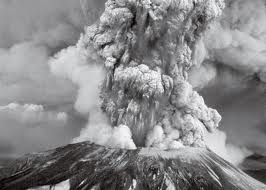
Photo from National Geographic magazine.

May 18, 1980. Eruption of Mt St. Helens. Photo from National Geographic magazine.

As you may already know, Mt. St. Helen’s erupted on this day, 34 years ago. This is a mountain in the Cascade range, one of the two mountain ranges in my state of Washington. I was in the 8th grade when it happened and although the mountain is nearly 200 miles from the city in which I grew up, I could see the ash plume from the home of the neighbor at which I was babysitting.

It was the first time I remember there being a natural disaster near where I lived. Unlike earthquakes, this seismic event could be predicted. The area was evacuated. Nonetheless, there were casualties, people who refused to leave the area. Harry Truman, an elderly man who lived on Spirit Lake, was interviewed prior to the eruption. He stated under no uncertain terms, would he leave the area. He stayed and he died.

What was most upsetting to me was the fact that two children, Day Andrew Karr (aged 11) and Michael Murray Karr (aged 9), were also killed. They actually lived in my town and their father TOOK THEM to see the mountain erupt. A photo of Day Karr’s lifeless and naked body, sitting in the back of a pick up truck was on the cover of a national magazine. I found the photo and planned to put it in this post but honestly, it is still too upsetting to me. The child had not been identified at the time the photo was published. As I recall, Day’s grandmother recognized him when she saw the cover of the NATIONAL MAGAZINE! What a horrible way to identify a body. My mother was asked to sing for the father and the boys’ funeral, which she did.

As I have mentioned, I have been dealing with anger about my cancer in the last few months. And as I have mentioned, anxiety typically underlies my experiences of anger. I feel it bubbling and sometimes it smokes and puffs a little. I have been less patient with my family.

I know that I am not going to blow like Mt. St. Helens. But I can feel something coming and I’m not sure how to prevent it. I can’t evacuate from myself. I keep walking in the woods, meditating, and so forth. I am trying to take care of myself. But this feels like a grief episode and likely increasing in part because next Saturday marks 2 years since my breast cancer diagnosis.

The other waves of grief have been ones I had to ride until I got to the other side. I suspect this will be the same. I can comfort myself with the view of a snow capped Mt. St. Helens that I saw from the airplane on my way back to Seattle from New Orleans. It was part of a beautiful range of mountains.


As I mentioned in The Hours, taking care of myself as a breast cancer patient is time consuming. For example, I still need 10-12 hours of sleep per night. I walk an hour to an hour and a half nearly every day. My wheat allergy coupled with the diet I eat to help maintain good health means that I eat very little prepared or processed food. Cooking from scratch takes time. I still find myself in health providers offices 2-3 times per week. And I work for a living. Right now, I bill about 18 hours per week. Twenty hours per week is considered full-time for a private practice psychologist. I used to bill nearly twice that much but admittedly, that was pretty unhealthy. The way I explained it to my husband was, “Imagine that you lost four hours of every work day and had 2-3 doctors’ appointments every week.”

And it’s not just trying to find time for work. It’s trying to find time for a social life, to spend time with my husband, and to spend time with my daughter. I have been looking at what I can give up to free up my time. There are some things like blogging and walking that take time but I will not give them up. My blog writing ebbs and flows in frequency. When I have a lot of ideas, it is because I have a lot on my mind to process and it is helpful to write about it.

I stopped seeing my naturopathic oncologist several months ago. I follow continue to follow her recommendations. We had transitioned to a maintenance schedule, anyway. I was also on a maintenance schedule with my acupuncture appointments. I was getting them every three weeks, traveling to a different city to get them. I told her I wanted to see if things continue to go well and check back with her as needed. I have decided that I am done with reconstruction and have no scheduled appointments with my surgeon. This means that I have scaled back to medical oncology appointments every three months, onco-surgery follow-ups every six months, massage every three weeks (I have been doing that for 13 years to manage chronic pain and stress issues), an annual mammogram, an annual MRI, a yearly physical with my internist (I am now one month overdue), psychologist visits every 2-4 weeks, and a trip to the dentist twice per year. I am still figuring out how to work in a dermatology visit as well as a trip to the eye doctor.

I have also opened up more work time by working on the weekends. I don’t work more than an hour or two each day but I don’t really like to do that. Due to logistics, cutting back a little on my practice means cutting back too much, due to the number of hours each of my testing patients requires. So I’m stuck between working a little less than I want to, which is boring and strapping us for cash or to work a little more than I’d like to. I talked to my husband earlier in the week and told him that I wanted to try to build a week off into my schedule every quarter. Because he is awesome, he quickly told me that he thought it was a wonderful idea. So, I’ve already taken off a week for New Orleans and have a vacation coming up in the summer.

I am so grateful to have flexibility in working all of this out and I will keep working on it since my energy level and responsibilities are still somewhat of a moving target.

Lindbergh High School Reunion '82, '83, '84, '85

Join us this summer for our reunion in Renton, WA!

George Lakoff

George Lakoff has retired as Distinguished Professor of Cognitive Science and Linguistics at the University of California at Berkeley. His newest book "The Neural Mind" is now available.

KomenWatch

Keeping our eyes and ears open.....

4 Times and Counting

Confessions Of A 4 Time Breast Cancer Survivor

Nancy's Point

A blog about breast cancer, loss, and survivorship

After 20 Years

Exploring progress in cancer research from the patient perspective

My Eyes Are Up Here

My life is not just about my chest, despite rumblings to the contrary.

Dglassme's Blog

Wouldn't Wish This On My Worst Enemy

SeasonedSistah

Today is Better Than Yesterday

The Pink Underbelly

A day in the life of a sassy Texas girl dealing with breast cancer and its messy aftermath

The Asymmetry of Matter

Qui vivra verra.

Fab 4th and 5th Grade

Teaching readers, writers, and thinkers

Journeying Beyond Breast Cancer

making sense of the breast cancer experience together

Entering a World of Pink

a male breast cancer blog

Luminous Blue

a mother's and daughter's journey with transformation, cancer, death and love

Fierce is the New Pink

Run to the Bear!

The Sarcastic Boob

Determined to Manage Breast Cancer with the Same Level of Sarcasm with which I Manage Everything Else

FEC-THis

Life after a tango with death & its best friend cancer