Archives for category: Mindfulness

A couple of days ago, my dear husband told me how impressed he was with my blog. Now, he has told me this before but this time he was making a positive comment on how frequently I post. He said, “I would have been able to come up with writing ideas for maybe two months. You’ve been doing this for TWO YEARS!”

Wouldn’t you know that since he said that I haven’t had a single idea for a post? Oh wait, this is a post. I guess I was wrong.

There’s no jinx, there’s just the spaces between ideas, otherwise known as accumulating life experience. No need for panic.

Breathe.

When I was in graduate school, we had the opportunity to attend colloquia every Monday night as part of the Carolina Consortium on Human Development, held at the Frank Porter Graham Center for Child Development, which is part of the University of North Carolina. The “grown ups” were all developmental psychologists. But child clinical psychology students such as myself, not surprisingly took many child development classes. So, from time to time, we showed up.

The exchanges were lively and fast. The debates were spirited without being disrespectful. It was intoxicating. I remember one psychologist was always asking the main presenter, “But what are the underlying causal mechanisms?” For every presentation, that was one of his questions.

Then it was his turn to present. His talk was brilliant but devoid of any talk of causal factors. So I asked him, “But what are the underlying causal mechanisms?” His response was, “I don’t care about why, there is only how.”

I thought the answer was a bit of a brilliant cheat but it really got me thinking. That exchange occurred over 20 years ago and it still has me thinking!

When I was an older child, I used to ask my mother, “What was I like when I was little?” She’d answer, “You laughed and smiled a lot. You asked A LOT of questions.”

I have long been a question asker. I am a curious person. I like to understand things. “What is it?” “How does it work?” “Why is it?”

I came from a more modest background than most of the people in my Ph.D. program. (Pennie was the exception. She was from Mill Creek, West Virginia and her father worked as a coal miner.) I had many moments of self-consciousness and insecurity as a student. But one of the tools I felt was strong and well honed was my ability to ask questions and to think about the possible answers.

In thinking about my cancer, I believe the question I have explored least of all is, “Why did I get cancer?” I learned about the what and how. But once I realized that I did not have any known genetic risk and set up healthy life habits, I dropped the question for the most part. It certainly could come back, especially the “Why me?” grief question. But for now at least, the question is on the back burner, at least from a personal standpoint. (In other words, I have not backburnered my interest in cancer research.)

In the meantime, I am focusing on how I live rather than why I live.


We all move forward through time because that is the nature of time; it progresses. Due to our brain structure, we are also able to travel back in time through memory. And based on our memories, whether they are biased, fading, or correct, we think about them as well as our current experience to make predictions about the future. These predictions often inform our current behavior.

Thus, we live in the past, the present, and the future. This makes life rich, but it also makes it complicated. We get all kinds of messages about which time is the best. “Live in the moment!” “Keep your eye on the prize!”

Getting stuck in any one time can cause a lot of problems, though. For example, depressed thoughts and feelings, for example, come in part from viewing today’s misery as being a constant. The past was always bad and the future will be bad. Past joys and the possibility of joy in the future are buried under the weight of today’s despair. Impulsive behavior comes from living too much in the moment. I want this now. I feel this now. The past doesn’t matter and the future only matters in like of getting the goal I want right now, accomplished.Later, after the negative consequences come crashing down, impulsive behaviors result in regret and guilt about the past. And anxiety often comes from living in the future of “what-if’s” and “what might be”.

One of the things I have noticed in my mindfulness practice, is that I am better able to integrate my past, present, and future. I observe the present and recollect the past. I use information from both of these times to inform the plans for my future. Being able to travel through the time of my own life is a fascination to me. I don’t always travel at the right time or to the right place. But I think I am getting better at it, more frequently feeling in more of some kind of balance.

Memory makes life complicated. But without it, we would always live in the present moment. And that, my friends, would be although a simple way to live, a very dependent, sometimes incredibly distressing way to live. There’s no sophisticated learning without memory. There are no moments of beautiful nostalgia. No dreams for the future and no appreciation for the way that people and their relationships unfold over time. I could go on and on.

A life with just one time is like a story without a beginning or an end, just the middle. And the middle is the crisis, as I recall, the problem that needs to be solved. I want to continue understanding the grand narrative of my life. It has many beginnings, middles, and ends. My life has many stories, some unfolding as we speak, and they are all part of who I am and how I connect with the rest of life.

Maya Angelou died today at the age of 86. She taught me so much.

I learned the power and beauty of the spoken word. Poetry accentuates the music in language. Maya Angelou’s poetry did this to such a great degree that for me, reading her written poetry instead of listening to her read it, was like watching a brilliant jazz combo with no sound. It just wasn’t the same. Her voice was powerful, beautiful, and the words were hers.

Many of us know that Maya Angelou feared the power of her voice so much that she stopped speaking to anyone other than her brother, Bailey, for years. She had been raped as a child, told her brother, who told adults, and the man who had raped her was briefly imprisoned and then murdered after a few days after his release. The then 9 year-old Marguerite Johnson held her voice responsible for the man’s death. Over time, she recovered from her trauma enough to speak again.

Not only did Maya Angelou overcome the fear of the power of her voice but she used the power of her voice as a singer, a poet, a teacher, and as an activist. And when she read her poem, On the Pulse of Morning, for President Clinton’s inauguration in 1993, I got goosebumps that seemed to last for days.

Another lesson I learned from Maya Angelou was the power of telling one’s life story, and further, telling it in installments. I started reading her autobiographies in high school. Although her first book, I Know Why the Caged Bird Sings, remains my favorite and the most memorable, I loved her life story. I burned through the three subsequent books that had already been published and then eagerly waited for the rest to be written. Her life is fascinating and she was pretty open about her imperfections. I see now that I missed her final installment published last year. How did that happen? Oh yeah, I was experiencing cancer treatment and the resulting chaos.

My blog is, in part, a memoir that unfolds in frequent, short installments. As you know, I get a great deal out of writing this blog. It’s not just the writing, it’s the sharing of my writing, the conversations that ensue, and the miraculous times when the words I write are exactly what a reader needs to think about at that time. Every once in awhile, I have a little nagging thought that my writing is self-absorbed. Maybe I am enjoying the attention I get from writing this blog, a little TOO much. I am no Maya Angelou but I have an interesting story to tell and I write well enough. Someday my daughter will read this blog and I hope it will be something that enriches her life and our relationship.

Maya Angelou also taught me the power of resilience. She was abused, repeatedly traumatized, mistreated, and oppressed. Maya Angelou’s life was a triumph of the human spirit and a testimony to the highest power of resilience. And then she used her life experience to help others. That may seem like a natural thing to do but it is not the case. Think of how many people justify their lack of compassion for others by giving examples of how they managed to be successful despite adversity so everyone else should be. These are justifications by parents for rejecting their own children and for everyday citizens for justifying policies that let children in our country and all over the world go hungry, to be poorly educated, and to live in unsafe conditions. Maya Angelou could have hurt others with her stories, beaten up others with her success, but she didn’t.

And if you have read Maya Angelou or heard her interviewed, you know that she does not take sole credit for her resilience. She talks about the support of her brother, Bailey or her close relationship with her son, Guy. She talks about her neighbor, Mrs. Flowers, who helped her speak again by having her over for tea time and time again and talking to her in the most beautiful way.

Today, I am thinking about the power of my spoken words. I have been short-tempered, as you know. Short bursts of anger and I yelled at my daughter yesterday. She was being a pain in the butt, but yelling isn’t a solution. I am thinking about the power of my written words, not just in this blog but in my work. The reports that I write for children and teens with ADHD and learning disabilities impact their lives. The care that I take in writing them can make an important difference in the kind of support they receive from their parents and from their schools. They can also give them a new, more positive way to understand themselves and in time, lead to strategies to cope with their particular patterns of strengths and weaknesses.

Today, I am going to think about how to be an adult who helps build resilience in others, people both near and far away. What can I do to honor the people who paved the path for me, who helped me along the way, by helping build a world in which children not only survive, but thrive?

I’ve learned that people will forget what you said, people will forget what you did, but people will never forget how you made them feel.
-Maya Angelo (1928-2014)

I almost always cringe when I hear someone who is not elderly, refer to their perceived decrepitude. “I’m soooo old.” “I hate getting old.” I compare it to my own internal tape that told me that I was fat for about 40 years. It was a harmful statement for me to make to myself and reinforces the pervasive negative view of overweight people. There are also pervasive negative views of old people. Our society, by and large, does not treat the most experienced of our citizens very well.

Puppies are cute. They are fuzzy and cuddly but they will also eat your shoe and poop on your favorite throw rug. Young people are also a bit like that. And during spring break, young people are EXACTLY like that.

My parents didn’t really complain about aging in the way a lot of people do.  They were happy and active people. Now they are happy, active, and elderly. In the fall, my mom will turn 80, my dad will turn 82, and the two of them will celebrate their 60th wedding anniversary on Thanksgiving. I know they have to navigate their daily lives differently than in the past and that this adaptation process continues. My parents are traveling to Yellowstone National Park this summer, a place they have gone many times over the years. This is the first time they are staying in a hotel instead of camping. This is a loss but they have found a way to visit and hike in one of the most beautiful and fascinating places on Earth.

My parents have been blessed with good health, this is true. And they do notice the effects of aging; they are not in denial and they have planned their life in a sensible way. But I wonder how different their lives would have been if they had proclaimed themselves old 30 years ago? I wonder what kind of limits they would have placed on themselves? Or how much time they would have wasted feeling badly about themselves instead of walking together every day, going camping several times a year, spending time with friends and family, and looking at the photos they both take of places and people.

Becoming really good at something takes a great deal of time. I am hoping to be around long enough to be an expert on living my life.

Joe and Martha MacKenzie, Thanksgiving 2010

Joe and Martha MacKenzie, Thanksgiving 2010. See, being as old as my parents looks like it could be fun!


As a psychologist, I work with a lot of parents who disagree about how to best address their children’s problems or often, whether there is a problem to address at all. A good deal of the time, these perpetual conflicts are a result of the couple trying to solve a different problem than the one they think they are trying to address. The real problem might be feeling like a bad parent and trying to solve it by deflecting blame to the other parent.

But what does it really mean to be good or bad? Kids often tell me that “bad kids” are the ones who get corrected by the teacher or who hit or who learn differently. In other words, “goodness” is defined by actions and abilities. A lot of the kids I see think of themselves as “bad”, which is an extremely painful state of being. I say, “I’ve worked with thousands of children in my life and I’ve never met a bad one. All children are good. Sometimes even grown ups get confused about this. They think that there are good and bad people.” When I say these things to children, I am not just trying to ease their pain. I mean it from the very bottom of my heart to the very top of my brain.

We make good and bad choices. We have skills at which we are good and those at which we are bad. We perform good and bad actions. These statements are true for all of us on a daily basis. We do good things and we do things well. We do bad things and we do things poorly. Every day. Every person. Are all of these good’s and bad’s equivalent in terms of importance? Of course not.

People are beings, not actions, skills, or decisions. Actions, skills, and decisions are capacities, not entities. I believe that every living being is a miraculous creation. A miraculous creation is a good thing. Every person is a miraculous creation. Why is this so hard to accept?

I spent a good part of my early life worrying about being “good enough”. The hardest times were when I was depressed. There were some things I learned getting myself out of those depressions, though. A very important lesson was that even having failed at happiness by becoming depressed was not the end of my life. I came back from the illness. I was more resilient than I had realized despite my imperfections. It was an important step in stepping away from the question, “Am I good?”

Stepping away from “Am I good?” is a really important part of self-acceptance. I don’t believe that self-acceptance is a absolute. It is a process toward an idea. I believe that I have traveled close enough to it to make a very large positive difference in my life.

I am discovering the freedom in self-acceptance, in stepping away from the question, “Am I good?” It allows me to more frequently see myself and others as whole people with beauty and mess. I am a messy imperfect but loving person. By accepting this, I am actually better able to make good decisions, engage in good actions, and learn good skills. I have a lot more time and peace as I learn not to berate myself. I don’t devote energy to fancy justifications for my actions.

Getting wrapped up in that question can cause so many problems. Even if you don’t believe that people are miraculous beings and inherently good, perhaps you might consider that classifying oneself and others as “good” or “bad” is really not helpful to anyone.

What does it mean to be good? It means that we are here. It means that we can move on to more useful questions, ones that bring love and compassion to our lives, instead of keeping us stuck.


APA-BlogDayBadge-2014

Today is the American Psychological Association’s Mental Health Blog Day. Since I am a clinical psychologist, not to mention a member of APA, I am republishing a post I wrote last fall, “I can deal. As I’ve disclosed in the past, I have a history of major depression. I have not had a depressive episode in over ten years. I attribute my years of good health even with enormous life stress to a combination of treatment (ongoing medication and psychotherapy, as needed), exercise, mindfulness meditation, good coping skills, and wonderful friends and family. One of the reasons I write about my own history of mental illness is that so many people fear it so much that they avoid getting support or even admitting that they have challenges. As a mental healthcare provider, I also know that people in my own field tend to either embrace the support that our field offers or to avoid using services or even the support of friends. If you are suffering from mental illness or even just unhappiness, what’s the worst thing that could happen if you sought out support? And what’s the best thing that could happen? You could get a lot better or at the very least, you would no longer have to suffer alone.


Today, my brain feels pretty functional and I feel calm despite the fact that I still have a number of unknowns in my life including the results of my MRI from last Friday. I spent a good 2-3 weeks up until last Friday on a roller coaster of anxiety. I can’t remember if it was Wednesday or Thursday of last week but on one of those days I was a mess for a few hours. I was so worried about my MRI and the prospect of going through cancer treatment all over again. I have had plenty of sadness and fear. This was different than in times past. As I have written, I have felt storms of emotion at different times during the past 1 1/2 years. But at my core there was a sense of peace and calm.

How was my core different this time? In addition to the stress around the MRI being scheduled, then cancelled, then rescheduled (I hate that kind of stuff), about a week or two into that whole mess, my energy dipped precipitously. I was really really fatigued. Like everyone else, I have a low energy day every once in awhile. But I had several in a row. And the fatigue felt different to me, it was the kind that can pull me down into very sad places. This scared me. Anxiety followed by prolonged fatigue is how my depression has started in the past. And I have had periods of time, especially in the winter when I experience this fatigue and although I can never be certain, it feels like the start of a depressive episode that never happens because I am able to fight it off with my medication and cognitive therapy techniques.

I have not had clinical depression in over 10 years but it has been a strong concern of mine that I would have a recurrence due to the stress of being a cancer patient. So I was really scared last week and although I talked to a few people about the fears I had about cancer recurrence, I told no one, not even my husband, about my fear of being depressed again. I felt isolated, lonely and guilty about being a very needy person. I was still able to work and behave with a semblance of normalcy when it was very important that I did so.

By Thursday night, I started feeling significantly less stressed. I had gotten the core of peace and serenity back even though I was still distressed. But I wasn’t entirely back to whatever “normal” is these days. My emotional states change so much more frequently and intensely than they used to and I understand why they do. I can live with the “normal crazy” of cancer treatment. I am still myself but in technicolor. When I am depressed I am not myself. There are some people who have persistent depression, which tends to be a steady, low level misery.

In contrast, when I’ve gotten depressed, it has been acute and more severe. I fell into a very scary, powerless, and hopeless chasm, into a world where I could act like myself for some periods of time but it was acting. And I didn’t feel like myself at all. The first time it happened, I kept thinking that if I just kept problem solving, it would go away. So I let my untreated depression go on for some time. The second time it happened, I recognized it within a week or two and thought, “Oh no, we’re not doing this again” and got myself back to see a psychologist and my internist within a week and my symptoms started subsiding very quickly, within a couple of weeks.

Now that I’m writing this, I am realizing that I handled that last episode pretty well. And I am also still seeing a psychologist every month, not to mention all of the healthy things I do that are good for both physical and mental health. Depression, you are not welcome, but if you come anyway, I can deal with you, too.

(Update: The results of the MRI showed “no evidence of disease” and that is my current breast cancer health status.)

When I was a girl, my younger brother, Jim frequently rode our bikes. I remember the pumping my legs furiously so that I could coast along for awhile without having to do anything to propel myself. It was exhilarating going down hills and on the flat, it created joyful stretches of ease, moments of effortlessness.

Being a healthy person, having a healthy marriage, and being a good parent are all “works in progress”. When John and I saw a psychologist for marital therapy years ago prompted by family planning issues, I asked her sincerely, “When is the time when we get to coast in marriage?” She promptly responded, “Never.” I remember my shock at her response at the time. It’s kind of funny looking back at my thoughts at that time. I do know that I was quite overwhelmed by my life and about to enter my second episode of major depression. It was a fantasy I had that after all of the hard work I had done in my life, that I would be able to coast. I would have an easy time as a wife, parenting  would get easy.

I was reminded of my wish to coast recently when I realized that after all of my hard work, I had strayed off of Weightwatchers and begun to gain weight. I didn’t gain a lot of weight and I’ve started losing again. It may not seem to be a big deal to you but I have gained and lost weight many times since I was 14 years old. And as I have mentioned, the last two periods of weight gain had put me into the clinically obese range. My breast cancer was highly responsive to estrogen and progesterone. Our adipose tissue (fat and other stuff) has glandular function and increases female hormone production. I know it is important for me to exercise and eat right. I am very lucky to not have physical issues that would interfere with my ability to exercise and to have a life situation that makes it possible for me to work part time. But even knowing these things, my weight has crept up in the past when I stopped paying attention to my habits, when I tried to coast in my life.

I have lived a good bit of my life working at capacity and feeling fairly stressed out. At these times, I have thoughts like, “It will be SO much easier, when ____________” This blank has been completed in many different ways over the years, “when I finish school”, “after the baby starts sleeping through the night”, “after my career is established”, “after my daughter is grown”, “when my husband’s job situation improves”, “after my cancer treatment is done”, “after my energy returns”, “after I start working full time again.”

But the truth of the matter is that although stress ebbs and flows throughout out lives, we are never done with it. And there are always unknowns and unexpected challenges that loom on the horizon.

In my work, I specialize in what for most children are chronic difficulties. And although many of them have loving and very skilled parents, even the most loving and skilled of the parents gets exhausted with the extra work their child or children require. There is also a period of adjustment after diagnosis that can take anywhere from weeks to more regularly, years, and sometimes, never. It is the adjustment to the idea that there will be no coasting as a parent and that one’s children will likely need more support and over a longer number of years, than other children.

I sometimes use an analogy with parents. I tell them, “Raising a child with these challenges is like running a marathon of unknown length and unpredictable terrain, with uphill, downhill, and stretches of flat. It is important to take the cups of water whenever you can.”

If I really think about it, coasting on a bike only lasted so long before I either had to brake because I was going too fast or start pumping my legs again so I could keep going. I have been working hard to take care of myself but also to nurture my relationships and carry out my responsibilities. I will keep working on the rhythm of knowing when to pump and when I can coast so I can keep moving forward and maintain my balance. And if if that little cup of water looks too small to last a lifetime, I will take them when they are offered.


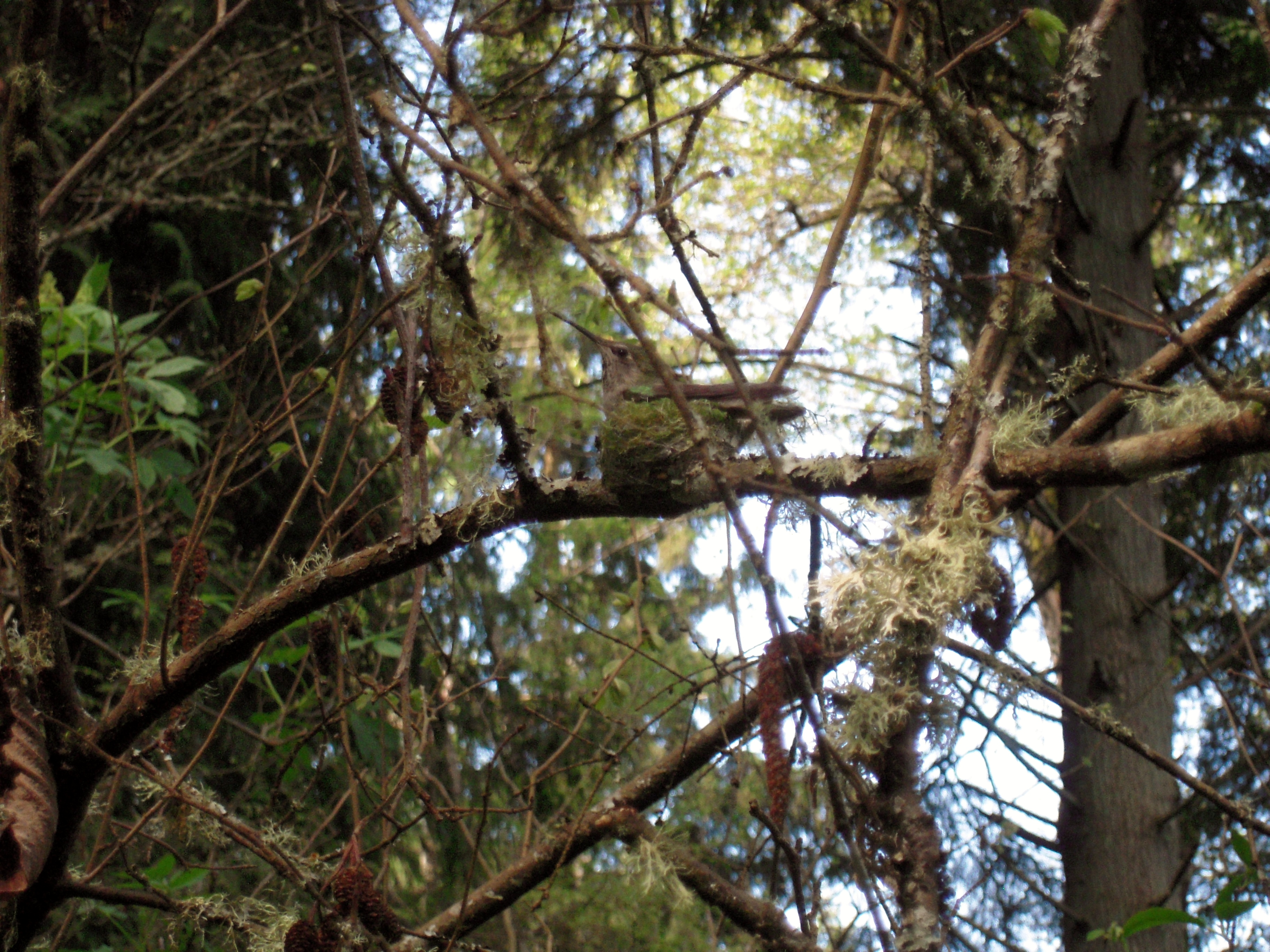
I was walking through the woods and I noticed her out of the corner of my eye. I snapped some photos using my phone and I memorized her location.

293

A humming bird sitting on her nest! I was thrilled! I ordered a real camera to take better nature photos. And the next day, I found this.

273
An egg! The tiniest egg you could ever imagine. A tiny little package of life.

This was the only view I got of the egg. Here’s a little video of the time she was kind of peeved with me for getting too close to her.

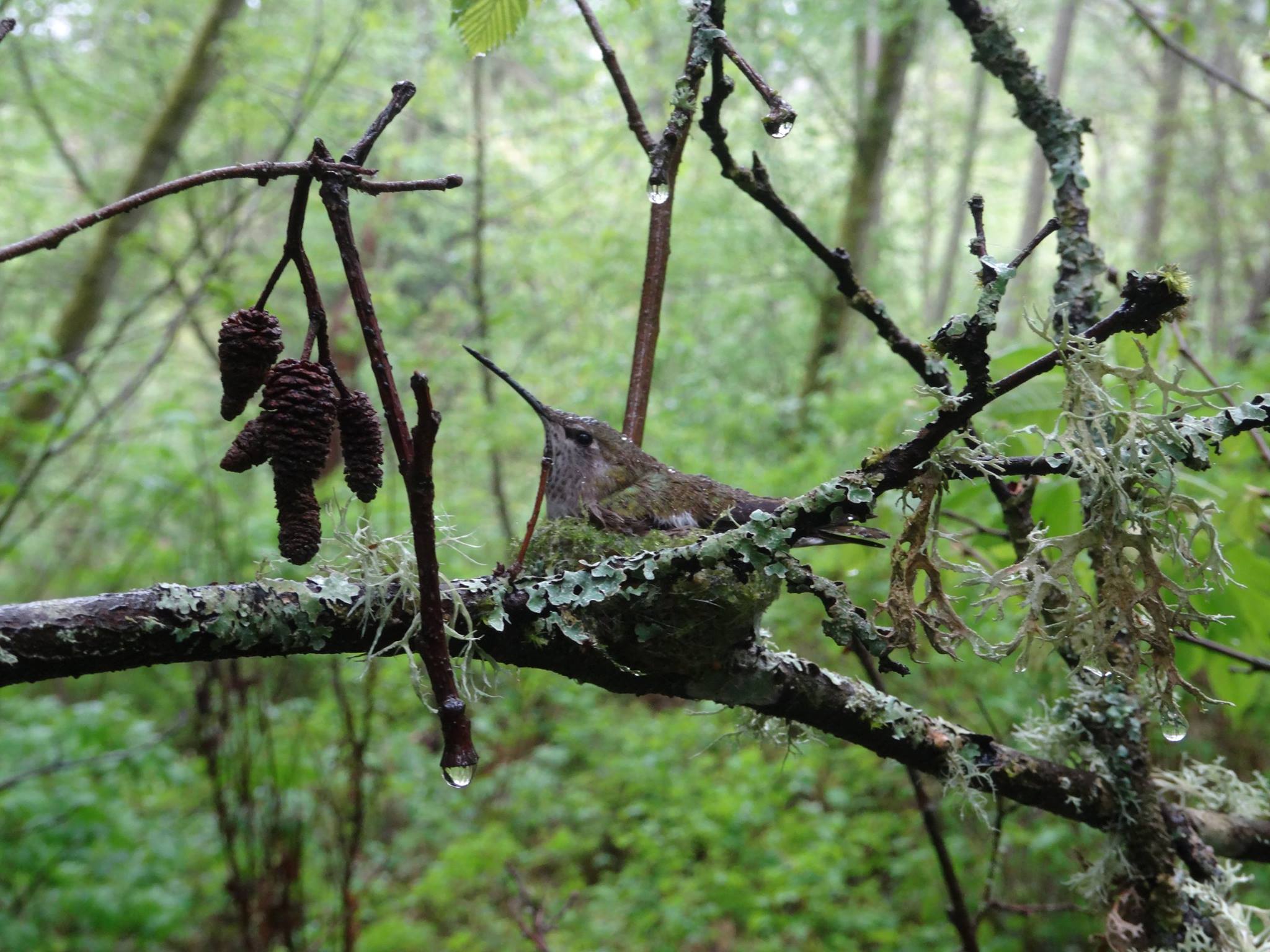
After a couple of days she seemed to get used to me. And she sat on that little egg, day after day. I was thrilled to have a chance to see the miracle of life in the nearby woods. Hummingbirds are small and feisty. And this mama, despite the fact that she has the brain the size of a pea, had the instinct to protect her baby. She knew how to fly around to make herself look larger and to make lots of noise. And she also knew when it was time to quell her own instinct to flee and to stay sitting on that egg.

This is a photo I took on a very rainy day. She sat there with the rain dripping on her head from the little twig above her. I thought it was a good metaphor for a mama’s love.

10271383_10203505974960413_6338930511465061000_o

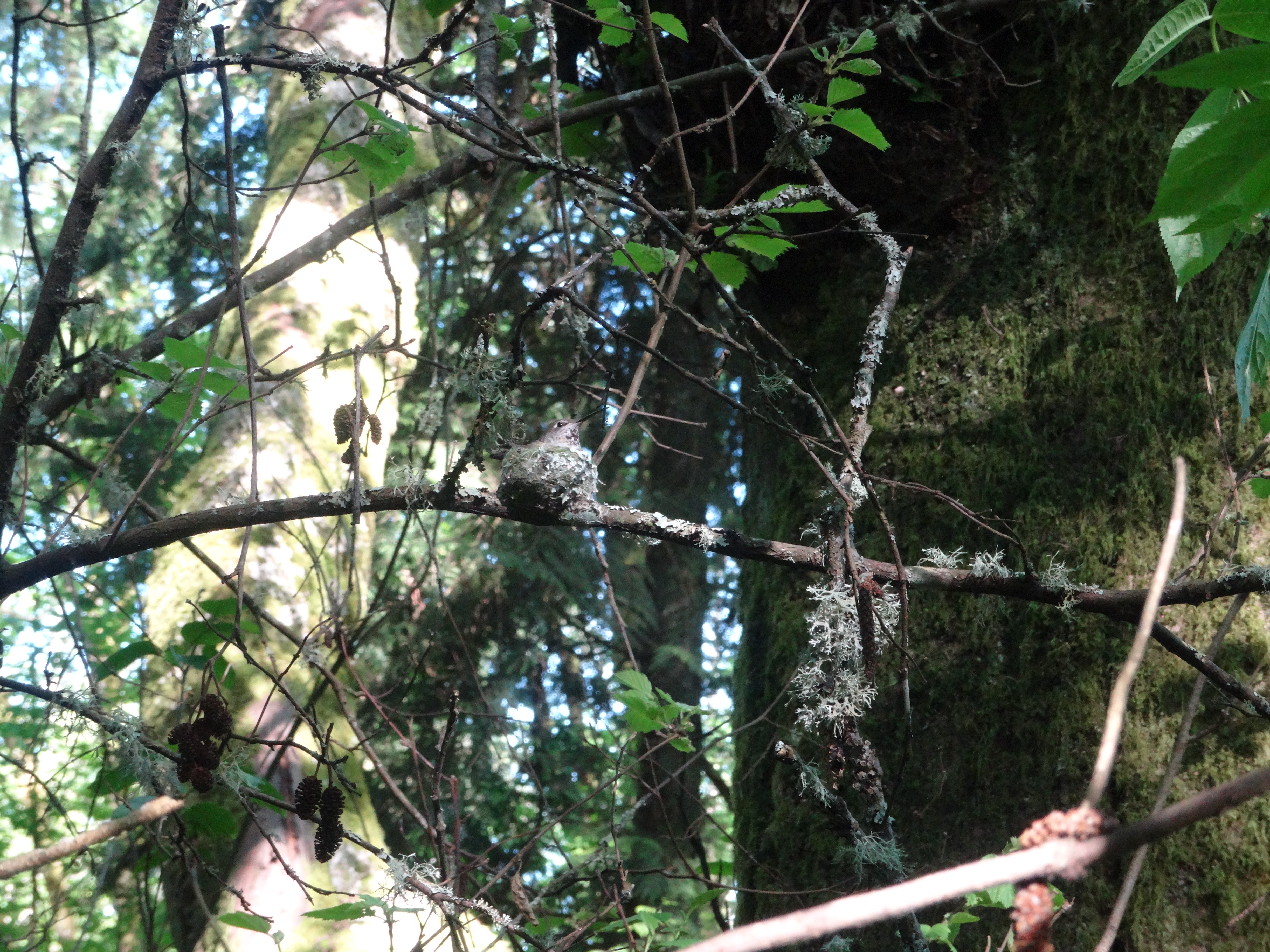
Every day or two, I visited the nest. I had done a little research on hummingbirds and learned that the gestation time would be 16-18 days for the egg to hatch. So, not knowing how recently she had laid her egg when I first found her, I expected to see a chick within a couple of weeks. I kept visiting and started feeling a little impatient because day after day, there was no chick.

Then I went to New Orleans for a few days. John and I walked back into the woods the day after our return.

DSC00487
Still no sign of the chick! It is possible that there was a chick under mama but it had been far longer than 16-18  days! Rip off! Where’s my miracle? Isn’t this a zoo?

Then it happened! A chick, a chick, a chick!!!!!!

DSC00528

I visited the chick a couple of times. I was planning to keep taking photos of the chick’s growth, the increase in feathers, and how little bird get loud and demanding as they await food from mamas who are scurrying around to get food for a baby who grows to her size.

Today, John and I set out for the woods. It was a breathtakingly beautiful Seattle spring day.

DSC00594

Nothing. Empty. That chick was still small and homely two days ago. Sometimes nests are empty because a chick has gotten strong and fledged. But other times, they are eaten by a predator or fall from the nest. This chick, whom I’d affectionately called my “grand baby” and who my Facebook friends had fussed over, is dead.

I had been saving my photos for a post on this blog. This is not the post I had in mind. But life is still a miracle and this Mama did her best, as we all do with our children to help them be strong enough to leave us.

Mothers’ Day is typically a very happy day for me. I have a close relationship with my mother, who is a healthy woman. I have a wonderful daughter. But I know that it is a day of loss for many. For those of you who have lost your mothers, who have lost your children, or who wished for children who were never to be, Mothers’ Day has a much different meaning. And then there are those of us who are mothers who understand that we can’t take our own health for granted. We pray that we will be there for our children as long as we can, especially while they are still chicks in the nest.

Life is full of mixed feelings. I hope that at least one of the feelings you experience tomorrow is serenity. If you are a mom who has lost a child, I know you worked to love and protect your children. If you are a daughter who has lost a mother, I know you brought moments of great joy into your mother’s life just by being her child. If you wanted children but it was not meant to be, think of all of the children to whom you have mattered by being a nurturing presence.

“How long have you been cured?”

Her question caught me by surprise. We were riding on a school bus from a beauty salon to the venue for the breast cancer charity event in which we  were both modeling. I knew that she was diagnosed less than a year ago. She was self-employed and had benefitted from the charity first hand.

I answered, ‘I was diagnosed almost two years ago.’

I could have corrected her but I didn’t. She had also invited everyone to a potluck at her house. I could tell that she was having a powerful experience of belonging, being surrounded by 29 other women who had been diagnosed with breast cancer as recently as 9 months ago and as long as 19 years ago. I could also see the fear in her eyes, that she had transitioned from the shock and adrenaline rush of the active treatment stage to  “Now what?” I figured that I needed to respect her grief process and trust that she would progress in her understanding of her disease.

Her question reminded me of past experiences. I grew up in a politically and socially liberal Roman Catholic church. We didn’t talk about Hell or who was going there. We didn’t talk about “being saved”.

So the first time I was asked, “How long have you been saved?” I was similarly taken by surprise. It just wasn’t the way I was used to thinking about myself because my religious upbringing was different.

I talked to one of my colleagues and friends about this a few years ago. He is a thoughtful man, raised Lutheran who is now a practicing Unitarian. He was shocked that I had been raised without the reassurance of going to Heaven. He’d found this belief quite comforting while growing up.

Being cured and being saved are absolute positives. They can mark an end of struggle and an end to gray.

I don’t wish to disparage anyone’s beliefs as long as they don’t hurt others. My personal belief is that God is beyond my complete understanding but that I experience God is in the love people show each other, how we take care of our world, and the beauty of nature.

I don’t know if I am cured. I don’t know if I am saved.

I know that I am here.

Lindbergh High School Reunion '82, '83, '84, '85

Join us this summer for our reunion in Renton, WA!

George Lakoff

George Lakoff has retired as Distinguished Professor of Cognitive Science and Linguistics at the University of California at Berkeley. His newest book "The Neural Mind" is now available.

KomenWatch

Keeping our eyes and ears open.....

4 Times and Counting

Confessions Of A 4 Time Breast Cancer Survivor

Nancy's Point

A blog about breast cancer, loss, and survivorship

After 20 Years

Exploring progress in cancer research from the patient perspective

My Eyes Are Up Here

My life is not just about my chest, despite rumblings to the contrary.

Dglassme's Blog

Wouldn't Wish This On My Worst Enemy

SeasonedSistah

Today is Better Than Yesterday

The Pink Underbelly

A day in the life of a sassy Texas girl dealing with breast cancer and its messy aftermath

The Asymmetry of Matter

Qui vivra verra.

Fab 4th and 5th Grade

Teaching readers, writers, and thinkers

Journeying Beyond Breast Cancer

making sense of the breast cancer experience together

Entering a World of Pink

a male breast cancer blog

Luminous Blue

a mother's and daughter's journey with transformation, cancer, death and love

Fierce is the New Pink

Run to the Bear!

The Sarcastic Boob

Determined to Manage Breast Cancer with the Same Level of Sarcasm with which I Manage Everything Else

FEC-THis

Life after a tango with death & its best friend cancer