Archives for category: Parenting

“Are you ready to frolic?”

I overhead the question, spoken in a gentle male voice, from a nearby campsite. After I turned my head toward the source, I saw that a father had asked his young girl, who couldn’t have been more than 17 or 18 months old, this question. She said something about “froggie”. He father responded, “Yes, let’s have froggie go frolicking with us, too.”

Camping brings forth images of enjoying stately woods in solitude, like one’s own personal communion with God. Unless one is a backpacker, this is typically not the case.

I am on vacation, camping on Orcas Island, which is part of the San Juan Islands in northern Washington state. We are extremely close to British Columbia, Canada. The islands are only accessible by boat. Some of them are accessible by public transportation, that is, the Washington State Ferry System, which is the largest of its kind in the U.S. It takes a good part of the day to get up here and there are very few campgrounds. We are staying at one of two on Orcas Island, the other being a dozen sites on Obstruction Pass, which are “walk in” (camp equipment is hauled down a mile long trail to the campground) and cannot be reserved ahead of time.

I reserved our campsite eights months ago and even that far ahead, most of the spots were already taken. So, the campground is a busy place. It also happens to be located right on the main road. Now, Orcas Island is far less densely populated than say, Manhattan Island, but car traffic is heard from our little campsite in the woods. We have also had visitors.  A little dog named, “Nacho” has visited three times since he arrived yesterday, along with his family, who hung both a U.S. and a Seattle Seahawks flag outside of their tent. Earlier this week, we had a number of visits from a blond toddler with big brown eyes. He just observed with curiosity, whatever we were doing in the seconds until his father, a gentle and patient Israeli man, walked down to scoop him up and take him back.

Campgrounds are typically a home base for outings into the wild or at least the wilder. Nonetheless, communion with nature can even be found in a busy state campground. (Tip: In the U.S., National Park campgrounds tend to be prettier and more secluded than state campgrounds. However, state campgrounds often have showers.) In our few days here, I have seen the green mountain in back of Cascade Lake, visible from our campsite, the sun glistening on the water. The nights have been clear and dark. Two nights ago, I saw the constellations and the Milky Way.

I hear people complain a lot about car camping around here because of the people “spoiling” nature. And honestly, sometimes people can really be annoying in the woods. But to me, hearing a father asking his little girl if she’s “ready to frolic” is a most gentle gift.

This is the gift of the next generation learning how to love nature’s majesty and surprise.

And froggie gets to join them, too.

What could be more natural?


It has happened so many times over the years that I don’t have a particular patient in mind as I write this. My first contact with a family is usually the mother of a patient. We usually talk on the phone for anywhere between 15-45 minutes so that she can get information from me and a sense of whether I am competent. And I get information about whether the referral is appropriate for me as well as a head start on honing the focus of my assessment. Mom usually tells me a list of concerns about her child. Things that don’t seem right. Things that seem harder than they should be. I am a child and adolescent clinical psychologist. Parents don’t want to meet with me if they think there is nothing wrong.

However, parents often tell their children, in front of me, “There’s nothing wrong with you.” It is meant to be a reassuring statement. It is not, even when it is said in all sincerity. (“There’s nothing wrong with you. The problem is that your school does not know how to teach you.”)

When a parent says this, it is damned confusing to a child or a teen. I mean little kids have fun when they come to my office. I play with them and mix in silly questions like, “If you had three empty swimming pools and could fill each with a different food or drink, what would you put in each one?” I also ask about things they would change about themselves if they could, questions about painful feelings, and other more heavy questions. Interviews with young children are not so much about questions and answers as how they interact with me and whether I can get a flavor for their personality and general cognitive level.

The other kids know. They know that they are struggling in school. They know that they are not getting invited to birthday parties. They know that they are getting yelled at by their parents. They know that their grades are bad. The older ones know which teachers actively dislike them.

This way of communicating sends the message that to have something wrong with oneself is too bad to speak of and must be avoided. It is a layer of non-acceptance that can make happiness very difficult. The confusion of being told that “nothing is wrong” when it is patently obvious plants the seeds of externalizing blame and/or internalizing shame, neither state being compatible with taking responsibility for one’s own life. Is it so bad to say something like, “Everyone has things they are good at and things they have to work on. You have a hard time making good choices sometimes. We will help you with this.”

This is part of the reason that the message I saw on Facebook the other day, “There’s nothing wrong with you” got me fired up. It is a seed that can grow into much unhappiness. I see so many wonderful people in my professional and personal life who struggle with perfectionism, never being satisfied that they are worthwhile and good people. I see very successful and outwardly happy people who I can tell, due to my own empathetic skills and life experience, seem like they are faking it. Pain has a way of bubbling to the surface, even when well hidden.

My own perfectionism, which has waned over the years, seems so unnecessary now. The part that remains is fairly stubborn but I will keep working on it. I know that parenting cannot stem the tide of the influence of our culture. But parenting matters and it matters a lot.

I try not to be preachy in my blog because I have tried to focus on my own personal experience. That tone is the most healthy for me. I was kind of preachy yesterday. But that’s okay. You can handle me being fired up every once in awhile. I also did not want to make my blog into a “psychologist’s blog” including advice. But today, I would like to share what I think is the very most important way to teach our children self-acceptance.

Work on your own self-acceptance. I have decided that not only am I not perfect but that perfection is a goal that is unworthy of me or of my family.

I deserve better. And so do you.

I am generally a patient and polite person. There are a few situations, however, that can get me fired up in a hurry. One of them is when people don’t take “no” for an answer. If you call me at home and are trying to sell me something, I will say “No, thank you.” If you keep talking, I will say, “Please put me on your do not call list” and hang up.

If you are the outreach director for a private tutoring and one-on-one school, who calls me repeatedly to set up a meeting even though I have told you I cannot do so,  due to cancer treatment, I will be irritated with you and tell you that your calls aren’t welcome and to please stop. Guess what happened today? The same woman showed up to my office, uninvited. Do you know how many uninvited visitors I get in my little office with it’s discrete location? About one per year. I told her, “No, I am not able to meet with you. I know about your school. I asked you not to contact me.” She replied, “But I thought that you just didn’t want me to CALL you.”

“Coming to my office uninvited is even more intrusive than calling. Please don’t contact me again.” She apologized and left.

Keep in mind that I ordinarily accept meetings with people from private schools and tutoring businesses. But this woman happened to call when I was going through intensive cancer treatment. I told her that, also told her that I would contact her in the future if I wanted to meet. But she kept calling and today, she showed up on my doorstep. I have actually referred families to this school and I will likely continue to do so because the person who does marketing is not the same as the people who provide the educational services.

Honestly, I feel mean when I set limits like this. But I also feel justified in being firm and direct. These hard sell tactics rely on people’s inclination toward politeness and needing to be seen as “nice”. The strategy is one that takes advantage of most people’s positive nature. I know the people who are not taking my “no” for an answer are probably not thinking of it that way. But the strategy itself is extremely disrespectful.

Hmm, is it really “extremely disrespectful”? It is disrespectful for sure. But the fact that my heart rate is still slightly elevated and I still feel residual anger about this intrusion tells me that it is time for me to explore why this situation set me off so.

I am by nature, a generous and helpful person. My parents are also generous people. But I also remember growing up, thinking that they had trouble saying “no” when asked for a favor. (It doesn’t seem this way so much now, so I wonder if I remember correctly.) It was like it was bad to even ask because my parents would say “yes” unless it was a telemarketer. (When vacuum cleaner salesmen called, my mom would always say, “I have dirt floors.” Ha!)

When I am asked for something, my initial inclination is to give it. But I have learned over the years that this is not always a good idea and in some situations, it is downright unhealthy. I can take time and energy away from my family, friends, patients, and from myself. I have also learned that there are people in life who will ask over and over again, giving nothing in return. And then there are the people who don’t even ask, they just take.

When I say “no”, I have already gotten myself to do something that I am not typically inclined to do. When the “no” goes unheeded, I feel unheard. Oh dear, there’s a trigger. I hate it when I don’t think people are listening to me. When I am unheard, I start repeating myself, I get stern, I may interrupt. I don’t feel generous. I feel in need of protection. The word that keeps popping into my head but I haven’t yet written it down because it feels too strong is “violated”. I feel violated. Do I feel helpless? No, I don’t but I feel very very wronged and that I may lose something of myself, the years to building up assertiveness and confidence, if I back down.

I often used my writing on this blog as a way to figure out a puzzle. I think I have gained insight in writing this but really, I am only scratching the surface and there is much to be uncovered. I think that this triggering experience comes from some kind of combination of my personality, my experiences as an individual, and my experiences as a woman. I’m not really sure and I will never really know. I do know that my tendency toward strong reaction negatively impacts my relationship with my daughter and with my husband. With my professional life, I am able to regain external composure even if feel internal strain.

I will keep working on this.

Note: I actually wrote this post several days ago and didn’t publish it because it felt unsettled. I am currently exploring the situations that are most triggering for me, “buttons” that when pushed, elicit an irrational response. I am trying to shrink these buttons. As I say, I will keep working on this, as unfinished and unpolished as it is. But it is as it is.

Last week I dreamed about my kittens. (Yes, I know, despite my formative years as a “dog person”, I have become a “cat lady” in my middle age.) My kittens are litter mates, brother and sister, both with pure black coats.

In my dream, they were conjoined twins. People looked at them and remarked, “Oh, look at the cute kitties!” Then the heads of the kitties started looking in different directions and the front right and left feet did the same. The kitties looked distressed. They were not working as a team.

When I awoke from the dream, I thought, “I need to use this image in a blog post.” Yes, really I did. As I’ve mentioned in the past, I am not someone who makes fancy dream interpretations. But I do think about my dreams, especially when I think they signal distress. At the time I was having the dream, I was concerned that John and I were not parenting as a team as well as usual and that we were having trouble communicating about the logistics of our lives. I think that is probably what the dream was about.

I have been pretty stressed during the last couple of weeks. I am an energetic extrovert. Nonetheless, I don’t function well if I am pulled in a hundred directions, living a fragmented life. I am not good at perpetually switching gears. That’s one of the reasons I was attracted to pursuing a research career rather than a career as a clinician. Clinical work means switching gears between people, situations, and goals, quite frequently. When I did research, I worked on one or two projects for years at a time. But I ended up being a clinician and thank goodness, I learned how to switch gears much better than I did previously.

Right now my workdays consist of switching constantly among work, driving my daughter around, getting to my healthcare appointments. My daughter has needed to be driven to one to three locations all around Seattle, every day, starting in the middle of the day. She takes the bus when she can but there are logistics to be worked there there, too.

Yesterday, I reminded her of what time she needed to be home from school (she is volunteering each morning to help with a band program for younger kids) so that I could take her to an activity at 2:00 pm in northeast Seattle. (We live in southwest Seattle.) The original plan had been for her to take the bus downtown and then take a transfer to get to the office. However, we’d tried that the day before and she missed the bus. Since it was mid-day, there was not another bus for an hour. I cancelled my annual physical so that I could come home from work and drive her. Seattle is not an easy city in which to get around. It is long, narrow, surrounded by water, and hilly, for starters. This means that there are a rather limited number of highways and streets available to get from one place to another.

As I complain frequently, I find driving to be taxing and stressful. I am a good driver and it is not that I feel really anxious when I am driving. It’s mostly that I have to think so hard. And it’s not that figuring out bus schedules and directions is that hard, especially with the Internet. It’s hard to remember to do it and to make sure my daughter has the information she needs and understands where she is supposed to be at what time and how to get there. (This is one time when I kind of wish we’d allow her to have a smartphone, but I digress.) Riding the bus involves a surprising number of steps and also, some background knowledge that a non-driver doesn’t necessarily know. Consequently, I need to break it down in my mind and then make sure she knows things I would otherwise take for granted. For example, “You have a parade after your appointment. It is north of where you will be. Do you know what side of the street to be on to take a northbound bus?” The answer is “no”. And she does not yet know north, south, east, and west. When I was her age, I didn’t either. Then there are the fragmented questions I throw out, “Remember your bus pass!” “Remember to pack a lunch!” “Remember your phone!” “Remember your band uniform. You’re not going to have a chance to come back home before the parade!”

If you are a long reader of this blog, you will know that I live with some rather forgetful people who actually need frequent reminders, even if they are not always happy to receive them, in the moment. And by the way, it is not enabling if your child is actually getting better at remembering these things on her own, which is the case for her. But she is only up to remembering these things about 50% of the time. Think about what your daily life would be like if you were not where you were supposed to be with the what you needed, half of the time. Also, you carry your bus pass in an old eyeglass case and your money in a ring box. And this is a major improvement in organization from years past. Finally, you don’t drive. See, having a nagging mom would be annoying but handy.

About two paragraphs, I was telling you about one example day. Then I veered off course. What you don’t know if that while I’ve been writing this post, I’ve stopped and started it many times. I actually wanted to write it last week when I had the dream. Right at this moment, I am fighting the impulse to walk out and investigate the bird sounds I am hearing.

When I am switching gears too much, coordinating multiple goals, I find that it is hard to stop switching gears. I find even more goals and they aren’t priority either. Instead of being a two-headed cat, I turn into a creature with an ever changing number of heads, all on one body. There is effort to do things but none of the cohesion required to get things done in an efficient way.

The first thing that happens to me is that I start getting forgetful. Then I start making mistakes. Then I start getting anxious that I am making a lot of mistakes and I am so distracted that my level of self-awareness waxes and wanes. Then I make more mistakes. Then I start a flurry of unecessary reassurance seeking. “Are you sure you have the bus pass?” “Hey, friend, did I just treat you badly?”

There is an expression that people use referring to feeling “centered”. It is a positive thing but honestly I can’t exactly articulate what it is. But what I can tell you that at this time, I don’t feel centered or “grounded”, another common description that people use to refer to a state of balance.

I don’t feel centered. I don’t feel grounded. I feel like I have an infinite number of heads and none of them contain good working brains. Now, these are subjective feelings. In reality, I am functioning. I am carrying out my life with competence. But I feel icky in the process.

My natural inclination is to think of the happy, balanced, reasonable, bright, organized, empathetic, and energetic version of myself as “the real me” and the other times are aberrant.

I am becoming increasingly, aware, however of how unreasonable this belief really is. I am always me. Who else would I be? The person who gets irritable with her husband because she is overwhelmed and fragmented? That’s me. The person who asked her husband to take care of a responsibility this morning because she was exhausted, even though she’s been irritable with him? That’s me. The real me is not that perfect and it is unhealthy for me to maintain a vision of myself as needing to meet that standard in order to be “real”.

The person who is feeling a little more grounded and centered after having sorted through her thoughts and feelings while writing this post?

That’s me, too.

I have goals in my life. Some day, my life will end. But my life, itself, is not a goal or an end point.

My life is an experience, with lines of continuity as well as flux.

What else would it be?

As you may recall, I completed about 90% of the requirements for an art history degree in addition to my B.S. in Psychology. (Yes, I’ve heard all of the jokes about my “B.S.” in conjunction with “psychology”. Believe me, I had to take calculus, among many other hardcore classes to get that degree. It was no B.S.) One of my professors often referenced Robert Hughes’ book on modern art, The Shock of the New.

Modern art didn’t come from nowhere but it was still a shocking departure from the familiar. Art had been representative, rather than abstract for a long long time. It was often idealized but always recognized.

The shock of newness does not just apply to our external world but also to feeling new. A fellow healthcare provider and dear friend shared a blog post about being a novice in healthcare, in other words being a trainee and new professional. The post made me think about being a psychology trainee in grad school as well as when I was a post-doctoral fellow.

In most measures, I am much better at my job as a clinician than I was when I was less experienced. But there were advantages of being a novice that were therapeutically advantageous.

For one, I was supervised so this made me extra conscientious to do things “by the book”. Supervision, by the way, meant doing my work with a supervisor either in the room with me or in a separate room, observing me on video monitors, all of the while commenting to other students or interns, also in the room, about the rightness or wrongness of my actions. So, I stayed sharp and kept on top of what I was supposed to be doing.

The largest advantage, however, was that my lack of experience as a parent made it much easier to deliver recommendations and teach parenting strategies, with a straight face. During my post-doc, I was a mother of an infant, but I still did not know how hard it would be to rear a child who could walk and talk. And disobey. And not perpetually vote me to be her favorite person in the world in a tie with her father. I didn’t know how parenting touches us in tender places, at our identity, and at the hurts we’ve held with us our own lives. I just said, “Do this!” I had a wonderful optimism. And most parents did what I recommended.

Once I got to understand what I was asking parents to do, I had to make adjustments. Every parenting situation is different. But as a parent, I can empathize with the fact that parenting is never easy and for some, it is incredibly hard.

Even so, I still ask parents to do a lot. I now understand the magnitude of my recommendations, in my gut. But now, because I am no longer a new parent, I have learned that just because something is really hard to do, doesn’t mean that it is not necessary to do.

There’s a vaudeville theater in my neighborhood, Kenyon Hall. It’s about two blocks from where I live, located in an old house. They have an antique Wurlitzer organ, which is occasionally played as live accompaniment to old silent films. They used to sell root beer floats for a dollar each on these movie nights.

We haven’t been there in a long time. There was a change in ownership and the types of entertainment offered there has narrowed. About ten years ago we went there with friends along with our daughter for a comedy juggling act, Brothers from Different Mothers. They were very funny and excellent jugglers. I laughed a lot.

Now, when I laugh, I do so loudly and with my whole body. Kenyon Hall is a small venue with no stage. We were sitting in the front row because we’d arrived early and wanted to make sure that we could see. I was quite noticeable and also conveniently close to the two performers.

I’d not seen them perform before so I didn’t know that they used audience members in their act. When it came time for that part of the show, I was promptly asked to go up front with them. I can’t remember everything that they had me do. But I remember being a very good sport about the whole thing.

But one part of the performance actually got a bit stressful. I was to grab one of the balls from one of the guys while he was still juggling. PERFORMANCE PRESSURE. I missed 2-3 times and I noticed that the juggler was holding the ball for increasingly longer times in order to make it easier for me to grab from him. I knew that there was only so long he could do this before having to attend to the other balls in the air. I also knew that if I didn’t get it soon, the act would drag. I mean, a woman hyena-laughing while trying to grab a juggling ball gets old after a few failures. Each time I tried to memorize the timing and rhythm of the balls in the air. On the next attempt, I got it, much to my relief. I had not spoiled the joke with ball dropping ineptitude.

I know it is cliche to compare one’s life to juggling balls. We all try to keep the balls in the air. However, when we parent, we are also trying to do a hand off balls or take balls from another, all in order to make sure no one’s load is burdensome. And we do it while each of us is juggling a full set of balls.

When my husband and I have an established and coordinated routine, this can go pretty smoothly. We know what to expect, can plan for it, and we’ve handled it before.

Then there are the times when the unexpected happens or we have to learn a new routine. At these times, it can feel like juggling water. I feel all of the responsibilities but can’t put my hands around them. What’s worse, I can’t tell which responsibilities are mine and which ones are John’s. They just splash to the ground, undone, and making a huge, undifferentiated mess. “Who’s water is this?” “And who stepped in it with muddy shoes?” “Who’s going to clean it up?” “What happened to the mop?”

I have been more irritable lately. I initially attributed it to the heat as well as my hatred of driving through downtown Seattle, something I am doing at least once per day right now in order to get my daughter to activities. All of these things do contribute to my mood.

Today, I woke up feeling sad and it took awhile to shake it. I realized that part of the reason is that each day is a different set of logistics and responsibilities. Our daughter’s schedule is different, every day. My schedule is different, every day. And not only am I taking my paperwork on the road, John and I have to figure out who is doing what, every day, almost from scratch. This means we have to remember to talk to each other about logistics and texts and phone calls from each other need to be exchanged. As a couple, this is not our strong suit. I over-communicate and my husband doesn’t communicate enough. It makes both of us a source of aggravation to the other.

Our daughter has two more years of high school. She will likely be driving in a year or two. There are some wonderful things that come out of spending time with her in the car. Yesterday, she told me what a fun time she’d had talking with me on the way to and from her activity.My husband and I have more evening time together during the summer, just the two of us.

Those are opportunities I can grab and hang onto.


I remember when I was starting grad school in my 20’s. One of my classmates was from the sunny city of Miami. I noticed that although she was actually younger than me, she had crow’s feet, those wrinkles people get around the corners of their eyes. I figured that since she already had them, I would get them fairly soon. But I didn’t.

The first wrinkles I noticed were above my left eyebrow. I can lift my left eyebrow above my right, just like Spock on Star Trek. I did it A LOT as a teen and a young adult. My younger brother and I laughed about it a lot. It was something I did when I was being silly and having fun.

Wrinkles are signs of aging. The first time I looked at myself and thought, “I’m not young anymore” was in my late 30’s. I was looking at the backs of my hands. They weren’t as smooth as they used to be. In other respects I still looked young. I’ve done a lot of work with my hands over the years. Writing, gardening, knitting, cooking, and caressing loved ones. My wedding and anniversary rings are on my hands.

When I was putting on make up this morning I saw them. I have crow’s feet that don’t go away when I stop smiling.

I’ve done a lot of smiling in my life. And I’ve squinted at the sun when I was in the mountains, the tropical rain forests,  and kayaking on the sea. I spend a lot of time outdoors, which makes me happy. I spend a lot of time with people who make me happy.

The lines I have, by and large, are not remnants of the bumps in the road of life, the wrinkles we have to smooth out. My wrinkles are from the best bits. They show the happy and productive moments that I have enjoyed. If I am lucky, they will continue to broaden and deepen, I hope.

When I was young my face was smooth. Now the lines tell a story, one that is meaningful and full.

Life lines is what they are.

Warning: Smiling can cause life lines! (Also, I told you that my husband puts his camera close to my face.)

Warning: Smiling can cause life lines! (Also, I told you that my husband puts his camera close to my face.)

I was driving a rental car with my daughter in the back seat; she did not yet weigh enough to sit in the front. She was 12 years old and on spring break from middle school. We had just been hiking at Kasha-Katuwe Tent Rocks National Monument in New Mexico. It was just the two of us; one of the mother-daughter trips we used to do together.

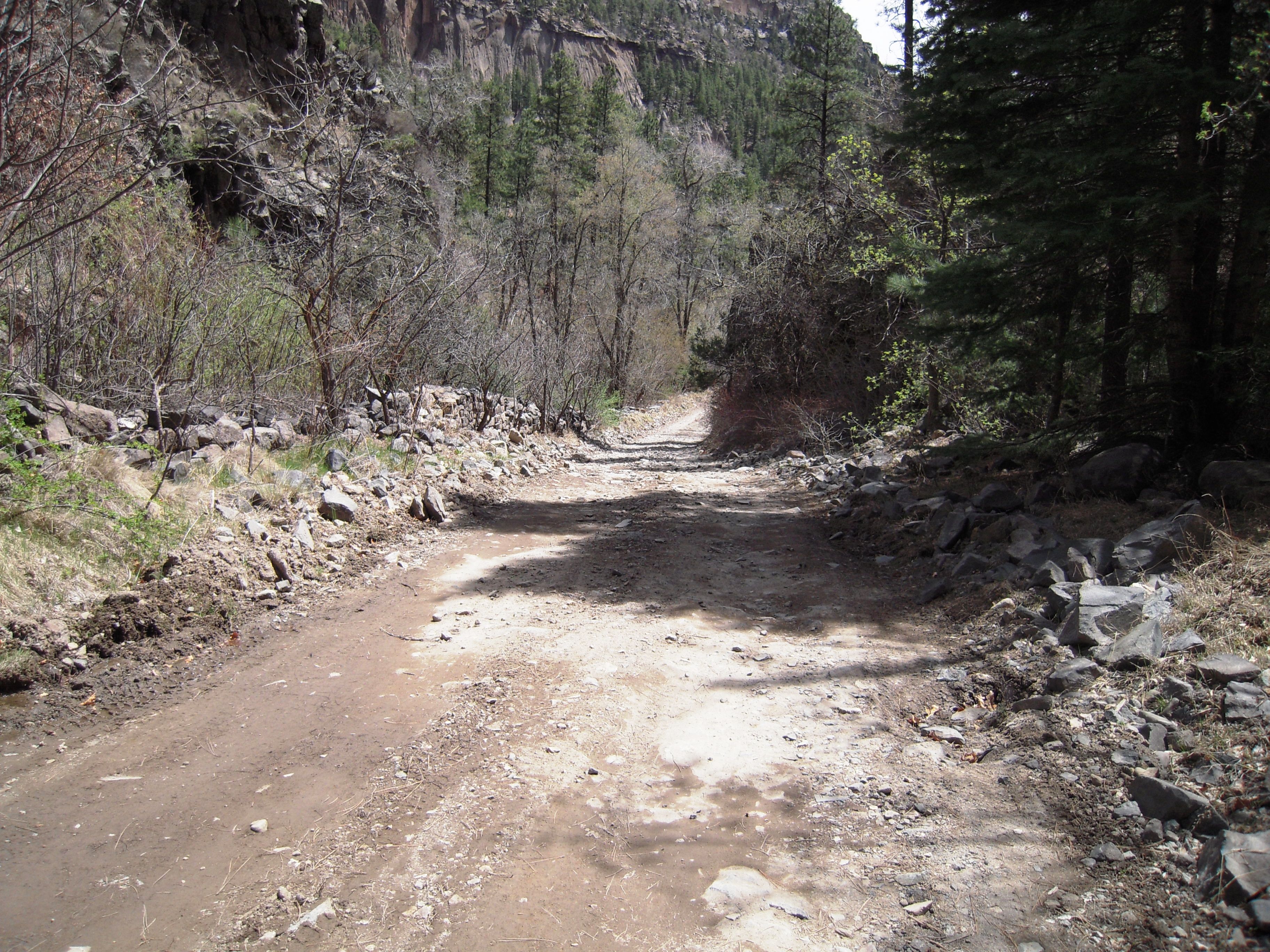
I entered in our next destination into the GPS and started following the directions. I got an instruction to turn onto a gravel road. I thought to myself, “Hmm, this doesn’t seem right.” I re-checked the GPS and then took the turn onto a well maintained but gravel road.

I still felt nervous. Gravel roads are not main thoroughfares. I was out in the wilderness. But I also thought, “Wilderness. I am from the Great Northwest. I have lots of wilderness experience.”

I kept driving, even though I knew that it was a one lane road. That was the total number of lanes. One. There were no turn around spots. At first I was concerned that we would encounter another car traveling the opposite direction. What would we do then? And then upon driving a number of miles and not seeing a single other vehicle or person, I started having different concerns.

The road led up gradually but persistently in elevation. I was driving through high elevation pine woods. The street was so narrow, it was like walking on a path in the forest. There were rock formations in the distance. It was breathtakingly beautiful.

As we got higher, the quality of the road started to decline. It was rutted and bumpy. It all happened really gradually. Then I saw it. It was a place to turn around. Now, if I had started driving at this spot, I would have immediately turned around and driven back to where we came from. I would have seen the situation for what it was. It was a dangerous place to drive. It was a place that required a four wheel drive and even then would have been difficult.

But I am a person of momentum and I was anxious. Usually I am quite risk adverse when it comes to physical safety. But I was not only anxious about the drive. I was anxious about my relationship with my daughter. She was shifting to preferring my husband to me. Dad was cool. Mom was not.

So a reason I kept driving was because I didn’t want to be an overly uptight mom anymore. I decided to take a chance. We got stuck when I drove over a boulder in the “road”.

It was noon. I had water and a first aid kit, which I put into a bag along with my GPS (from which I had recorded the GPS coordinates for the rental car) and my cell phone, the latter of which was low on battery power.

I was externally calm. I was doing the best acting job that I could. I told my daughter that we would walk back to the gas station we had passed prior to going up the gravel road. I had located the name and address of the gas station on my GPS. It was hot. I knew it was a long walk. I was wearing hiking shoes but my daughter was wearing Converse low tops. I was on the edge mentally and emotionally. I was barely keeping it together. I kept having fears that we would be attacked or raped and no one would be able to help us. I knew that I had made a horrible error in parenting. I didn’t know how we were going to get the rental car back.

Knowing if I also had to contend with a cranky tween, I would totally lose my composure, I told my daughter, “We need to walk about 10 miles. I’m sorry I got us into this situation. If you do the walk without complaining, I’ll give you $50.”

Suffice to say it was the best money I’ve ever spent. Along the walk, I intermittently checked for cell phone reception. When I found it, I called 911. However, the reception was spotty and the calls were lost when I shifted my weight. Further, dispatchers from different jurisdictions answered each time, because we were lost in an area close to border between two counties as well as close to tribal lands. After many attempts, I gave multiple dispatchers the GPS coordinates for the car, the address for our destination, the name of the road I was on (you know it’s bad when the 911 people can’t find the road on their maps), and our current location. I also knew that texts would be sent as soon as I walked into areas with cell coverage. I texted my husband our location and instructions to call 911.

We finally found our way to the beginning of the gravel road. I recorded the GPS coordinates and took a photo of some distinguishing features at the entrance to the road since there were no street signs. Just as we were starting to walk on asphalt, a car filled with a family of sight see-ers stops to ASK US DIRECTIONS about the gravel road. I explained our situation and they kindly offered us a ride to the gas station. We got to the gas station and I asked to use their phone since I was still out of cell phone reception. I informed 911 of our location. Then I dug enough change out of my purse to get my daughter and I something cold to drink.

About 10 minutes later, I saw two police cars pull into the parking lot, one from the county sheriff’s office and the other from the city of Santa Fe. I walked out and the sheriff looked annoyed. And he was. None of the information that I’d communicated to the 911 dispatcher had been communicated to him. Stealing my mom’s catchphrase for embarrassing situations I said, “Whatever you are thinking, it is probably true.”

He said, “We’ve been looking all over for you along with the Santa Fe and the tribal police. We were just going to send out a search helicopter.”

I communicated a great self-awareness of my major judgement error along with my multiple attempts to communicate my location to the 911 dispatchers. (Meanwhile, my stomach was lurching as I was thinking about how much money a helicopter search would have cost the fine tax payers of New Mexico.)

He settled down and turned out to be super nice. He actually even pulled the rental car and got it facing the right direction. It took a lot of skillful maneuvering. Then he followed us until he was sure that we made it out of the wilderness okay.

I called my husband that night when my daughter was out of earshot. He had not received my texts. I told him what I had done. Then I started bawling. “I’m so sorry. I made a horrible and dangerous parenting decision. I am so sorry.” At times like these, my husband knows exactly what to say.

Was it true that I was an uptight mom?

Yes.

Was it true that I needed to take more chances in my life?

Yes.

Was trying to be a cool mom a good reason to keep driving?

No, absolutely not.

The problem was, and I was mindful of this as I reflected on the incident, was that being so careful in my life, I did not know when to heed my own anxious feelings and when to move past them. And this was a situation that sneaked up on me gradually.

Some fears are rational, some are not. When I’m afraid of everything, I don’t know the difference.

I’ve come a long way since that drive and so has my daughter. I accepted the fact that I was not cool to her about one second after we got stuck; I have never turned back. Mom’s are not supposed to be cool. I have learned to face many fears, both rational and irrational. I will face many more.

In the meantime, I am staying clear of gravel roads.

Kasha-Katuwe Tent Rocks National Monument

Kasha-Katuwe Tent Rocks National Monument

New Mexico with Zoey 04_2011 105

This is the nice part of the road.

This is the nice part of the road.


The scenery for the long walk. The sheriff informed me that we walked through cougar habitat. Yikes! I am more afraid of cougars than any other wild animal I've encountered, including alligators and bears.

The scenery for the long walk. The sheriff informed me that we walked through cougar habitat. Yikes! I am more afraid of cougars than any other wild animal I’ve encountered, including alligators and bear.

I was quite an awkward 11 and 12 year-old, as many girls are during those ages. I was and I still am very close to my mom and I remember talking to her about that stage of not being a young child but not quite being a teenager. Mom had suitable song lyrics for this and sometimes responded by singing, “Too young for boys, too old for toys, I’m just an in-between.”

“In between” is a phrase that has been popping into my mind frequently. I feel like an “in-between” as a cancer patient.

Actually, when I really think about it, I’ve felt like an “in-between” during this whole process and I see my friends going through the same thing. I remember in the early days of breast cancer I was shuttled back and forth between assessment and treatment. And even some of the treatment, that is surgery, was also used for assessment. There are blurry lines. It is a systematic process but there are many data gathering and decision points.

Other than my tamoxifen and Lupron shots, I am not in active cancer treatment. My oncology appointments are more spread out. I don’t even see my surgeon any more, I just see the nurse practitioner in the surgery office who works with “survivors”, the ultimate “in-between” status. Actually, there’s another in-between because if I am to need to have a breast cancer surgeon again, I need to see someone else. Dr. Wonderful not only “broke up” with me for being too healthy, he also retired from clinical practice, just last week. He is remaining at my cancer center doing research and in a leadership position regarding improving patient care. At least I can still send him a Christmas card later this year. He will not have moved back home yet. (He is Canadian, from Toronto, and I’ve always figured that he and his wife will move back to be with their sons and grandchildren.)

My current “in-between” balancing act is juggling my responsibilities. Okay, this is not a new balancing act as I have done it throughout my entire experience with cancer. However, as my energy is increasing, I have been able to work more. During 2013 my income, after deducting my expenses, was 50% of what it was pre-cancer. 2014 will not be a year like 2011 but it will be a much better year. I can see myself getting out of debt. My husband and I celebrate our 25th wedding anniversaries along with our 50th birthdays in 2015. We would like to take a trip to Turkey along with our daughter, to celebrate. We have a lot of saving to do if we are going to be able to take that trip. I certainly can’t contribute to that kind of expense without getting out of debt.

I am feeling the tug of responsibility to my friends, especially my friends in the breast cancer community. I know that I am not as available for communications as I once was. Some of my friends I know only through online conversations. I don’t like to distinguish them from IRL (in real life) friends because all of my friends are real life friends. Great distances as well as time differences can make communication difficult, though. And further, I confess that I am less likely to ask, “how are you” to friends who are having emotionally and physically difficult times. I don’t like to ask that question unless I am prepared to respond with the kind of time someone needs if the answer is not, “I’m fine, thank you. And you?”  I am frequently pulled away to other responsibilities at home and at work. I don’t want to do a half-assed job of supporting my friends. I’ve had too many times in my life when a friend has asked “How are you?” during a hard spot in my life and my eyes tear up with the anticipation that I will be able to share my burdon with someone only to find out that the friend really does not have the time or mental energy just right then to tend to me.

I am also worried about losing my connection with the breast cancer community. I write frequently, but when I am really busy, I have fewer ideas. I don’t want my ideas to dry up and then the social connections to dry up as well.

Most of all, I am worried about losing my connection to the opportunity (not “gift”, mind you) breast cancer and my emotional recovery have given me to truly cherish life. I want to be connected to and mindful of the full richness of life.

I suspect I will work my way through this. I also suspect that I will not run out of things to communicate, even if not through blogging. And as far as blogging goes, I think I still have much to write here on this page. But I also want to respect and take note of the anxiety and fatigue I’ve been feeling lately. The anxiety is of the “lurking in the shadows” variety and not the spinning top anxiety I get when I go into overdrive.

Maybe the “new normal” that is talked about is actually a radical acceptance that life is always in-between.

Feeling “entitled” is considered a “bad” thing typically. Sometimes, I feel entitled.

I feel entitled to expecting commitments to be kept. I’m not talking about big things, people. I’m talking about when people promise to do the dishes.

And with my teen daughter, I always PREFER to be treated with respect. But I don’t always feel entitled to respect. I am a child/adolescent psychologist, after all. I know what teens can be like.

And I don’t mean that most of the time, I just let things go. Teens are still to be held accountable for their behavior, despite the fact that the disrespect can be normative. Just because it’s normal doesn’t mean that they just get to do whatever they want to do.

Feeling “entitled” is a whole different ballgame. As a parent, I rarely feel entitled. But every once in awhile I do.

My teen daughter recently returned from a camp for which I paid. She LOVED it. I was so glad that she LOVED it.

But she has been internally rolling her eyes for the last few days. She’s been rude in the way that “good kids” can be.

Today I told her, “Please speak to me more respectfully.”

She explained that her manner of speaking was the way that she addresses her peers.

Without getting into the whole, “I am not your peer, I am your mother” debate, I responded, “That may be but when you see your friends, you hug them and look happy to see them. You don’t do that with with me so it’s not the same.”

I heard a couple of rounds of, “I love you Mom, very much” until she left for her evening activities.

I try really hard not to use guilt to motivate my child. But sometimes she needs feedback. She needs to know that I have feelings.

The vast majority of the time, she is able to get her brain out of her “peer cave” and into a more complicated world, the world in which both adults and children have feelings, that can be hurt.

Lindbergh High School Reunion '82, '83, '84, '85

Join us this summer for our reunion in Renton, WA!

George Lakoff

George Lakoff has retired as Distinguished Professor of Cognitive Science and Linguistics at the University of California at Berkeley. His newest book "The Neural Mind" is now available.

KomenWatch

Keeping our eyes and ears open.....

4 Times and Counting

Confessions Of A 4 Time Breast Cancer Survivor

Nancy's Point

A blog about breast cancer, loss, and survivorship

After 20 Years

Exploring progress in cancer research from the patient perspective

My Eyes Are Up Here

My life is not just about my chest, despite rumblings to the contrary.

Dglassme's Blog

Wouldn't Wish This On My Worst Enemy

SeasonedSistah

Today is Better Than Yesterday

The Pink Underbelly

A day in the life of a sassy Texas girl dealing with breast cancer and its messy aftermath

The Asymmetry of Matter

Qui vivra verra.

Fab 4th and 5th Grade

Teaching readers, writers, and thinkers

Journeying Beyond Breast Cancer

making sense of the breast cancer experience together

Entering a World of Pink

a male breast cancer blog

Luminous Blue

a mother's and daughter's journey with transformation, cancer, death and love

Fierce is the New Pink

Run to the Bear!

The Sarcastic Boob

Determined to Manage Breast Cancer with the Same Level of Sarcasm with which I Manage Everything Else

FEC-THis

Life after a tango with death & its best friend cancer