Archives for category: Parenting

Maya Angelou died today at the age of 86. She taught me so much.

I learned the power and beauty of the spoken word. Poetry accentuates the music in language. Maya Angelou’s poetry did this to such a great degree that for me, reading her written poetry instead of listening to her read it, was like watching a brilliant jazz combo with no sound. It just wasn’t the same. Her voice was powerful, beautiful, and the words were hers.

Many of us know that Maya Angelou feared the power of her voice so much that she stopped speaking to anyone other than her brother, Bailey, for years. She had been raped as a child, told her brother, who told adults, and the man who had raped her was briefly imprisoned and then murdered after a few days after his release. The then 9 year-old Marguerite Johnson held her voice responsible for the man’s death. Over time, she recovered from her trauma enough to speak again.

Not only did Maya Angelou overcome the fear of the power of her voice but she used the power of her voice as a singer, a poet, a teacher, and as an activist. And when she read her poem, On the Pulse of Morning, for President Clinton’s inauguration in 1993, I got goosebumps that seemed to last for days.

Another lesson I learned from Maya Angelou was the power of telling one’s life story, and further, telling it in installments. I started reading her autobiographies in high school. Although her first book, I Know Why the Caged Bird Sings, remains my favorite and the most memorable, I loved her life story. I burned through the three subsequent books that had already been published and then eagerly waited for the rest to be written. Her life is fascinating and she was pretty open about her imperfections. I see now that I missed her final installment published last year. How did that happen? Oh yeah, I was experiencing cancer treatment and the resulting chaos.

My blog is, in part, a memoir that unfolds in frequent, short installments. As you know, I get a great deal out of writing this blog. It’s not just the writing, it’s the sharing of my writing, the conversations that ensue, and the miraculous times when the words I write are exactly what a reader needs to think about at that time. Every once in awhile, I have a little nagging thought that my writing is self-absorbed. Maybe I am enjoying the attention I get from writing this blog, a little TOO much. I am no Maya Angelou but I have an interesting story to tell and I write well enough. Someday my daughter will read this blog and I hope it will be something that enriches her life and our relationship.

Maya Angelou also taught me the power of resilience. She was abused, repeatedly traumatized, mistreated, and oppressed. Maya Angelou’s life was a triumph of the human spirit and a testimony to the highest power of resilience. And then she used her life experience to help others. That may seem like a natural thing to do but it is not the case. Think of how many people justify their lack of compassion for others by giving examples of how they managed to be successful despite adversity so everyone else should be. These are justifications by parents for rejecting their own children and for everyday citizens for justifying policies that let children in our country and all over the world go hungry, to be poorly educated, and to live in unsafe conditions. Maya Angelou could have hurt others with her stories, beaten up others with her success, but she didn’t.

And if you have read Maya Angelou or heard her interviewed, you know that she does not take sole credit for her resilience. She talks about the support of her brother, Bailey or her close relationship with her son, Guy. She talks about her neighbor, Mrs. Flowers, who helped her speak again by having her over for tea time and time again and talking to her in the most beautiful way.

Today, I am thinking about the power of my spoken words. I have been short-tempered, as you know. Short bursts of anger and I yelled at my daughter yesterday. She was being a pain in the butt, but yelling isn’t a solution. I am thinking about the power of my written words, not just in this blog but in my work. The reports that I write for children and teens with ADHD and learning disabilities impact their lives. The care that I take in writing them can make an important difference in the kind of support they receive from their parents and from their schools. They can also give them a new, more positive way to understand themselves and in time, lead to strategies to cope with their particular patterns of strengths and weaknesses.

Today, I am going to think about how to be an adult who helps build resilience in others, people both near and far away. What can I do to honor the people who paved the path for me, who helped me along the way, by helping build a world in which children not only survive, but thrive?

I’ve learned that people will forget what you said, people will forget what you did, but people will never forget how you made them feel.
-Maya Angelo (1928-2014)
Although I see kids for psychotherapy, most of my time as a psychologist is spent as a diagnostician. I gather background information, I do tests, I scour through records, and I do lot of thinking and a lot of writing. Then I meet with parents and I go over the results.

Most of the time, parents are satisfied and grateful for the report and for my recommendations. I believe that this is a testament to their parenting and also a reflection of my experience delivering complicated information about serious problems. There are other times when I am pretty sure that the news I am going to share is going to be much different than expected and it’s going to be viewed as bad. At these times, I’m tempted to tell parents, “I don’t make the news; I just report it.”

But to do so would be flip and unprofessional. I have to keep my eye on the highest priority, which is to communicate clearly and respectfully in order to provide good patient care.

Since I specialize in conditions that impact school functioning, I do a lot of intelligence testing. As I tell parents, there is no be all and end all measure of intelligence or of every type of intelligence. But the tests I use are rigorously developed and evaluated; they are useful in helping answer questions about why children are not doing as well with school as one would expect.

Working at grade level is the expectation. But some children do not work to grade level in many areas. This can be due to a number of things such as learning disability, ADHD (although ADHD does not always impact academic learning), or lower than average intellectual ability. Lower than average intellectual ability includes intellectual disabilities but some children just have lower than average intelligence; in other words, they do not have the degree or pervasiveness of difficulty that we used to call “mental retardation”. And to make matters worse, these students usually struggle in school without special education support because they do not easily fit into one of the special education categories.

The kids who are “merely” below average often fly under the radar. If they have a cooperative nature, work very hard, and gets lots of parent support, they can actually do quite well in school until material gets less concrete and more abstract. These are the kids who start sticking out in adolescence, a time when for most teens, abstract thinking skill development accelerates rapidly. (Alas, if they could apply these higher order thinking skills to making better life decisions…)

I sometimes find myself doing private testing for an early adolescent child who has had a history of learning difficulties, which have accelerated only to learn through testing that the probable reason is low intelligence. Then I have to think about how to share this “bad news”.

There are parts of our society that confuse “goodness” with intelligence. Intelligence is a good thing but it does not make a person good nor does low intelligence make a person “bad”. Most of intelligence appears to be inherited. Another bit is subject to environmental experiences. Most people are average.

When it comes to talking to the parents about the results of these evaluations, it is very difficult to say, “Your child is a very hard worker and is actually doing better in school than we would expect.” That’s not exactly the best news to hear.

So, we do a lot of talking and I do a lot of explaining and placing things into context. I do a lot of talking about what it takes to be a happy and successful person in life, things that are not necessarily related to high intelligence.

But I try to make the challenges clear, too. A lot of kids get yelled at for not doing better at school even though they are working EXTREMELY hard. A lot of kids also need as many educational resources that a school district and family can afford to provide. They are “it takes a village” kids. I have to make my best argument for getting the child as much support as possible but I can’t do that if I gloss over the difficulties.

I wish every child had the same resources and same opportunities but they don’t. It’s my job to try to make sure that they can do their best with the particular package of strengths and challenges that they have. I remind myself of older kids that I see who have beaten the odds and moved mountains. Invariably, they are hard working kids, with parents who have provided early and long lasting support, with supportive teachers and healthcare providers.

Sometimes, but certainly not always, great things can result from the bad news.

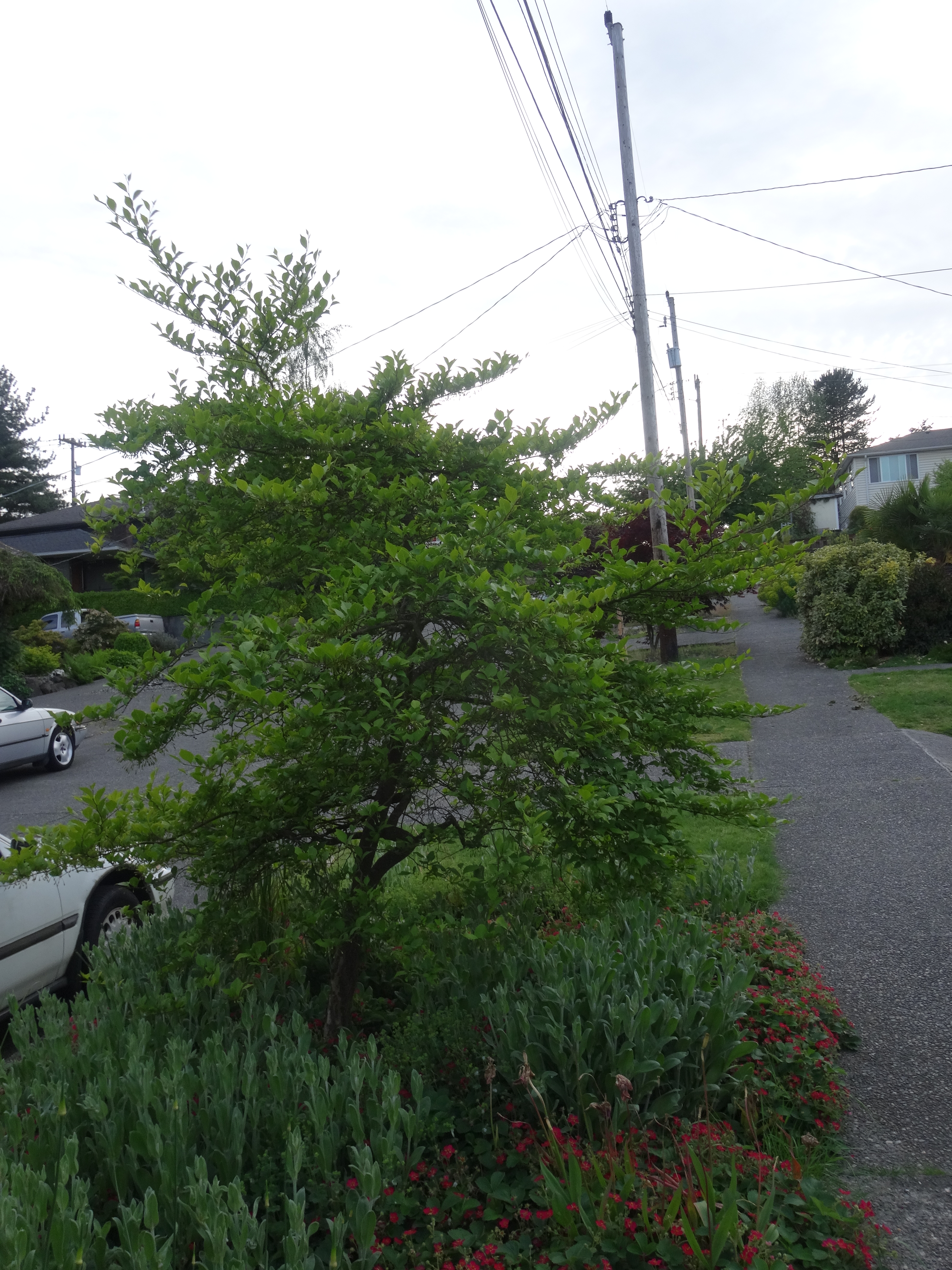
About ten years ago, we planted two trees in front of our house. They were the same size and the same kind of tree, styrax japonicus (Japanese snowbell). We made planting holes of the same size and fertilized the bottom of each hole identically. They receive about the same sun exposure and I watered them in the early summers, the very same amount. Water drainage may be slightly different as one of the trees is a tiny bit uphill from the other.

If those trees were my children, one could say that I loved them equally and that they both came from “good homes”.

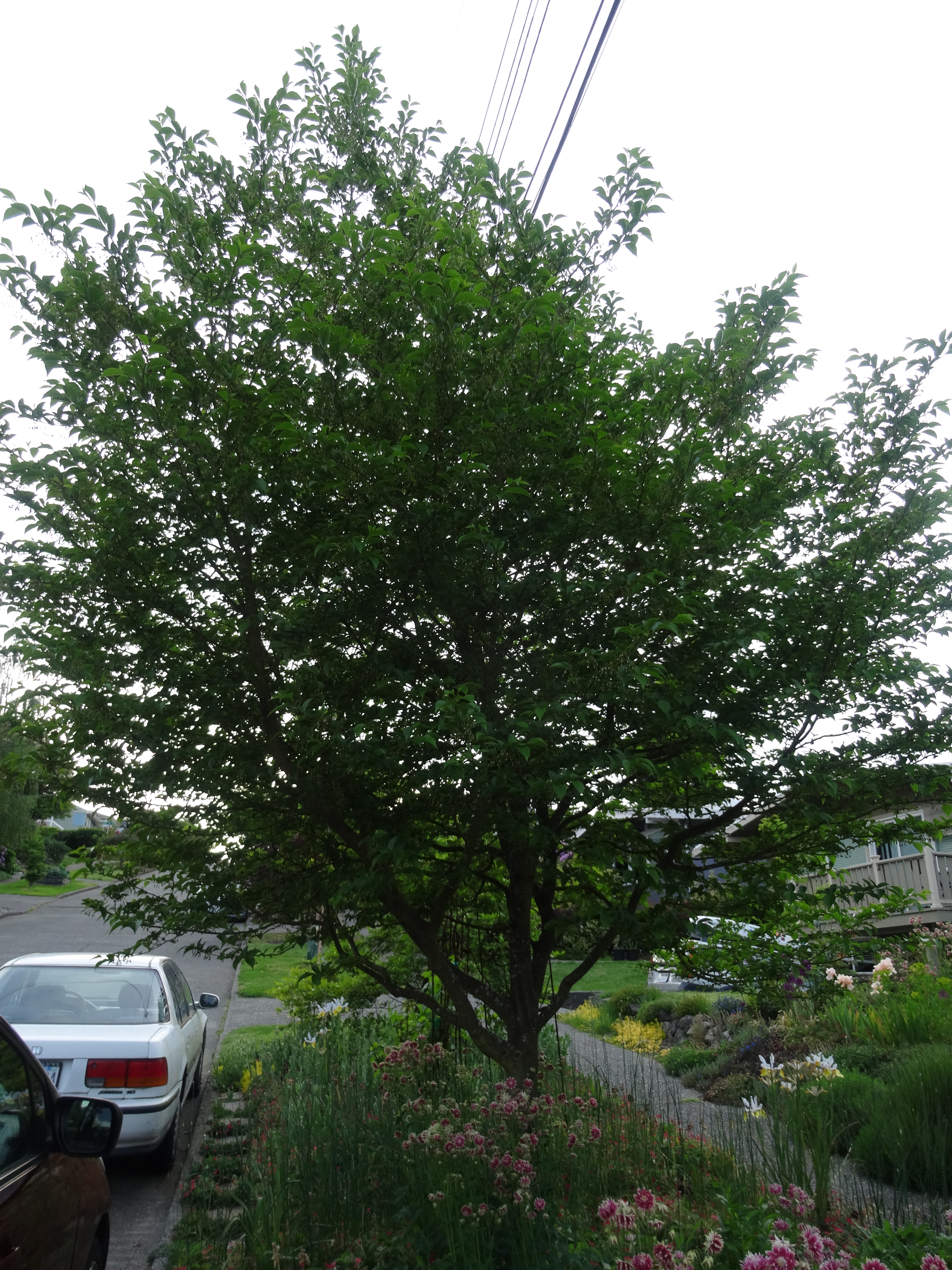
This is what they look like:

DSC00722

DSC00723

The first tree is the picture of health. The second tree is about half the size and oddly shaped. This difference became noticeable several years ago. Although the size difference has increased, at least the little tree is looking healthier these days. It is actually going to bloom this year. It didn’t for a few years and I actually wondered if it was going to make it. The leaves, however, are already yellowed with age on the small tree but not the big one even though they have not had leaves for more than a few weeks. When the tree was misshapen and stopped blooming, I sought out advice and gave it extra care and attention. Maybe I’ve actually given that little tree more love than the big tree.

I really don’t understand why the little tree is making such poor life choices. I really don’t understand why it isn’t trying harder. I really don’t understand why that tree doesn’t care enough and isn’t living up to my expectations. Doesn’t it appreciate everything I’ve done for it?

Yes, those are really ridiculous statements about a tree, that for whatever reason outside of its control, has a much harder time growing and thriving than the tree next to it.

However ridiculous those statements are, they are applied to children daily. Yes, I know that children have brains and trees do not. But children are vulnerable and developing beings. They need much care and support.

And you know what else? Some of them, for whatever reasons beyond their control, have a much harder time growing and thriving than others. Some of these reasons have to do with mental health.

An estimated 20% of children and adolescents in the U.S. have at least one diagnosable mental disorder. That’s a lot of people and most of them do not receive mental health services. Most of the children and adolescents in my practice have more than one mental disorder. A lot of the kids I see display behaviors that are frustrating, irritating, and annoying to their parents and teachers. And sometimes the intensity of their misery and lack of thriving is downright scary.

Unfortunately, time and time again, children even the very youngest of them, are blamed for their mental disorder with quick explanations such as, “He is choosing to act that way.” “She just needs to try harder.” “He just doesn’t care.” “She shouldn’t be behaving this way anymore.”

Sometimes those statements are just plain wrong. And sometimes there is truth to them but they are not a solution. People act as though these statements are the final word and nothing is to be done. So I ask, “Why is it so hard for this child to make healthy choices? How can we help?”

I ask, “Why is it so hard for this child to motivate himself? How can we help?”

I ask, “Why is this child not meeting developmental expectations? How can we help?”

A good bit of the time, there are adults around the child who “step up to the plate” to help. They do so despite the amount of parenting stress. They do so despite the unfair number of students in their classrooms. We also need to provide more support to parents, teachers, and the other caregivers who are the most important influences in the early part of children’s lives.

These are very difficult roles that most of us choose to take on in life. Frustration is inevitable. Sadness is inevitable. Confusion is inevitable. But the children are not responsible for the fact that it is harder for them to grow, thrive, and meet our expectations. The fact that their jobs are harder to do often translate to our jobs being harder to do.

After all of these years, my little tree is very much alive and I actually think it is interesting and pretty. I wonder how it would have grown if I’d just yelled at it?


As I mentioned in The Hours, taking care of myself as a breast cancer patient is time consuming. For example, I still need 10-12 hours of sleep per night. I walk an hour to an hour and a half nearly every day. My wheat allergy coupled with the diet I eat to help maintain good health means that I eat very little prepared or processed food. Cooking from scratch takes time. I still find myself in health providers offices 2-3 times per week. And I work for a living. Right now, I bill about 18 hours per week. Twenty hours per week is considered full-time for a private practice psychologist. I used to bill nearly twice that much but admittedly, that was pretty unhealthy. The way I explained it to my husband was, “Imagine that you lost four hours of every work day and had 2-3 doctors’ appointments every week.”

And it’s not just trying to find time for work. It’s trying to find time for a social life, to spend time with my husband, and to spend time with my daughter. I have been looking at what I can give up to free up my time. There are some things like blogging and walking that take time but I will not give them up. My blog writing ebbs and flows in frequency. When I have a lot of ideas, it is because I have a lot on my mind to process and it is helpful to write about it.

I stopped seeing my naturopathic oncologist several months ago. I follow continue to follow her recommendations. We had transitioned to a maintenance schedule, anyway. I was also on a maintenance schedule with my acupuncture appointments. I was getting them every three weeks, traveling to a different city to get them. I told her I wanted to see if things continue to go well and check back with her as needed. I have decided that I am done with reconstruction and have no scheduled appointments with my surgeon. This means that I have scaled back to medical oncology appointments every three months, onco-surgery follow-ups every six months, massage every three weeks (I have been doing that for 13 years to manage chronic pain and stress issues), an annual mammogram, an annual MRI, a yearly physical with my internist (I am now one month overdue), psychologist visits every 2-4 weeks, and a trip to the dentist twice per year. I am still figuring out how to work in a dermatology visit as well as a trip to the eye doctor.

I have also opened up more work time by working on the weekends. I don’t work more than an hour or two each day but I don’t really like to do that. Due to logistics, cutting back a little on my practice means cutting back too much, due to the number of hours each of my testing patients requires. So I’m stuck between working a little less than I want to, which is boring and strapping us for cash or to work a little more than I’d like to. I talked to my husband earlier in the week and told him that I wanted to try to build a week off into my schedule every quarter. Because he is awesome, he quickly told me that he thought it was a wonderful idea. So, I’ve already taken off a week for New Orleans and have a vacation coming up in the summer.

I am so grateful to have flexibility in working all of this out and I will keep working on it since my energy level and responsibilities are still somewhat of a moving target.

When I was a girl, my younger brother, Jim frequently rode our bikes. I remember the pumping my legs furiously so that I could coast along for awhile without having to do anything to propel myself. It was exhilarating going down hills and on the flat, it created joyful stretches of ease, moments of effortlessness.

Being a healthy person, having a healthy marriage, and being a good parent are all “works in progress”. When John and I saw a psychologist for marital therapy years ago prompted by family planning issues, I asked her sincerely, “When is the time when we get to coast in marriage?” She promptly responded, “Never.” I remember my shock at her response at the time. It’s kind of funny looking back at my thoughts at that time. I do know that I was quite overwhelmed by my life and about to enter my second episode of major depression. It was a fantasy I had that after all of the hard work I had done in my life, that I would be able to coast. I would have an easy time as a wife, parenting  would get easy.

I was reminded of my wish to coast recently when I realized that after all of my hard work, I had strayed off of Weightwatchers and begun to gain weight. I didn’t gain a lot of weight and I’ve started losing again. It may not seem to be a big deal to you but I have gained and lost weight many times since I was 14 years old. And as I have mentioned, the last two periods of weight gain had put me into the clinically obese range. My breast cancer was highly responsive to estrogen and progesterone. Our adipose tissue (fat and other stuff) has glandular function and increases female hormone production. I know it is important for me to exercise and eat right. I am very lucky to not have physical issues that would interfere with my ability to exercise and to have a life situation that makes it possible for me to work part time. But even knowing these things, my weight has crept up in the past when I stopped paying attention to my habits, when I tried to coast in my life.

I have lived a good bit of my life working at capacity and feeling fairly stressed out. At these times, I have thoughts like, “It will be SO much easier, when ____________” This blank has been completed in many different ways over the years, “when I finish school”, “after the baby starts sleeping through the night”, “after my career is established”, “after my daughter is grown”, “when my husband’s job situation improves”, “after my cancer treatment is done”, “after my energy returns”, “after I start working full time again.”

But the truth of the matter is that although stress ebbs and flows throughout out lives, we are never done with it. And there are always unknowns and unexpected challenges that loom on the horizon.

In my work, I specialize in what for most children are chronic difficulties. And although many of them have loving and very skilled parents, even the most loving and skilled of the parents gets exhausted with the extra work their child or children require. There is also a period of adjustment after diagnosis that can take anywhere from weeks to more regularly, years, and sometimes, never. It is the adjustment to the idea that there will be no coasting as a parent and that one’s children will likely need more support and over a longer number of years, than other children.

I sometimes use an analogy with parents. I tell them, “Raising a child with these challenges is like running a marathon of unknown length and unpredictable terrain, with uphill, downhill, and stretches of flat. It is important to take the cups of water whenever you can.”

If I really think about it, coasting on a bike only lasted so long before I either had to brake because I was going too fast or start pumping my legs again so I could keep going. I have been working hard to take care of myself but also to nurture my relationships and carry out my responsibilities. I will keep working on the rhythm of knowing when to pump and when I can coast so I can keep moving forward and maintain my balance. And if if that little cup of water looks too small to last a lifetime, I will take them when they are offered.


My daughter saw it for the first time. She saw my TRAM scar. She had been very careful to avoid seeing any of my surgery scars especially a year ago, after she saw my very small and tidy scar that runs the circumference of my belly button that was a result of TRAM reconstruction. Seeing that little nothing of a scar was upsetting to her. She is not squeamish. It upset her because as she explained at the time, “They did it to MY mom.”

I was trying on blouses. I had to wear one in the charity fashion show with jeans. My daughter also happened to be trying on clothes and since I have a full length mirror, she was coming in and out of my room.

She happened to walk in when my TRAM scar, which sits about 3 inches below my waist, was exposed. She said, “Mom, your scar! That must hurt!”

The scar is wide; it arcs from one hip to another. I have been told by physicians that it is an incredibly neat scar for a TRAM; my surgeon is extremely skilled. It has faded over a year’s time. But it is still red and the vertical suture marks are quite visible.

I explained, “It doesn’t hurt any more. But yes, it was a big surgery and it hurt a lot at the time. That’s why it was hard to get around and why was home for seven weeks.”

She listened relatively attentively and then went on with what she was doing. This was the longest conversation we have ever had about one of my surgeries. She didn’t run from the room. She didn’t say, “Mom! I don’t want to talk about it!”

When I first had my TRAM surgery, I could not stand upright and I was instructed not to do so for some time to avoid damaging any of the internal or external stitches. I couldn’t laugh for awhile. I could feel my strain of my tissue against the edges of my sutures, which were basically holding me together. It burned like Hell. The same thing happened if I sneezed or coughed.

Currently, I have no evidence of disease. The searing and burning fear of cancer have faded for now along with the physical discomforts and pain. There were times, early on, when my daughter was so anxious about my cancer that she paced like a caged animal.

My daughter is a teen and her life is complicated. Most teens have a lot of emotional tumult in their lives. It is the norm and it is part of the re-organization that takes place that allows them to grow and become independent. I know my daughter’s emotional plate is full without having to worry about her mother. And I hate that. I hate that she has to deal with her mother having had a life threatening illness and that she has to deal with the possibility of recurrence. It’s a loss of innocence; I don’t know if she really appreciates that.

I’ve never been an emotionally perfect mother. I work to be as healthy as I can be. And I can’t expect myself to be a physically perfect mom, either.

The love I have for her, though not perfect, is infinite. I am so happy to be a mother and I am beyond blessed to be the mother of my remarkable girl.

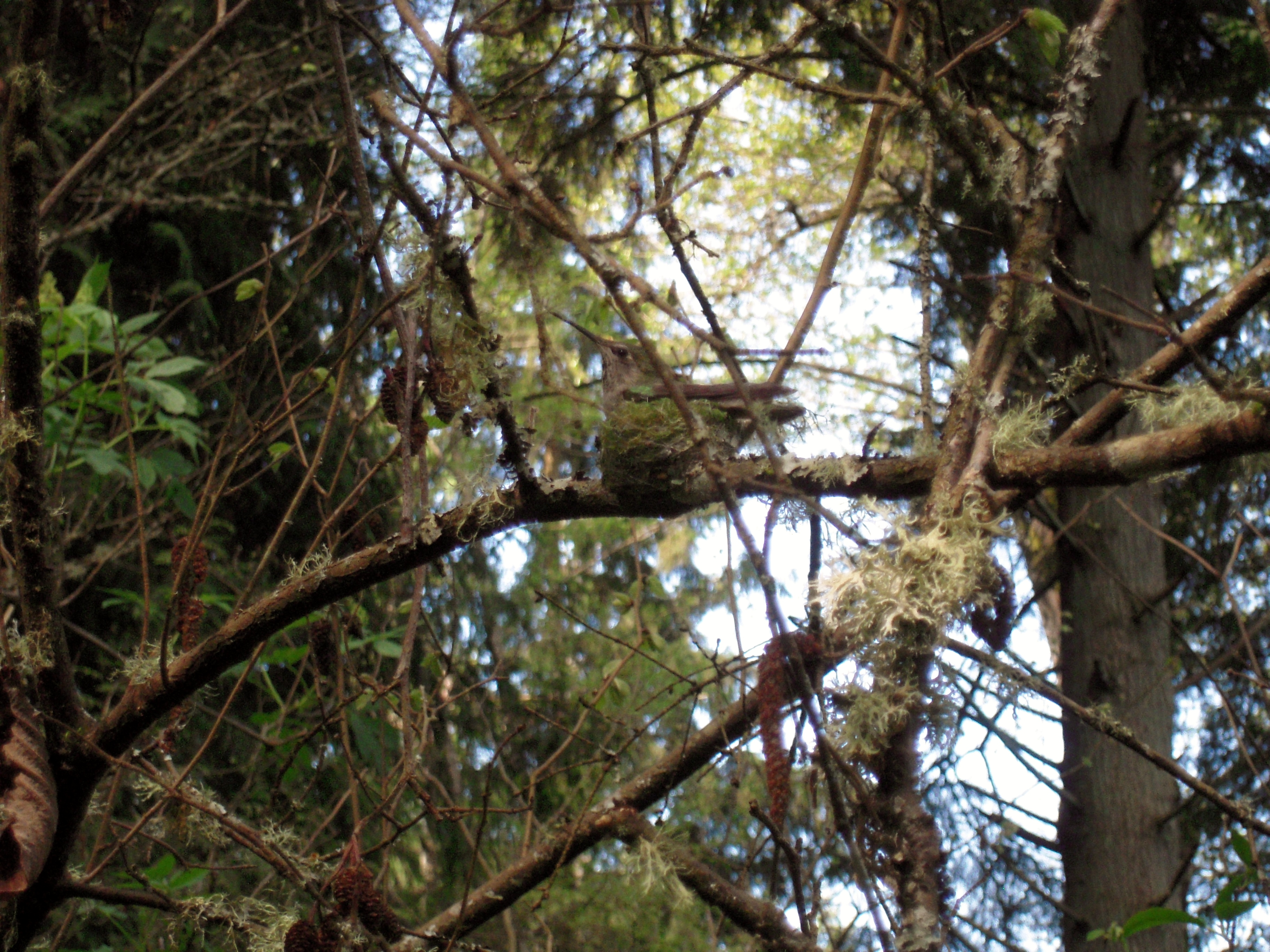
I was walking through the woods and I noticed her out of the corner of my eye. I snapped some photos using my phone and I memorized her location.

293

A humming bird sitting on her nest! I was thrilled! I ordered a real camera to take better nature photos. And the next day, I found this.

273
An egg! The tiniest egg you could ever imagine. A tiny little package of life.

This was the only view I got of the egg. Here’s a little video of the time she was kind of peeved with me for getting too close to her.

After a couple of days she seemed to get used to me. And she sat on that little egg, day after day. I was thrilled to have a chance to see the miracle of life in the nearby woods. Hummingbirds are small and feisty. And this mama, despite the fact that she has the brain the size of a pea, had the instinct to protect her baby. She knew how to fly around to make herself look larger and to make lots of noise. And she also knew when it was time to quell her own instinct to flee and to stay sitting on that egg.

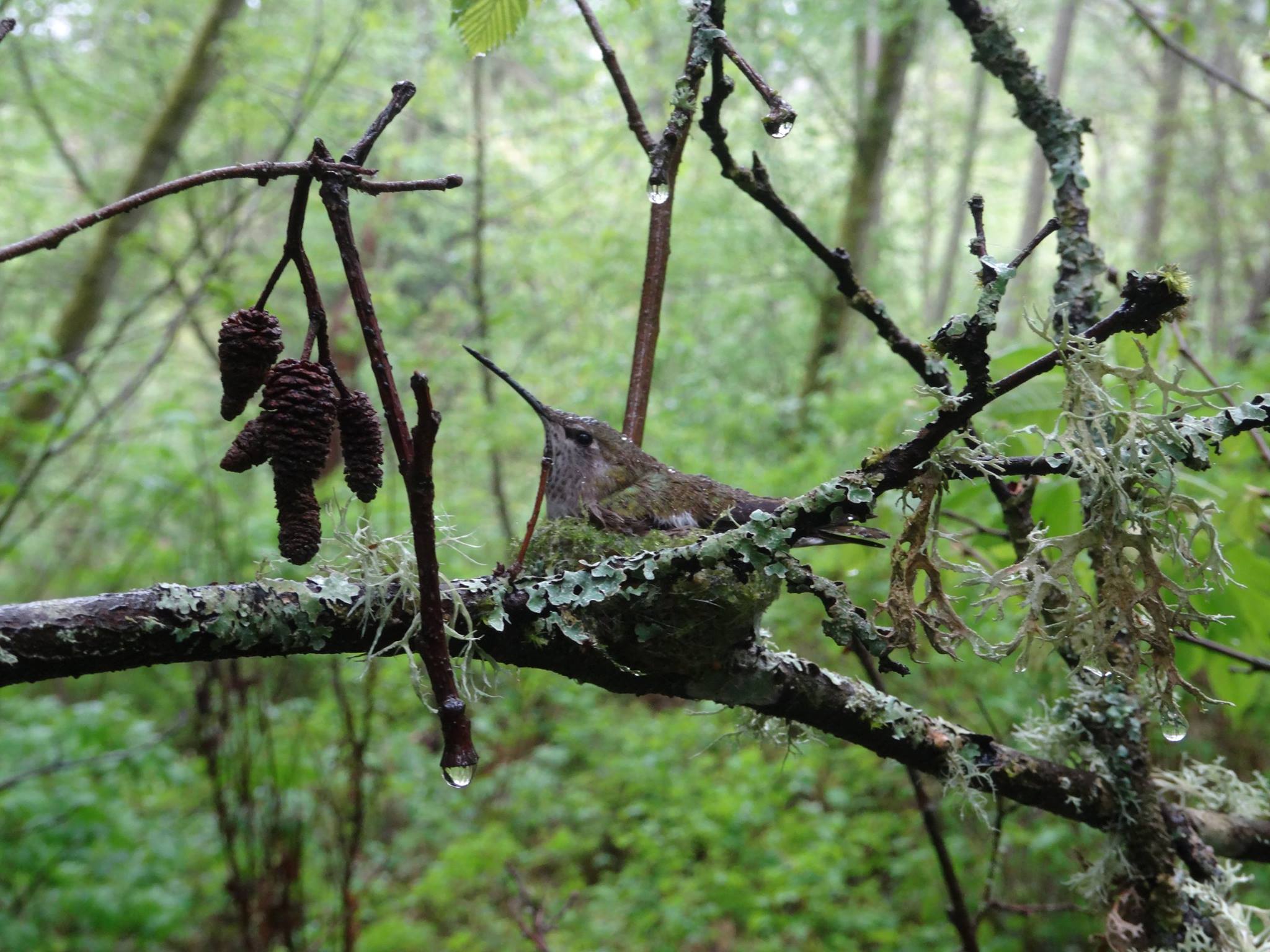
This is a photo I took on a very rainy day. She sat there with the rain dripping on her head from the little twig above her. I thought it was a good metaphor for a mama’s love.

10271383_10203505974960413_6338930511465061000_o

Every day or two, I visited the nest. I had done a little research on hummingbirds and learned that the gestation time would be 16-18 days for the egg to hatch. So, not knowing how recently she had laid her egg when I first found her, I expected to see a chick within a couple of weeks. I kept visiting and started feeling a little impatient because day after day, there was no chick.

Then I went to New Orleans for a few days. John and I walked back into the woods the day after our return.

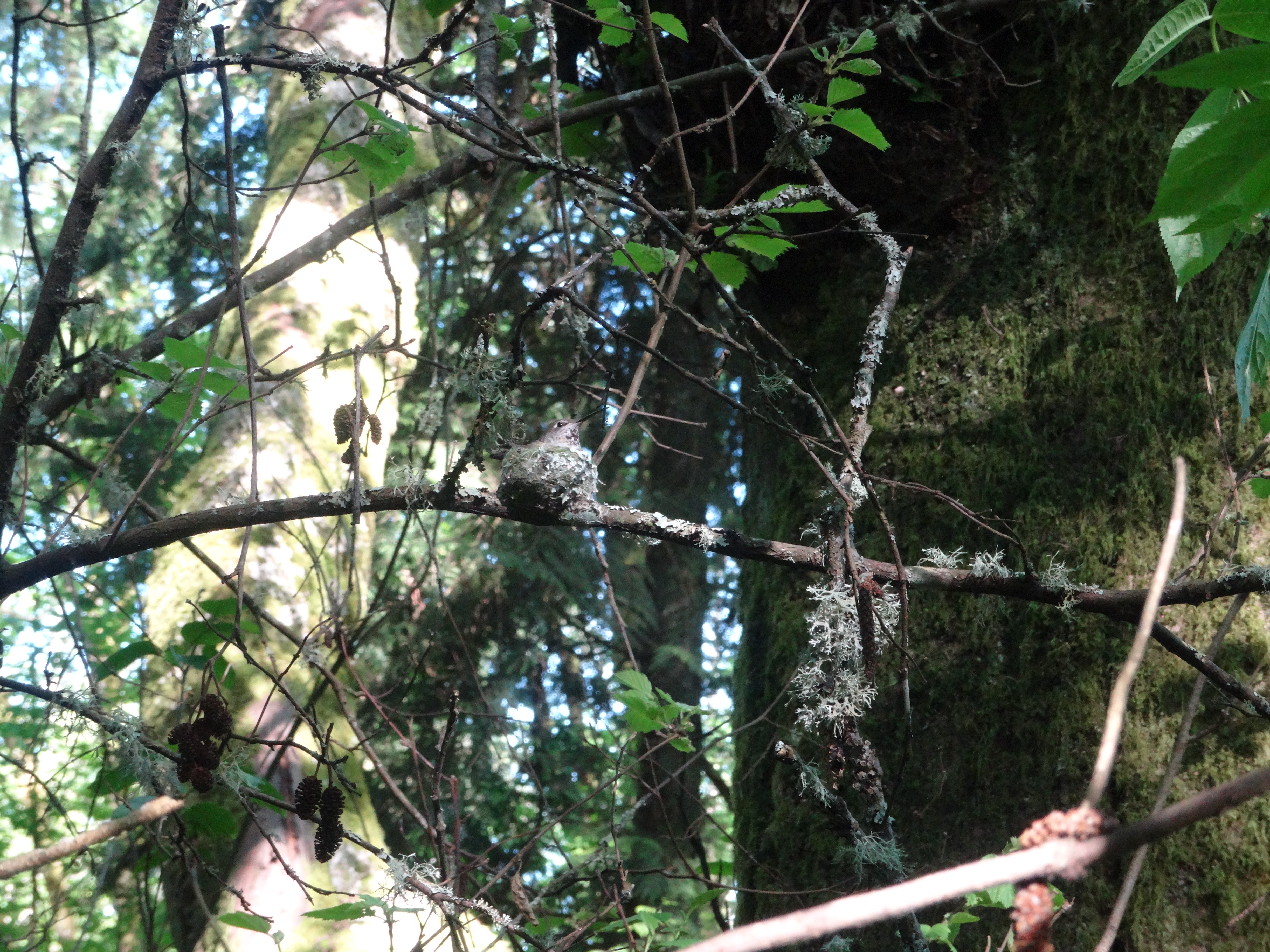
DSC00487
Still no sign of the chick! It is possible that there was a chick under mama but it had been far longer than 16-18  days! Rip off! Where’s my miracle? Isn’t this a zoo?

Then it happened! A chick, a chick, a chick!!!!!!

DSC00528

I visited the chick a couple of times. I was planning to keep taking photos of the chick’s growth, the increase in feathers, and how little bird get loud and demanding as they await food from mamas who are scurrying around to get food for a baby who grows to her size.

Today, John and I set out for the woods. It was a breathtakingly beautiful Seattle spring day.

DSC00594

Nothing. Empty. That chick was still small and homely two days ago. Sometimes nests are empty because a chick has gotten strong and fledged. But other times, they are eaten by a predator or fall from the nest. This chick, whom I’d affectionately called my “grand baby” and who my Facebook friends had fussed over, is dead.

I had been saving my photos for a post on this blog. This is not the post I had in mind. But life is still a miracle and this Mama did her best, as we all do with our children to help them be strong enough to leave us.

Mothers’ Day is typically a very happy day for me. I have a close relationship with my mother, who is a healthy woman. I have a wonderful daughter. But I know that it is a day of loss for many. For those of you who have lost your mothers, who have lost your children, or who wished for children who were never to be, Mothers’ Day has a much different meaning. And then there are those of us who are mothers who understand that we can’t take our own health for granted. We pray that we will be there for our children as long as we can, especially while they are still chicks in the nest.

Life is full of mixed feelings. I hope that at least one of the feelings you experience tomorrow is serenity. If you are a mom who has lost a child, I know you worked to love and protect your children. If you are a daughter who has lost a mother, I know you brought moments of great joy into your mother’s life just by being her child. If you wanted children but it was not meant to be, think of all of the children to whom you have mattered by being a nurturing presence.

His eyes were wide and near tears. He is a pre-teen boy who I first saw when he was a 3 year-old. He said, “I can’t talk about it. If I talk about it I will have to run out the door.”

The kids, I see, however, are not typically good at keeping their thoughts to themselves. I waited for less than a second and he talked about it. He talked about it a lot. His mother was diagnosed with cancer last fall. He hates that his mother’s chemotherapy makes her so sick. He blamed her oncologist. I told him that a lot of people feel that way but explained how the drugs work and their side effects.

At one point he said, “The side effects of cancer treatment have affected my behavior and my attitude.” He also noted that his mother is less patient when she is sick from chemotherapy and observed, “I’m a person who needs people to be very patient with me.”

This wonderful boy has wonderful parents. He has a unique set of challenges and strengths. He works hard to help himself and his parents work hard to support him. Cancer does not give anyone a pass. And it doesn’t give our children, even the most vulnerable among us, a pass.

The more time I spend with cancer in my life, the more I re-encounter my friend, Nancy’s statement, “Cancer has tentacles. It affects many people.”

As most of you are aware, the Superbowl was played yesterday. It was the 48th Superbowl but only the second one in which my hometown team, the Seattle Seahawks, played. They played against the Denver Broncos, who in contrast, have been to the Superbowl seven times, having won in both 1997 and 1998.

I used to be an avid sports fan. I watched all kinds of sports including Monday Night Football. I lost interest in football after college, I must admit. The fact that my husband knows and cares less about team sports than I do (with the exception of the Oakland A’s as he still speaks fondly of attending the World Series with his late father in ’72, ’73, and ’74), made it easy for me to stop watching. And I know that a lot of people disagree with me but I also stopped following football because it’s a brutal sport. It’s just not safe and we get young kids to do it.

Yesterday, though, I put my concerns aside and watched the game. It was really exciting. But the game wasn’t close at all. The Seahawks dominated from the very first play. The Broncos made a lot of mistakes from the very first play, giving two points to the Seahawks on a safety only twelve seconds into the game. A safety is a weird little way that the defense can score. In other words, our team scored without ever having position of the ball. That kind of start off to the game had to have been pretty discouraging for the Broncos.


The Broncos really didn’t ever recover and the looks on the players faces just got more and more defeated. Yes, they are totally overpaid and what they do is grossly overvalued by our culture. And their humiliation is not akin to the pain of starving to death. But the pain was real and I felt sad for them. When I played softball as a kid, my team was never any good. I remember we once got incredibly routed. It was incredibly frustrated. I was mad and just wanted the game to end. But I also had a job to do so I kept trying to do my best through the entire game. The Broncos didn’t stop playing. They probably didn’t play as well as they would have otherwise but they kept playing until the end.

There was another super bowl lost over the weekend. It was a loss of a literal bowl. I accidentally broke my yellow 4 quart Pyrex mixing bowl.

20140201_162859

There it is in shards. It was an ordinary mixing bowl but it was a super bowl, nonetheless. It originally belonged to my grandmother MacKenzie, my dad’s mom. I never met her as she died in 1957, before I was born. She was a child of German immigrants who lived in the Midwest, Chicago and then later in St. Paul, MN. She had four children, three of whom survived past infancy and were born in three different decades, Bill in the teens, Helen in the 20’s, and my dad in 1932. By 1940, my grandmother had lost both an infant son and her husband. The mixing bowl is a bit big for cake making so I typically think of  her having made yeast breads in it. It is the perfect size for proofing dough. Or perhaps she made apple strudel. I know that she was fluent in both English and German but when I’ve asked my dad whether she made German food he says, “She just made regular food.” She sounded like a very interesting woman. In addition to raising three children and becoming a widow during WWII, she worked for the Veteran’s Administration. She was also known on bitterly cold Chicago winter days to invite the African American postal carrier inside to warm up and eat a bowl of soup. This was in the 1940’s. I think this showed a great deal of class. My dad is a very fair person and it sounds like his mom was, too.

My mother inherited this bowl before I was born. She used it to make bread and cakes. And yes, I said that it was too big for cake but not too big for the cakes that my mom made for our family of eight. I remember the sweet and yeasty smells that the bowl contained. I licked leftover cake and cookie batter out of that bowl. When I married, my mom gave the bowl to me and I have had it in my kitchen for nearly 24 years.

My mom did not give me the bowl because I am the only daughter in the family. It wasn’t because it was something traditionally feminine. She gave me the bowl for the special significance it holds in my life. I was a premature baby. I stayed in the hospital for some time but even by the time I was taken home, I was too small to bathe in an infant tub.

Mom bathed me in that yellow Pyrex bowl until I was big enough for a regular tub. I broke a family heirloom. It has made it through multiple cross country moves. On Saturday I was trying to separate it from a larger bowl in which it was nested within the cabinet and it dropped to the floor. It wasn’t a long drop. I can be clumsy in the kitchen because I move too quickly. I have to believe that I’ve dropped that bowl many times before.

The bowl fragments will go out with the trash tomorrow and end up in a landfill. It’s cliche to say but it is true that the memories will live on. And not just the memories of three generations of cooks but the shared memories of mothers who have nurtured their families with food and with physical care taking. And as our culture has changed, we have more men who understand the meditative aspects of baking as well as the feel and smell of a baby when you take her out of the tub to dry off. She’s wet but you hold her to your chest and rub her with a towel. You feel the warm water seeping into your clothes and you smell Johnson and Johnson’s Baby Shampoo.

We win and we lose. We struggle and thrive. We build things and break things. We will continue to care for each other.

Yesterday, I was reading through my posts for 2013 as a review. I’d had a good and productive day. I was happy all day. And then I came to my post from August when I was hit with grief over the anniversaries of my mastectomy as well as the death of my friend, Gina. I remember that day in August. I cried for hours, which is something I have done less than a handful of times in my life outside of the two times I had clinical depression.

Yesterday I cried for about 20 minutes and then I actually felt good again. I’m not one of those people who usually feels better after crying. I mean I know that it is necessary to express grief but I still usually feel exhausted and cotton headed after I cry. The grief startled me because I found instantly found myself loudly and sloppily crying. The intensity of my grief felt like the day Gina died. And my worries about my own mortality, especially the prospect of dying before my daughter is grown, only intensified it.

I’m of the opinion that life is complex and there’s usually not one reason why something happens. But I will say that viewing a series of black and white photos of a husband and wife over the course of the wife’s treatment and later death from breast cancer, likely was a catalyst for this latest crying jag. One of the photos is a head shot of the pair in bed, holding each other, each with a look of utter bliss. It’s a beautiful and happy image. And it reminds me of my husband and I. John is a very affectionate man. He hugs me in his sleep and if I awaken in the middle of the night and put my arm around him, he makes a sigh of contentment and holds my hand. And I don’t mean that he sometimes does this. He always reaches for my hand, every time over the past 23 years. So I looked at that photo and immediately inserted myself into the image. And this woman who was born in the 70’s died. And you can see the progression of her illness in the photos with each photo showing loves and losses in the most poignant way. I found myself thinking, “That could have been me. That still could be me.” I didn’t dwell on the thoughts but I had them nonetheless.

I had nightmares that night. (People, when you wonder why I am careful about watching intense, violent, and/or scary films. This is why. They have given me nightmares since I was about 6 years old.) In one, I was at a parade that included some past beauty queens, women who were now middle-aged. They were beautifully dressed but instead of being on a parade float, they were lying in open caskets on wheels! Even in the dream I thought, “What on Earth? What is this supposed to symbolize about women, beauty, and aging?” And then later in the dream, I was at the funeral of a relative. I don’t remember anything except she was a woman in my family. I remember having grief during the dream about missing my grandmother who died in 1993. In the final part of the dream, my daughter was acting completely and utterly out of control. As rebellious and angry as she could be. It was terrifying.

I am a genuinely happy person. One who has been through a lot. And lots of people have been through a lot in their lives with different impacts and different ways of coping. I am a person who feels things deeply but I am also a deep thinker. And I feel both positive and negative emotions as well as having positive and negative thoughts. I feel happy and calm most of the time. I think part of these intense moments I have of sadness and fear come from the enormity of what I have to lose, my family, my friends, my independence, my capacity to help others as a psychologist.

Today’s New Year’s Eve resolution is to remind myself of the strength of my connections, my connections to myself through my own self-awareness and the purposeful way in which I try to lead my life. My connection to my daughter who is doing so well and so happy right now. My connection to my husband who loves me so dearly that he reaches out to me even when he is fast asleep. Who trusts me so deeply that he allows me to be very open about the ups and downs of our relationship as well as our own personal shortcomings. My connection to my parents; I can’t imagine how hard it must be as older people, to worry about your child’s health and mortality. When my friend, Preben got cancer over five years ago, while still in his 30’s, I noticed that his parents started visiting him much more frequently. I told him half jokingly, “That’s what you get for getting cancer and scaring your parents.” My connections with my extended family have also strengthened. I have some wonderful cousins and sister-in-laws and my brothers have actually nudged themselves out of their comfort zone a little to be a bit more affectionate with their sister.

My friendship connections over the past year and a half have seen the most change. I have made a number of new friends who have startled me with their intense and generous kindness. I know that some of them will come and go but I think that a good number of them will be lifelong friends. I have had old friendships that have evolved into something much deeper than they were in the past. But I have also experienced some lost friendships and some that have been made weaker by my cancer. This mixture of bitter and sweet, of gains and losses, is somewhat dizzying to a person like me who craves consistency and solidity. But I have learned to cope with chaos in my life. I want to be happy and I know chaos happens no matter what I do. So what is my choice other than to try to make peace with it, live along side of it, and accept that I sometimes lose my footing.

Finally, today I remind myself of my reconnection with nature. I spend time outside every day. I have been able to travel to the mountains and to the sea. I am outdoors during good weather and in bad. Even in the most exposed and vulnerable parts of nature, there is beauty. I feel a strong spiritual connection to everything when I walk. It is both intensely personal and beautifully communal.

That is today’s resolution. Tomorrow is a new day and a new year. I wish all of you good things in 2014: moments of joy, moments of peace, and fortitude among the suffering and chaos. Thank you for your connection and support. Xoxoxoxo.

20131120_131015

Lindbergh High School Reunion '82, '83, '84, '85

Join us this summer for our reunion in Renton, WA!

George Lakoff

George Lakoff has retired as Distinguished Professor of Cognitive Science and Linguistics at the University of California at Berkeley. His newest book "The Neural Mind" is now available.

KomenWatch

Keeping our eyes and ears open.....

4 Times and Counting

Confessions Of A 4 Time Breast Cancer Survivor

Nancy's Point

A blog about breast cancer, loss, and survivorship

After 20 Years

Exploring progress in cancer research from the patient perspective

My Eyes Are Up Here

My life is not just about my chest, despite rumblings to the contrary.

Dglassme's Blog

Wouldn't Wish This On My Worst Enemy

SeasonedSistah

Today is Better Than Yesterday

The Pink Underbelly

A day in the life of a sassy Texas girl dealing with breast cancer and its messy aftermath

The Asymmetry of Matter

Qui vivra verra.

Fab 4th and 5th Grade

Teaching readers, writers, and thinkers

Journeying Beyond Breast Cancer

making sense of the breast cancer experience together

Entering a World of Pink

a male breast cancer blog

Luminous Blue

a mother's and daughter's journey with transformation, cancer, death and love

Fierce is the New Pink

Run to the Bear!

The Sarcastic Boob

Determined to Manage Breast Cancer with the Same Level of Sarcasm with which I Manage Everything Else

FEC-THis

Life after a tango with death & its best friend cancer