Parents often tell me that their children are “very verbal”. Typically, this means that their child talks a lot. Sometimes, it also means that their child has a creative way with language or that he or she is particularly bright. The children who fit the latter description, also tend to talk more than average.

My first and last negative report card comment was in kindergarten, “talks during rest time.” I am verbal. I talk a lot. I like to think that I have a lot to say. Whether I have a lot to say is debatable, but what I believe is a quite objective truth is that my mind has a lot to think and that a lot of those thoughts are verbal. There’s a lot of talking that goes on in my head. No worries, people! It is my voice that is doing the talking.

There are a lot of advantages to having a busy verbal mind. I have a quick sense of humor. I am good at observing and solving problems. My thoughts are useful in my writing, in my interactions, and in my daily contemplation.

Sometimes, however, I can’t get it to stop. My thoughts are worried and frenetic. They keep me up at night. At other times, they are relentlessly busy conveying boring but mindsucking information. I generally dislike Talk Radio. Talk talk talk. Going nowhere. Taking up space where meaningful existence could occur.

At many times, the most meaningful existence is rest. It’s slowing down. I love the holidays. But the hustle and bustle amid the dark drizzly days of the northern latitudes can be difficult. Tonight will be the longest night of the year. There will be about 8 hours of daylight tomorrow. We have 16 hours of daylight on our longest day. If you tell me it makes no difference, I would guess that you live at the Equator. I get tired when it gets dark. During the holidays, there is a lot to do during the lowest energy time of the year.

You’d think during this time of year since my body slows down that my thoughts would, too. You would be wrong, I’m afraid. Although the Talk Radio in my head does not seem to require much energy to produce, it certainly takes energy from me.

The holidays are not the best time to take on a campaign for changing my habits. But I did just that when I decided to complete a self-directed course on Mindfulness Based Stress Reduction. The current formal mindfulness meditation is the body scan. The body scan is just that. It’s a guided meditation during which I shift my attention and awareness to different parts of my body. The particular scan I am doing  takes 32 minutes.

An advantage of the body scan, compared to other formal meditations, is that it can be done in bed. My Fitbit has recently confirmed that I am a very restless sleeper. Consequently, I often awake not feeling altogether rested and happy to stay in bed to do the body scan. I’ve been doing the daily body scan practice for over a week now.

At first, my thoughts constantly interrupted the words of the recorded voice on the body scan. This has been such an issue in the past that I decided against doing guided meditation for nearly three years after first giving it a try. It was like an exercise in voices interrupting one another, mine and the voice of the recording. This time, I decided to give this another try.

My young cats, Leeloo and Basie, have added an extra element of challenge. They are energetic and social. They like to use me as a blanket and running path while I am meditating. I also experienced one meditation, using my tablet since my phone was not working. Unfortunately, my tablet was set up to turn itself off every 5 minutes. So, I had to turn it back on every 5 minutes.

I have enough experience with mindfulness meditation to just keep going with my meditation, redirecting myself back to the exercise, even if it is very interrupted. I will obviously try to plan better for the next meditation, if there are factors I can control. If not, I go with it. In the past, I would have stopped meditating because I was frustrated that I was not “doing it right”.

One of the things I love most about mindfulness meditation is that all of my experience is part of the meditation as long as I stick with the process of trying. Sometimes I have a “good” meditation. Sometimes, I have a “bad” meditation. But every meditation is a meditation. Every meditation counts.

I have found over the course of my body scans that my thoughts are slowing down, bit by bit. I still have fits and starts. Sometimes I fall asleep or zone out. But it is a helpful process, a useful one.

Arguing with the Talk Radio in my mind has not been useful in my life. However, listening followed by redirection, has changed the channel.

DSC02108


As I mentioned in my last post, I am leading a mindfulness group on social media. I posted a short mindfulness activity this week. Inspired by an article about adult coloring books posted by my friend and fellow blogger, Yvonne, I developed a simple 5-10 minute long mindfulness exercise on coloring. I provided a link to free coloring pages for those that did not have their own book. Adult coloring books are popular right and there was some enthusiasm among group members for doing this exercise.

The instructions for the exercise were to engage in coloring for 5-10 minutes, with the goal of staying engaged, non-judgmental,  and in the present during the activity, noticing sights, sounds, and tactile sensations as well as thoughts and emotions during the exercise. Although I wrote the instructions for the exercise, I did not complete it myself until a couple of days later.

I love art. I have yet to learn how to draw or paint. I even took a self-directed course designed for people to whom drawing does not come easily. I did well until the exercises advanced to the point when I had to learn how to draw three dimensional scenes rather than line drawings. This was one of the early lessons. I still have all of the art supplies necessary to complete the course. In general, I have amassed a lot of art supplies. I have used most of them for various craft projects.

A few months ago, I bought a couple of adult coloring books. The patterns were mesmerizing. I love colored pencils. However, I’d worn my beloved colored pencil collection down to nubs. I decided to buy new pencils. I looked online and drooled over the possibilities. I ended up buying a lot of colored pencils. Like A LOT a lot. It was actually five sets of 24 that I bought. Yes, that’s 120 pencils. Well obviously with that kind of pencil population, I also needed a case in which to store them. My dream was that I would have a case that would allow me to see what I had while I was using them and keep them organized.

My dreams were realized with the purchase of a zippered multi-section pencil case that holds 120 pencils. I spent a couple of hours unwrapping and sorting those pencils by color. This, in and of itself, was a mindfulness exercise. Here they are in their color-organized glory:

20151208_210237

Yes, I realize that the photo is a bit out of focus. It is hard to focus when I am drooling and misty-eyed over the beautiful spectrum of my colored pencils.

Oh wait, did I mention that I can not yet draw a lick? Though it is true that I have used pencils for craft projects and that I used to use them often, I had not done any colored pencil related crafts in some time, maybe at least a year or two. Maybe even three years. I bought a couple of adult coloring books and waited for inspiration. I waited for awhile.

I was eager to do this mindfulness exercise. I had my case of 120 colored pencils and a barely used coloring book full of glorious flower patterns. I got out my materials and set a timer. I looked at the page. I looked at my colored pencils.

I don’t remember mindfulness meditation having so many choices!!!!!! What now? I was a little overwhelmed but I connected with my breath and chose a flower. What now? Then I chose a pencil and I started coloring. What now? In the middle of the 15 minutes I had allotted for this exercise, my family walked through the front door. They started asking me questions and giving me greetings. Can you believe it? Did they not know that I was trying to be one with my coloring?

My mindfulness exercise was full of decisions and interruptions but I kept taking my mind back to the exercise, listening to the sound of the pencil rubbing against the paper, feeling the pressure of the pencil against my fingers, and looking at the combination of colors that emerged on the page. As I worked, despite the interruptions, my work became more organized and less overwhelming. I felt more grounded just seeing that something had happened to which I had connected.

12309650_10207820860389852_8988977096973527105_o

I picked up my camera and took a photo of my work.  It popped visually off of the page just like the flowers that I encounter and photograph on my walks do. I am not always mindful, but when I am, things come to my full attention. Sometimes this means seeing something clearly sticking out from the background.

As Jon Kabat-Zinn, the founder of Mindfulness-Based Stress Reduction, says, “mindfulness is not doing, it is being.”

Now what?

Now can be sloppy. Now can be imperfect. Now can be an interruption. Now can be painful. Now can be joyful. Now can be peaceful. Now can be sweet.

Now what? Now is what.

What else can there be?

I started writing this post while at the Palm Springs Airport waiting to board the first flight back to Seattle, which is my home. My family and I had just enjoyed the long Thanksgiving weekend in the southern California desert.

I have long associated Palm  Springs with wealthy retirees and mid-century modern style, a place where the Hollywood elite used to live.

I chose Palm Springs as a 50th birthday trip due to its proximity to Joshua Tree National Park. It’s not that I don’t like the other offerings of the area, the style, the history, or the architecture. I love those things. But what I also love and what I needed for this trip was to in nature and to be in the sunshine.

I had never visited this part of the country.  We flew into Palm Springs in the late morning. We flew into a valley surrounded by mountains. The mountains were right there. Close. Really close. I had no idea. I was smiling as I lugged my cooler full of food to the rental car. (My allergies mean that I can’t eat at restaurants and there was no way I was going to waste time in California at the grocery store, especially on Thanksgiving Day.) We drove to the rental house, ate a little lunch, and my daughter, who hates traveling and doesn’t suffer in silence, retreated to her room. It was just after noon.

You know what is open on Thanksgiving besides grocery stores? National Parks. I looked at my husband and said, “Let’s drive to Joshua Tree.” We climbed into our rental car and drove past more and more mountains, mountain-shaped stacks of rocks, wind farms, and tumble weeds. We arrived at the entrance to the park and pulled over.

Joshua Tree is full of surreal beauty, of endless marvels to behold, despite the fact that it is a very harsh land with not enough water most of the time and too much at others. In the summer, it is incredibly hot. There is not a lot at Joshua Tree to support life even on a beautiful cool November day. And yet there is life, tucked into the lifeless rocks and in the soil, which could kindly be described as “poor”.

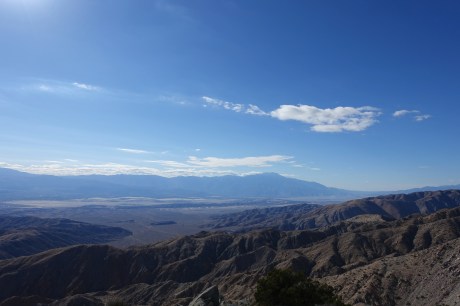
This is Joshua Tree in it’s quiet stillness. I am from a mountainous area and I know what the majesty of mountains can mean. Where there are mountains, there are the edges of geologic plates, those seams in the Earth’s surface that prove to us that there is no such thing as solid ground. There are earthquakes. There are volcanoes. There is a sizable section of the southwest border of Joshua Tree that runs right along the southern tail of the famed San Andreas Fault. I got a look at it from a vista overlooking the mountains and Coachella Valley. I could see it! Honestly, despite the fact that I live in a part of the world that is considered to be geologically dangerous and have happily camped on top of the large caldera also known as Yellowstone National Park, being so close to that fault was a tad disconcerting.

This area is an area of natural disaster. It is an area of famine and devastation. As I was hiking, I couldn’t help but think about how this area is not only beautiful despite past devastation but in large part, because of it. And yet, I was having a marvelous time. To be honest, I have found myself worn down lately by the onslaught discouraging and heart-breaking national and world events. A lot of people are being violent and hateful. Actually, there will always be individuals who commit violent and hateful acts. This is sad but what I find nearly heartbreaking and stretched to my limits to bear is the violence and hatefulness of our culture. Dealing with individuals is one thing. Trying to change sick and dysfunctional aspects of a culture, is another endeavor entirely.

Lately, I have found myself more discouraged. I have found myself to be more harshly judgmental. Harsh judgment is incompatible with compassion. I strive to be a peaceful and compassionate person. I have found myself struggling to maintain my balance. The change is not dramatic. I’m not flailing but I feel more effort of my daily life. When I was in Joshua Tree, I found balance and peace. The stark and beautiful landscape pulled me into the present and into a state of mindfulness.

I have been practicing mindfulness for about 3 1/2 years now. I’ve been walking most days and taking photos for about that long, too. I try to eat healthfully. I try to post regularly to this blog.  I’ve lost a bit of steam and focus. I have been contemplating strategies to help me renew my efforts and avoid losing further momentum.

Last night, my friend Rachel, who is also one of my major college mentors, posted on Facebook. “I want to start a cyber commune. Any ideas?” I suggested that we start a FB study group to do a mindfulness meditation program together. She asked me to lead it. Seeing the opportunity to refocus my mindfulness practice, I immediately agreed. Within 5-10 minutes and with my agreement, Rachel had set up the group and we started inviting people. I identified a self-guided online program last night.

I don’t want to spend so much time looking at the fault in the valley, wringing my hands, and hoping for rain.

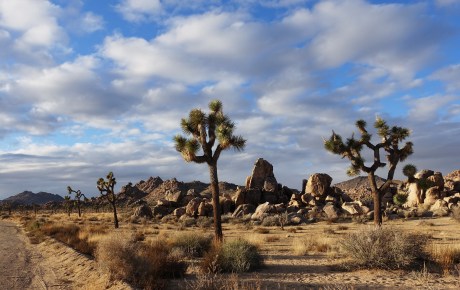
Joshua trees and rocks in Joshua Tree National Park.

Joshua trees and rocks in Joshua Tree National Park.


Keys View Point.

Keys View Point.


From Keys View Point, overlooking Coachella Valley and the San Andreas Fault.

From Keys View Point, overlooking Coachella Valley and the San Andreas Fault.


People say that every day is a gift. This is true to the extent that every day is not totally under our control. Gifts are not earned or brought into being. They are given to us.

Some gifts are not welcome and are returned.

Some gifts are not welcome but cannot be returned.

Some gifts are exactly what we wanted only to be met with disappointment.

Some gifts fill an empty spot that we never knew we had.

Gifts can accumulate over time, like links in a chain, on which we can hang memories and meaning.

Some gifts are small gems with their own light and singular beauty.

Today is my 50th birthday. I woke up and thought to myself, “I am 50”, which was accompanied by a broad smile on my face. Today is a beautiful gift, the gift of life, the gift of family, the gift of friends, and the gift of love. I have pain, sadness, anxiety, and heartache in my life. But I also have an embarrassment of riches in cherished gifts. I offer you the gift of my wishes today.

I wish you the gentle hopefulness that comes from witnessing the quiet beauty of nature.

I wish you the spark that comes with taking on a new endeavor.

I wish you the joy that comes from exuberant connection.

I wish you the contentment that comes with the habits of our daily life.

I wish you the peace that comes with the ease of suffering.

I wish you the music your heart’s desire.


DSC03784

As described in my last post, the first step in pottery throwing is centering the clay on the wheel. My pottery teacher says that it takes students typically four weeks just to learn how to get the clay to stick to the wheel head, to mix the clay by coning it up and down for structural integrity, and to keep it centered.

The next major step is opening up the form. First, a thumb or sponge is used to make a small opening straight down into the clay. This is much harder than it sounds or looks. For most of my pieces, this has resulted in losing center and turning my clay into a wobbly mess. I typically end up taking a wire tool and removing the clay off of the wheel. Unfortunately, the clay has to dry out for awhile and be rewedged to remove air bubbles, before being re-used.

One of the reasons that I have focused more on plate-making is that they do not have to be opened. Yesterday, I arrived at class still not having independently made a decent cylinder, a basic form. I had, however, watched a number of pottery teachers on the Internet over last weekend. What they were doing didn`t look any different than watching my instructor. A lot of pottery is learned through feel and I was just not getting it.

I came into the studio and tried throwing a plate, which ended up going off center in the last step. It was not worth trying to save so I took it off of the wheel, balled it up, and put it back into my clay bag to be used in a couple of weeks. Then I tried to throw a cylinder, which turned into a saucer sized plate. I liked the looks of it so I was not too bothered by the fact that the clay had a mind of its own. Then it collapsed and I wired it off, discovering that the bottom was so thin that it was not viable, anyway. Counting the two plates I tried to throw last week, I had now made four wet clay blobs in a row. I was feeling a little frustrated.

Mikki, our instructor, had other things in mind. She wanted us to learn to make mugs. A mug is a cylinder. We were also adding curves to the form to make it easier to make a handle that would accommodate fingers. I centered my clay, mixed it up and down three times, took a deep breath and poked my thumb into the top of the clay to make my opening. To my surprise, it worked. Then I took my thumb and pulled it across the bottom of the form to widen the cylinder. I had a couple of close calls but there was nothing that I was not able to repair. I had successfully opened up the form without collapsing it.

Then it was time to “pull” the form. Basically, that is when most of the vertical growth occurs in the form. I carefully followed the steps but my form went awry. I asked my instructor for help. She put her fingers in my piece and said, “Oh, you didn’t make your hole deep enough.”

When I opened up, I had not gone deeply enough. I have also ruined forms by going too deep. I have also ruined forms by not having the wheel spin fast enough. I have ruined them by going too slow. As for this form, I was able to fix it and had a break through about what “pulling” a form actually meant and I moved my hands, slowly at the speed of the wheel, just as I had been instructed to.

By the end of the night, I had made two nice looking mugs. No, they didn’t match. I was actually kind of happy for that. I like variety. Next week, we’ll learn how to make and apply the handles.

By going deeply enough at the right speed and by trying over and over, I will have made a vessel from which I can derive sustenance. Opening up leads to many outcomes. Fortunately, life gives us many many do-overs.

When I was in college, I lived in the dorms for the first two years. Our dorm had a pottery room, which was open for student use. One of my acquaintances, a ceramics major named Kal, was hired to provide instruction. I wanted to learn how to throw a pot on the wheel. However, I purposely avoided going to the pottery room when I knew that Kal would be there. Kal acted as if he had a strong romantic interest in me. He was never anything except a polite and respectful young man to me but he was really intense. When he looked at me it was as if he were picturing what our children might look like when we got married. As a 19 year-old, this was too much. It made me feel uncomfortable and off balance.

One day, I went into the pottery room by myself, whacked off a hunk of clay, plopped it on the wheel, got the wheel turning, and tried to shape it into a pot with my hands. It was quickly obvious to me that pot throwing skills might be enhanced by instruction. I managed to take an off center blob of clay and transform it into an even more off center blob of clay with ridges. I’m not even sure how I got that clay scraped off of the wheel but I did. Then I did a little hand building followed by having some fun with the slip molds. Slip molds are easy. You pour in the clay slip, wait a bit, and then pour it out leaving a lining on the mold. Put it in the kiln and presto, a perfectly molded piece came out, ready to glaze. I can’t say that it actually stoked my creativity, using those slip molds getting the same shape, over and over.

It is now thirty years later and I am learning to throw pottery on a wheel. I signed my husband and I up for a pottery class at the local community college. This is the first class we’ve taken together since the travesty that was ballroom dancing at the Bloomington, Indiana YMCA, 17 years ago. I have signed us up for other classes in the past few years and have had to cancer them due to urgent parenting needs that have made it necessary for us to stay closer to home. We spend every Thursday night working with clay. The first thing we learned was to wedge the clay, in order remove the air bubbles and prevent cracks. Then we learned to center the clay on the wheel. Working with un-centered clay is kind of like trying to get a washing machine back in balance by hugging it.

To center clay, you have to make it stick to the wheel and you have to stick it to the right spot. Then you have to use your hands and tools to move some of the clay while keeping the whole pile of clay stable. It is a dance of flux against stability and like any dance, it requires coordination. The first thing I learned to do after wedging was centering. Then I was kind of stuck because I could not get the clay to move the way I wanted it to. It either moved too much and unevenly so or nowhere at all. Micki, our instructor came over to each of us at these times and helped us out either with verbal instruction or by demonstrating the technique on our work.

With each lesson, I learned a different part and by the 4th lesson, I had learned enough parts that I was able to get the clay to do some things that I wanted. I had a few epiphanies that led to my hands working together but performing different jobs. I am learning to use my right hand to create change and to use my left hand to hold everything steady while also accommodating the growth of the object. I am learning to move my hands at the right speed. I am learning to use the strength of my forearm and body weight to create width instead of willing the heel of my hand to be flatter and stronger. I can make a reasonably acceptable looking plate now. I am still working on pulling up the clay higher for cylinders, a process that has been somewhat hindered by the fact that the flat surface of a plate is much more interesting to decorate.

I am very much enjoying this class, as is my husband. We are both learning. Perhaps if I wanted to and dedicated the time to it, I could get really good at throwing plates. I suspect I will keep learning to make new things, each a combination of struggle and discovery.

I do know that with each new learning I start the same way, by taking the time to get my work securely centered to the wheel before getting creative or fancy. It requires patience, persistence, and plenty of do-overs.

A lot of teens do not understand their own mortality. That is normative. I was not a normal teen. I was hyper-responsible and tightly wound, in equal measure. Consequently, when I grew old enough to get my driver’s license, I was struck by the enormous responsibility that came with the power and the privilege of driving. I understood that I could really hurt, maybe even accidentally kill someone.

I don’t particularly like driving. Nonetheless, I am a good and responsible driver. Most of the time, I pay very good attention. However, sometimes, I have a lapse in my attention, as everyone does. I forget the power I have in driving a car. Fortunately, these lapses typically do not have negative outcomes except when I notice them and think about what could have happened.

Yesterday, I was walking to my car after work. I was crossing a street when I saw a car in my peripheral vision headed toward the intersection. I stopped because I could tell by her speed that she was not planning to stop. She had not seen me. She still didn’t notice me when she stopped at the stop sign. I was standing less than a foot away from her. I could see her in her car. She didn’t look angry, sad, or anxious. She looked focused on getting to where she wanted to go.

I watched her car as she turned onto another street. I muttered to myself, “Geez, lady you could have run me over.” I was surprised that she still hadn’t noticed me. Without looking on the pavement below me, I started crossing the remainder of the street. I didn’t see that the road was damaged right in front of me. There was a deep rut in it. I stepped right in it, lost my footing, and crashed to the ground onto my left knee and the heel of my left hand. I was sprawled in the middle of the street. I knew that I would be able to walk away but my feet were under me at odd angles, my briefcase and purse were flung across the street, and I was scared. A man on the sidewalk saw me and helped me to my feet. He walked with me for a bit to make sure I was steady on my feet.

The woman in the car was not trying to hurt me but she was not mindful of the power, the privilege, that she had. Having narrowly escaped being seriously hurt or killed, I reacted with fear and distraction. My next action after saving my own life was not one based on good judgement. Seattle streets and sidewalks are notoriously uneven. I have walked thousands of miles on them. It is important to watch where I am going because it is easy, otherwise, to trip on something.

When we are afraid we don’t always make the best judgments. We tend to flee, fight, or freeze up. This is not because we are stupid. It is part of our nervous system’s survival system during which energy is decreased from the more reasonable and sophisticated parts of our brains. That’s why training and protocols are so important for people who work in emergency or dangerous situations. Training buffers against the snap judgments we can make when dealing with threat.

Most people do not intentionally abuse their power against others but there is danger in not being mindful of it. The woman in the car was not aware of her power over me because she wasn’t even looking. She didn’t even know about me. I suspect she would have felt remorseful and given pause had she realized what could have happened.

Sometimes we don’t realize our own power. We don’t realize the privileges we have that others do not. What if that woman had hit me, exclaimed that I couldn’t have been hurt because she had no power over me and further, that I deserved to fall in the street because I had not used good judgment and taken a look where I was going? That, my friends, would be ridiculous.

But we do it, every time we dismiss out of hand the experiences of individuals who have less access to power than do we. And we encounter it daily when we encounter individuals who are so used to their higher status and power that they assume all is as it should be.

A female African American student at Spring Valley High School was subject to what most people would consider excessive force by a European American South Carolina police officer whose job it was to protect students and staff at the school. A portion of the interaction was captured on a fellow student’s smartphone. The video has “gone viral” on social media and the officer has been fired. Further, a federal investigation in underway. I can’t read minds but given the fact that the police department spokesperson felt obligated to note that the conflict, “started with her” coupled with the fact that this particular officer has been investigated for racial discrimination in the past, I wonder if the firing of the officer has more to do with image management than to the police department’s mission to protect and serve.

Police officers are trained to protect the public. They are trained to avoid using more force than is needed to do their job. They are trained to de-escalate situations. This officer was assigned to protect these high school students, including the young woman who was not following his orders and may or may not have struck him before he laid hands on her.

“She should have just done what he said and there wouldn’t have been any problems.”

“She’s a trouble maker, anyway.”

“She should not have hit the officer.”

Why do we focus so much on the actions of the person with minimum power?

The officer had more power than the student due to his sex, race, size, position, and the fact that he was armed. She wasn’t even standing up. She was sitting in one of those one-piece chair and desk combinations that you have to bend yourself in and out of.

Let’s say that the officer was afraid of this slender young unarmed woman who was sitting in her desk/chair combo while he was towering over her with a career full of experience and training for these type of situations. Is that the officer you want on the force?

Since almost everyone has a video camera on their cellphone, we’ve been seeing some startlingly awful and violent exchanges. I am not at war with our police officers. Most of them do a good job, responsibly. But there are far too many people out there abusing their power and privilege only to have a sizable portion of the public blame the victims for it. Remember the video of the  woman who was pulled out of her car and pushed to the ground for failing to turn on her turn signal and ended up dead in jail a few days later? The number of posts to social media that I saw that were victim blaming made me sick.

“She shouldn’t have mouthed off to the cop.”
“I feel sorry for the officer. He’s going to have to live with this the rest of his life.”

As far as I know, acting like an asshole, using poor judgment, mouthing off to an officer, or failing to follow police directions are NOT crimes punishable by death or brutality.

Power is to be shared. When it cannot be shared, it is to be used responsibly and for the good of all.

Privilege is to be earned, not inherited.

Power and privilege are not license to kill.

I attended a professional workshop last month on mindfulness. There were a number of exercises, one of which was a 30 minute long body scan. Afterward, we discussed our physical sensations as well as the overall experience in a small group. In a body scan, one focuses on and notices one body part at a time, moving to different locations in the body. I shared the observation that when we were instructed to focus on our torso that I found it difficult to shift my attention from the parts of my body that are numb from my mastectomy and reconstruction. One of the women in our group said to me, “I’ve been through that. I had a mastectomy 20 years ago. I thought my life would never be the same. But I don’t even think about it any more.”

I know that she was trying to be encouraging but my first thoughts were, “Wait a minute! You can’t take my cancer away from me!”

I hate that I’ve had breast cancer but I love how I changed my life in reaction to it. I don’t want my life to be the same as it was before. I want to stay mindful and appreciative of the preciousness of life. There’s only one person who could really take that away from me and that person is me.

I’ll keep doing my best to keep myself in line.


During my last two walks, I’ve been keenly aware off my gait. I have attended to my footfalls, the way some of my flesh moves a bit from the impact of each step and how I can feel the strength of my muscles in my stride. My legs are curvy, solid, and strong. They support my weight and take me places, through noisy streets and peaceful ones, through rain and wind and through the delicious sunlight that cracks through the clouds during the fall.

I have been meditating on my steps. Since I began recording my walks at the beginning of December 2012, I have walked over 2500 miles, through seemingly endless medical appointments, seemingly endless reconstructive surgeries, through work and family life, navigating an ever changing life with a map that at times seemed etched with the lightest pencil marks. One of the unexpected gifts of writing this blog is that I am able to go back and see that despite the fits and starts and lack of linear progress, I am growing and changing, in mostly positive ways. I am moving forward on strong limbs.

The last week of September was Double-Scan Week. I had a diagnostic mammogram to follow-up on the “probably not cancerous” mass that was discussed six months ago at my routine screening. Dr. Bang informed me that it was 2mm and that it had been visible on previous mammograms. On the Friday of the week, I had my annual MRI. Typically I have one scan every six months, either an MRI or a mammogram, but not both. I could have spaced them out a little but then I figured I’d just drag on the stress of waiting.

The mammogram was a breeze. One of the things I love about my cancer center is that they always provide results during my visit when  I have a diagnostic mammogram. The radiologist was pleased that the mass had not changed shape or size and that it still had the appearance of a benign cyst. I go back in 6 months for follow up, a typical course of action for monitoring. The MRI was a bit trickier. For some reason, the imaging lab that I usually go to has closed abruptly and all services had to be moved to another imaging lab, nearby. They were very nice and for extra credit, their MRI machine was shiny new. I asked them how long it would take to get results and the tech told me that my oncologist would receive results that very day.

Saturday was a very nice day and I woke up Sunday in a very good mood. My husband and I took a ride to the mountains. Then it happened, the upsurge in anxiety that seems to come out of no where. My heart started beating fast and I was having trouble concentrating. “What’s happening to me? Oh yeah. Double Scan Week.” I told my husband what was happening. Unfortunately, he was not having a good day and was not as supportive as I wanted him to be. I find more and more that there are people who are just tired of my damn cancer. I don’t know if it is self-invalidation or invalidation by others or a combination of both. But I do sense that there are people in my life who are waiting for me “to get over it”.  Personally, I don’t think it is so bad that I have a little anxiety spell for a few hours.

It’s hard to get over it when there are physicians around who keep wanting to look at what is going on in my body through scans. I waited. And waited. I was not particularly nervous. Last year, I found my own MRI results on my electronic medical record. No news, tends to be good news at my cancer center. They usually jump into action if there’s anything that’s concerning or potentially concerning. I tried not to check online too often and each time, there was nothing there.

Yesterday, my friend, Julie asked me if I had gotten results. “No, not yet. Last time it took about two weeks.” She said, “Hasn’t it been two weeks already?” It had been a week and a half. I told her that I was not too worried but would give them a call on a day I was not seeing patients. I don’t like receiving news by phone. Who knows what I will be doing when they call? Julie said, “Okay, I will be impatient for you.”

I  don’t see patients on Wednesdays so I called my oncologist’s office this morning. I expected that if I were to get a call back today that Dr. Rinn would call me in the evening, as she has in the past. And I got the call at about 8:30pm. Due to the abrupt change in labs, the new labs’ reports have not yet been integrated into the electronic medical records for the cancer center. Dr. Rinn was apologetic about the wait. She told me that no abnormalities were found inside of my breast but they saw something on my skin. She asked, “Did you have a rash or something?”  “Yes, I had eczema on and below my left breast that day. I didn’t think to say anything about it.” She told me that she was going to tell the radiologist and see if they would be satisfied. Otherwise, I will have to go back in six months and have another double-scan week. It’s not the worst thing but it was a challenging week not to mention that after 3+ years of being a cancer patient, I am getting a bit concerned about all of the zapping and injecting I get for scans.

I am relieved about my news. I am also grateful that I did not waste too much time worrying and working myself into a tizzy. But I also felt a strong wave of compassion for my friends with metastatic cancer. They have scans so frequently, treatment so frequently, and have to wait for a living. Literally.


My husband, John’s late Grandma Ann lived in Roseburg, Oregon, a small town in southern Oregon. Ann was a woman of habit, retired school teacher who got her hair set every week. It nearly always looked perfect. She ate meals everyday with her friend’s at the King’s Table, an all you can eat buffet. And when I say “every day”, I mean it. Every day, for decades, even when company came over.

Sometimes the company was John, then a child, along with his parents, visiting from California. Roseburg, then a logging town, was not surprisingly home to many lumberjacks. As you can imagine, being a lumberjack is heavy work and consequently, a lot of the lumberjacks were very large men. They not only ate a great deal but they also saw a great deal at King’s Table with their all you can eat buffet. According to John, the lumberjacks ate so much that the restaurant made a policy change. No more all you can eat. Each diner was limited to one plate.

How would the lumberjacks get enough to eat? One day, John saw a lumber jack amble toward the buffet. He picked up a plate, walked past the salads, walked past the vegetables, and straight to the mashed potatoes. Like Richard Dreyfuss in Close Encounters of the Third Kind, he piled his plate with a mountain of potatoes. Then he walked over to the meat section and stuck as many fried chicken legs into his potato peak as humanly possible. He’d done it. He’d packed 5 million calories of starchy, greasy, protein onto one plate.

Roseburg, a small town in a beautiful state, made the news on the first day of this month. A young man committed a mass shooting at the local community college, killing several people. The U.S. has seen an increase in mass shootings. Nonetheless, the majority of gun deaths are not due to mass shootings, they are the day to day shootings, intentional and unintentional, which occur in the U.S. at an alarming rate. The mass shootings capture our attention because they seem so random, are so severe, and tend to occur in small “safe” towns.

Understandably, people are upset. I am really upset. I am tired this issue, which is so divisive in my country. I am so tired of people not even being able to talk about it in a civil manner. I am tired of people presenting opinion and what they wish were true as actual truth. I am tired of people using emotional reasoning, greed, and religious fervor to argue against laws that would prevent death while still upholding the constitution.

Some people seem to think that unless they have the right to their own personal mountain of guns that they are being oppressed and made unsafe.

How many people have to die?

We’ve had enough.

Enough.

Lindbergh High School Reunion '82, '83, '84, '85

Join us this summer for our reunion in Renton, WA!

George Lakoff

George Lakoff has retired as Distinguished Professor of Cognitive Science and Linguistics at the University of California at Berkeley. His newest book "The Neural Mind" is now available.

KomenWatch

Keeping our eyes and ears open.....

4 Times and Counting

Confessions Of A 4 Time Breast Cancer Survivor

Nancy's Point

A blog about breast cancer, loss, and survivorship

After 20 Years

Exploring progress in cancer research from the patient perspective

My Eyes Are Up Here

My life is not just about my chest, despite rumblings to the contrary.

Dglassme's Blog

Wouldn't Wish This On My Worst Enemy

SeasonedSistah

Today is Better Than Yesterday

The Pink Underbelly

A day in the life of a sassy Texas girl dealing with breast cancer and its messy aftermath

The Asymmetry of Matter

Qui vivra verra.

Fab 4th and 5th Grade

Teaching readers, writers, and thinkers

Journeying Beyond Breast Cancer

making sense of the breast cancer experience together

Entering a World of Pink

a male breast cancer blog

Luminous Blue

a mother's and daughter's journey with transformation, cancer, death and love

Fierce is the New Pink

Run to the Bear!

The Sarcastic Boob

Determined to Manage Breast Cancer with the Same Level of Sarcasm with which I Manage Everything Else

FEC-THis

Life after a tango with death & its best friend cancer