Ross McElwee is a documentary film maker originally from North Carolina, the state that is the top grower of tobacco in the U.S. In his 2003 film, Bright Leaves, he explores the industry, especially its impact on his family, who still live in the state. In one scene, he films an examination carried out by his brother, Tom, a physician, on one of his patients, a middle aged woman.

The dropping of her examination gown reveals an enormous black tumor that has replaced where the woman’s breast tissue used to be. It has been there, growing for a VERY long time. This is the first time she has gone to a physician about it. Tom asks her questions with a gentle professional tone that belies his obvious incredulity and alarm. His patient calmly answers the question while the audience feels the horror of, “Oh my God, she has REALLY bad cancer and she’s acting like she has a hangnail!”

After this horrific moment, McElwee zooms in onto just the tumor. No one being filmed is talking. And then he keeps the tumor in view for a very long time; it seemed like several minutes but it probably was not nearly that long.

The disgust and horror abated and I was able to look at the tumor, I mean REALLY look at it. By getting a close up view, it became an abstract and almost sculptural object. I looked at the color, the shape, and the texture. When the scene was over, I thought about it for a great while and obviously, I still think of it today. The horror I felt initially was real. And the tumor, up close, removed from its emotional associations, was also real. And then I integrated both of these experiences into my understanding of this woman, her physician, and her cancer.

There are upsetting aspects of life that keep us noticing our feelings about them. And we can get stuck on the fear. I know this very well being a naturally anxious person. It is easy for me to start fixing a problem that I assume is real because I feel anxious. The real problem may be that I have gotten myself overly stressed and that I need to slow down, think about something else, exercise, talk to someone, write, or something else that calms me.

I started my mindfulness practice two years ago to gain more balance and calm in my life. It has helped me enormously in this respect. I am learning to observe my life in small pieces but much more thoroughly. And in observing little pieces at a time, I find it much more tolerable. It is easier for me to move past the fear, anger, and sadness of the painful aspects of my life. It has helped me understand my experience of cancer, bit by bit, and has contributed dramatically to my emotional recovery.

Since mindfulness is an approach to experiencing life, it can be done at any or all times of the day. Mindfulness meditation is a more discrete practice. I did it several months as a resting meditation, twice per day, using a meditation timer. Then I noticed I was having the experience when walking, especially when I am in the woods, looking at flowers, or at the beach. Although I still do resting meditation, I more frequently do active meditation while on my walks.

When I first started meditating, I could see the benefit but frankly, I thought I was doing it wrong or cheating in some way because my brain was full of jumping monkeys. I was often thinking about other things, in rapid succession. My mind is typically active, but in the stress of cancer and for many months to come, it was kind of ridiculous. I knew that in mindfulness, I was just supposed to notice my distraction and this would typically redirect my thoughts. In other words, I wasn’t doing it “wrong”. Although I still had a little doubt in myself, it was relaxing to meditate and I was committed to my healthier life style so I persisted.
Over time, I have found that mindfulness has gently seeped into the rest of my life. It is not something that I have to schedule though it is a byproduct of other activities that I do on a regular basis such as see my psychologist or more frequently, writing this blog.

I find that mindfulness is more about “what to do” than “what not to do” To a person who has struggled with anxiety, guilt, and depression, I find this to be a very liberating approach. My main goal in practicing mindfulness was to reduce the distress in my life and build my emotional resilience.

It has done just that. It has also increased my experiences of joy, bliss, and contentment. In other words, mindfulness has not only helped me feel “less bad”, it has also helped me feel “more good.”

I have rediscovered myself as a physically active person. Most recently, I have rediscovered my visual talents. I typically think of myself as being very verbal, a talker, a person who thinks in words rather than images. And this is true. I will not deny this. If I were to do so, there would be a line up of friends and family who would remind me of my chatterbox ways.

But I am also a visual person. I excelled at mathematics. I used to be able to read music with a startling array of notes on the page, 32nd notes, 64th notes. I could play really really fast and I needed to be able to visually process that information as well as use the other parts of my brain, which translated the notes into motor movements as I touched the keys of my flute, supported my breath, made the quick changes to my facial muscles needed to produce different sounds.

Most importantly, I love visual arts. I have yet learned how to draw or paint but I am an artistic person. I am good with color. I am good at arranging physical spaces. I have an artistically decorated home and office. I love to make things with my hands. And as I’ve mentioned recently, I have recently resumed taking photos.

I take my camera with me on my walks. I used to take photos with my smartphone. I enjoyed it so much that I bought a “real” camera last April. Little did I realize when I bought that camera that I was adding another layer to my mindfulness practice.

My camera is not expensive but it is surprisingly good. In particular, the macro lens has allowed me to get up close to things and see them in a different way. I started taking photos of leaves and flowers up close. And then I got even closer.

When I get really close, the blooms become abstract and almost sculptural. It is like entering a new visual world. I am not an expert at either mindfulness or photography, but combining these practices has deepened my joy in life. I am noticing patterns, some interesting, some beautiful, everywhere. I am seeing the familiar in a different way.

Kurt Koffka long ago said, “The whole is other than the sum of its parts.” I believe this to be true. But I do find that in looking at parts, lots of them, bit by bit, by examining them in detail, I am not only seeing more of the whole but I am feeling more whole.

DSC01705

Rose

DSC01689 (1)

Poppy

DSC01714

Allium

DSC01682 (1)

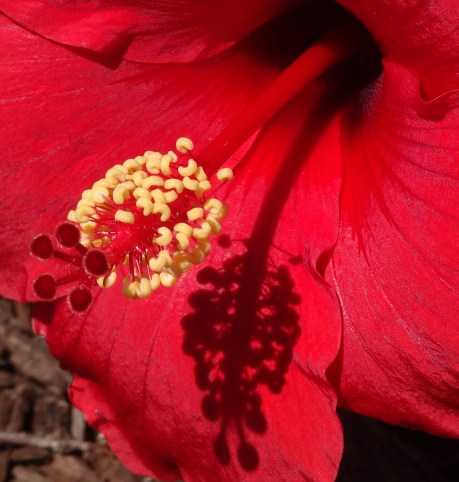
Hibiscus

DSC01751 (1)

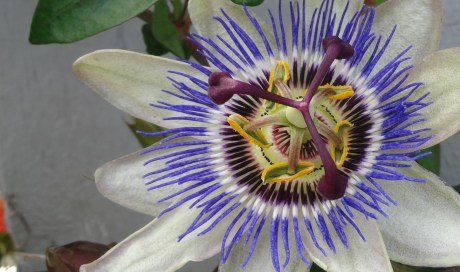
Passionflower

I took a good number of art history classes while I was a student at the University of Washington. One of the classes, Asian Art, was taught by Glen Webb, a man originally from Kansas, if memory serves. Dr. Webb was an excellent instructor. He was interesting and knowledgeable. He was also daring and adventurous. I remember his describing the amazing Buddha sculptures carved into cliffs in Afghanistan. Even in the 80’s they were already being destroyed by Afghani soldiers. He gently lamented, “I had wonderful slides of them but I dropped them down a crevasse.”

Glen Webb was also the second person I’ve encountered in my life who comported himself with balance, an incredible calm, and peacefulness. (The first was Archbishop Emeritus of Seattle, Raymond Hunthausen.) Glen Webb was also a Zen Buddhist monk. He had followers in Japan.

I could be a ball of anxiety in those days, and for many years to follow. I thought to myself, “I want that. I want what he has.”

So I listened to how he described Buddhism. One of the things he taught us was the axiom, “I am that.” If we are all part of everyone else then there is no self. In other words, “I am that.”

No self? Hmm. “I don’t want that. I am not that. I am me”

Connection threatens identity. Identity threatens connection.

An experience like breast cancer can send us back to adolescence, which is a major period of identity development. “I that this but not that. I am not what you tell me that I am.”

“I am not cancer.” “I am not pink ribbons.” “I am not a survivor.” “I am not a warrior.”

If you ask me who I am, I will tell you, “Elizabeth MacKenzie.” (And if you have a pencil in your hand, I will note that it is “M-a-c” and that the ‘K’ is uppercase.

But if I really think about it, my name says very little about who I am. My name is not my identity. My name merely identifies me.

That doesn’t mean that my name is not important because it is important to me.

I am cancer, it is a part of my life whether it ever returns or not.

I am a cancer survivor if I think of it as a process rather than an end point. I am a cancer survivor until I die, whether I die from cancer or not.

I am a psychologist until I die.

I am a mother until I die.

I am a wife until I die.

I am a friend until I die.

I am that but I am not just that.

I am so many things.

And so are you.

Today is Fathers’ Day. Giving my dad a gift is often tricky whether it is Fathers’ Day, his birthday, Christmas, Arbor Day, or Just Because I Love You Day. Unless I cook him dinner. That’s a gift he always loves as long as I don’t include mushrooms or zucchini or make anything too spicy.

But I can’t always cook for my dad for special occasions. Sometimes, I try to buy him something. When I was in college I used to describe my dad as “The man who has nothing and wants nothing.” It was an exaggeration and a joke to describe the difficulty of buying my dad anything! My brothers tell me about their gift giving challenges with Dad, as well. Sometimes we discuss our strategies for selecting a gift. I have settled on getting non-returnable items. This MOSTLY works.

You see my dad has a habit of refusing gifts because they are “too expensive”, “I only want a card”, and “I just want to spend time with my family.”  And he is being sincere that he would be happy with a card, a phone call, and/or spending time together.

However, there are gifts Dad will accept and he looks kind of happy to get them. So, gift-giving with my dad is a bit like playing a slot machine. Sometimes the payoff is big.

My dad gave a lot to us and that is one of the reasons we like to give him gifts. One of the gifts my dad gave to me was his love of taking photography. When I was a young girl, I remember that Dad decided that he needed a hobby. He chose photography. Dad purchased a good quality Nikon camera and built a darkroom in the house. I spent lots of time with him, at first watching him build counter tops and cabinets, and then later, I watched him develop film and make prints using his color enlarger. I remember how he worked to find the right balance of magenta, yellow, and cyan. I remember how used a piece of cardboard for dodging an area of an image to increase contrast.

Dad’s favorite subjects were nature. My parents love to be outdoors. My father has had many cameras and has been taking digital photographs for many years. I can’t imagine how many photos he has taken in the past 40 years, not to mention all of the old family photos he has copied and preserved.

I used to take a lot of photos. Some of them were good. Then I stopped. Then I started again with the camera on my smart phone. This gave me enough of a boost to buy a decent camera again, nothing too expensive, but a nice camera that takes nice photos.

I can never return to my dad what he gave to me in my life.

But I can give him the gift of my photography. And Dad, you can’t return this gift.

So there.

Happy Fathers’ Day. I love you, Dad.

DSC01568

“Mom, do want to see the present I got Dad for Fathers’ Day?”

Seeing that she is headed to the front door of the house, I reply, “Yes, but where is it?”

“I hid it behind the blackberry bush. I want it to be a surprise!”

“You mean the blackberry bushes a couple of blocks from here?”

“No, the blackberry bushes right over here!”

We walked a couple of blocks (I was right about the location) and there it was, a blackberry bush along a neighbor’s retaining wall that spills over onto the side walk. My daughter reached behind it and pulled out my husband’s gift, wrapped in a beach towel. I convinced her to take it home in case it rains in the next few days.

The gift was also not very well hidden. My daughter is not good at hiding, whether it be things, her emotions, or her thoughts. She is not good at being sneaky even when she tries, her emotions are easy to read, and her thoughts if perhaps not shared immediately, come out eventually.

In some ways, this is incredibly refreshing and endearing. For her life to be out in the open to others and to herself. In this way, I think she takes after me. However, I learned the hard way in life that it is important to be able to trust someone before sharing private information. I made a lot of mistakes.

I grew up thinking that not sharing was hiding. Over time, I learned to respect my own need for privacy. I learned to set better limits with people and to better determine who is trustworthy and who has not yet earned my trust. Sometimes setting a limit means something as simple as not answering a question and changing the subject. People I don’t trust with my most vulnerable thoughts and feelings are also ones who are very likely to be offended if I say, “That’s private. I don’t want to talk about it.”

People used to ask, “Why do you have just one child?” Now these folks were close friends or family. They were people I’d JUST MET. As I’ve written in the past, I made evasive jokes or changed the subject. If someone says something rude to me, I don’t respond, “You hurt my feelings” unless I want to maintain or develop a close relationship with that person.

So with all I’ve learned about privacy and trust, how did I end up writing a very self-disclosing blog? One of the main reasons I started this blog was to process a very stressful and traumatic experience in a healthy way. As a psychologist I know that we can get stuck if we don’t integrate painful experiences into the rest of our lives. This is a balancing act. It means that I can neither hide from my cancer nor hide from the rest of my life.

At this present moment, I can’t think of another way I’d rather live. And if I do, you know I’ll probably end up writing about it here.

A couple of days ago, my dear husband told me how impressed he was with my blog. Now, he has told me this before but this time he was making a positive comment on how frequently I post. He said, “I would have been able to come up with writing ideas for maybe two months. You’ve been doing this for TWO YEARS!”

Wouldn’t you know that since he said that I haven’t had a single idea for a post? Oh wait, this is a post. I guess I was wrong.

There’s no jinx, there’s just the spaces between ideas, otherwise known as accumulating life experience. No need for panic.

Breathe.

I come from an Italian-American family. I learned early on that eating is a way for people to connect. Cooking is a way to say, “You are important. I care about you. I want you to enjoy this meal and our time together.”

I also come from an artistic family. Some food is BEAUTIFUL. The way it looks, it smells, it tastes, the texture on your tongue. Beauty in edible form.

Good food brings people together. It can hold you in place while simultaneously transporting a group of people to another world. I have cooked a number of Thai menus, before this cuisine was ever present.

When I was a girl, I watched Julia Child on television. I thought her awkwardness and lack of pretension were funny. I found her cooking to be mesmerizing. I also watched Graham Kerr, The Galloping Gourmet and loved Jeff Smith’s books.

Even though I started cooking early, it took many many years to become a good home chef. I still have much to learn. But honestly, I can turn it out for guests. I can create a food experience for many that is unlike the best restaurant experience.

Is this because I am fine restaurant quality chef? No, of course not. At my best from a technical standpoint, I am an excellent home cook.

What I aspire to provide my friends and family is my communication of love in food form. I try to provide healthy and tasty food in a warm atmosphere.

Also, I like to eat.

That is why I cook.

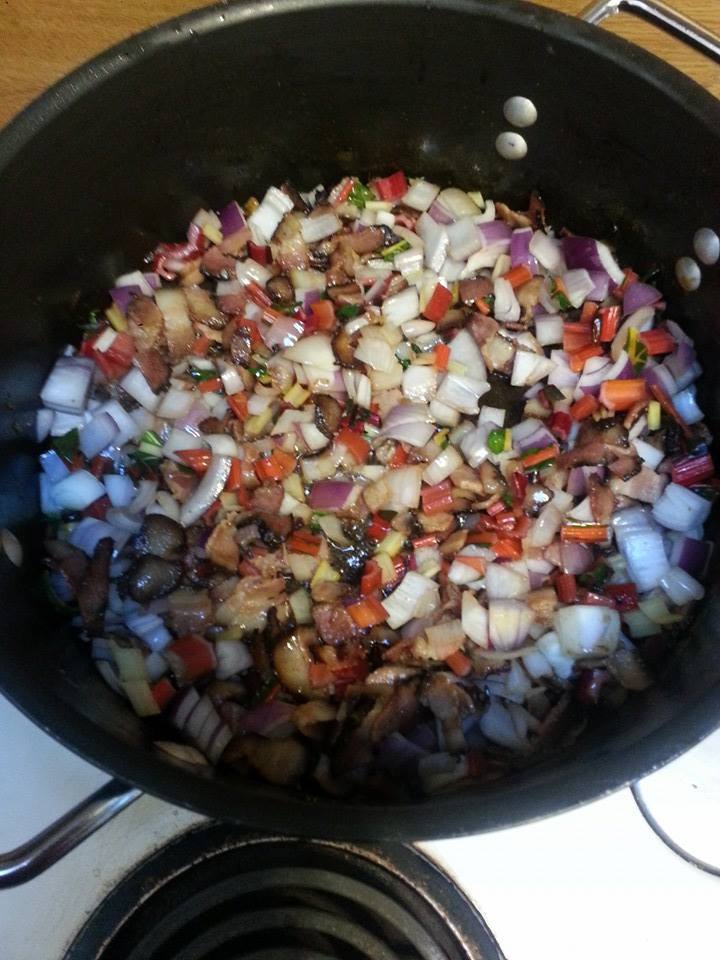
1185191_10201805153160931_1671469321_n 1268306_10201805153480939_1505079312_o 1459859_10202482551615469_1759293863_n

When I was in graduate school, we had the opportunity to attend colloquia every Monday night as part of the Carolina Consortium on Human Development, held at the Frank Porter Graham Center for Child Development, which is part of the University of North Carolina. The “grown ups” were all developmental psychologists. But child clinical psychology students such as myself, not surprisingly took many child development classes. So, from time to time, we showed up.

The exchanges were lively and fast. The debates were spirited without being disrespectful. It was intoxicating. I remember one psychologist was always asking the main presenter, “But what are the underlying causal mechanisms?” For every presentation, that was one of his questions.

Then it was his turn to present. His talk was brilliant but devoid of any talk of causal factors. So I asked him, “But what are the underlying causal mechanisms?” His response was, “I don’t care about why, there is only how.”

I thought the answer was a bit of a brilliant cheat but it really got me thinking. That exchange occurred over 20 years ago and it still has me thinking!

When I was an older child, I used to ask my mother, “What was I like when I was little?” She’d answer, “You laughed and smiled a lot. You asked A LOT of questions.”

I have long been a question asker. I am a curious person. I like to understand things. “What is it?” “How does it work?” “Why is it?”

I came from a more modest background than most of the people in my Ph.D. program. (Pennie was the exception. She was from Mill Creek, West Virginia and her father worked as a coal miner.) I had many moments of self-consciousness and insecurity as a student. But one of the tools I felt was strong and well honed was my ability to ask questions and to think about the possible answers.

In thinking about my cancer, I believe the question I have explored least of all is, “Why did I get cancer?” I learned about the what and how. But once I realized that I did not have any known genetic risk and set up healthy life habits, I dropped the question for the most part. It certainly could come back, especially the “Why me?” grief question. But for now at least, the question is on the back burner, at least from a personal standpoint. (In other words, I have not backburnered my interest in cancer research.)

In the meantime, I am focusing on how I live rather than why I live.


He was a young teen and had been a patient of mine for at least a year. He had a long history of aggression, both verbal and physical. He expressed a lot of aggressive fantasies. But he was also a very smart and sensitive boy. At times, when he spoke it sounded like beautiful poetry.

He was hurting and vulnerable, a time that could produce a lot of aggressive posturing or that could produce some real talk about the real things that were bothering him. On this day, he told me proudly about his plan to end the Iraq War. His knowledge of military strategy was impressive, I must admit.

His aggressive fantasies, however, only fed his black and white thinking as well as his use of real aggression. I was not trying to encourage this. Seeing that I was not responding he said, “Dr. MacKenzie, isn’t that a great idea?” I responded with a couple of statements like, “You’ve given this a lot of thought” and perhaps even an interpretation, “Sometimes when we feel out of control of our lives, we like to feel very very powerful.”

He was a very persistent kid, though, and he was really proud of the elaborate combination of air, land, and sea forces that would win us the war. “Come on, you’re not answering the question. What do you really think?”

I knew that this boy respected me and considered me an important person in his life. He had very little peace in his life. We’d had many many conversations in the past like this one. I wanted to try a different response but I knew it was risky. I replied, “I am a pacifist.”

I’ll never forget the look on his face of incredible disappointment. I explained to him that I thought that finding peaceful solutions to world problems should be a goal of our country, that I knew it was unrealistic to expect to avoid all war, but that I was concerned that aggression was used so readily. There were additional reasons that had nothing to do with my self-disclosure, but he stopped seeing me within a month or two.

Pacifism is not a dirty concept but as a word it is treated as such. Pacifism is not “passivism”. Peace making is an incredibly active process requiring lots of planning, reflecting, listening, understanding, persistence and just plain work. It is also not being a door mat. Pacifism is about relationships, respect, and getting along. It is about justice and equality.

I know there are some people who believe in pacifism as an absolute. I don’t. I believe that it is a relative concept and further, that it is relatively neglected.

I think most people would agree that military force should not be the first line solution to a problem. War is often an act of domination. But it is often an act of desperation, if you really think about it. But it is often treated as a ready solution. And probably part of the reason for this is that we have a military at the ready all of the time. We have a war machine. Where is our peace machine? We don’t have one that is nearly the size, scope, and organization as our military.

Today, we commemorate D-Day, when Allied forces stormed the beach at Normandy, contributing to the end of WWII. So many sacrifices were made by so many people because the world had turned completely upside down.

How better to honor those losses by working harder not to repeat them?


I grew up with many animals. We raised pigeons and rabbits. My brothers competed in shows with the pigeons and to make a long storOny short, we ate the rabbits, much to my younger brother’s and my dismay. We had MANY cats. Although I did not grow up on a farm, most of our cats were like farm cats. Some of our cats were outright feral. We had a feral cat we called, “Mama” and I remember many times working to tame her kittens. They would hide in the wood pile and my brother and I would coax them out with a yarn tied to a stick. Many times, we were successful. Nonetheless, we had many cats who would hiss and scratch if we got near them. It is very easy for cats to revert back to the wild when they live in the woods. Our kitties lived outdoors, whether they were feral or tame. We had a large metal pan out in the yard next to our barn for feeding. When it was feeding time, I would pick up the bag of “Little Friskies” walk to the front steps of the house and shake it. At the sound of the food bag, cats would come running from all directions and would form a single file line, walking out to the food pan.

Only a few of the cats were what I would really call “pets. Of the first three cats we had, George and Fred (who turned out female) were friendly. Tom, who was a large orange tabby, who lived up to his name, got into lots of fights with other cats. He was big with incredibly sharp claws. Tom was an ornery cat and we stayed clear of him. One of my favorite cats was Delilah, a black cat. She was friendly and delightfully odd. Delilah walked with her tail crooked. When she ran, her backside shifted from right to left.

The last cat I remember growing up was a tiny stray kitten I found in the barn when I was a teen. He was a black long-haired cat with smokey accents to his fur. He was so young that he did not yet know how to clean himself. So I gave him baths. He was the only one of our cats who was ever allowed into the house. I can’t remember his name but he was a really sweet cat who we had for a long time. My husband even remembers him. My main pet growing up was a dog, Britt. She was the sweetest thing. Britt let us dress her in clothes; she loved any kind of positive attention. She lived 15 years and died on my wedding day.

John and I lived in rented apartments and houses for the first several years of our marriage. We also moved around a lot, living in four different states between 1990 to 1999. Life was stressful and complicated. John has always wanted to have a dog. Dogs require a lot of attention and are pretty dependent. I love them but I did not want the responsibility. He asked about cats and I also said, “no”. I did not want to have one more living creature to pick up after. In other words, I am pretty much no fun.

Right after our daughter’s third birthday, we visited some of my in-laws in Eastern Washington. This is the part of the state that is sparsely populated, technically desert, hot in the summer, and cold in the winter. My in-laws lived in an area where many unwanted cats were dumped. This time, there was an adorable adolescent stray male cat hanging around my father-in-law and his wife’s house. This cat acted like a dog. He was a beautiful gray tabby with white feet. He had amber greenish eyes.

By the time John and I went to bed, I said, “Can we take him home?” You will perhaps not be surprised to know that even a person like me who can be no fun about the prospect of having a pet in concept, is a total softy when it comes to an adorable stray kitten who is likely to be eaten by coyotes without an indoor home.

We took him home and our daughter named him, “Ollie”. He was a wonderfully healthy cat for three years and then he had some kind of anxiety break (hey, even the vet agreed with me) and acted like he had PTSD. Ollie was aggressive to anyone who didn’t live at the house. Also, he sprayed in the house constantly despite the fact that he’d been neutered and many measures we took to help that cat relax including giving the cat Prozac! (It helped some.)

Some people took our cat’s issues personally and a supposed “cat person” actually rather angrily suggested that we get rid of him after he’d hissed and swiped at her. (For the record, I’d repeatedly told her to stay away from our cat until I could put him in the bedroom. She thought she had special powers and would actually corner him in the kitchen, when he’d jumped up on the bill paying table. People, if a cat is twitching its tail and laying its ears back, take notice. If it gets up high, it is trying to make itself larger. It is scared and threatened. Don’t corner scared animals, especially when someone is telling you right then, “You are getting too close. Please back away from the cat.”) My response to her was, “We don’t kick out family members for having mental illness.” And that’s truly how I feel about it. I may drag my feet about having an animal live with us but a big part of this is because I take the responsibility very seriously. Once you are part of our family, you are part of our family. The end.

Those of you who have been reading my blog for a long time know that Ollie died about a year ago. He had metastatic cancer. John had been begging me for years to let him be an outdoor cat but I was afraid of him being run over by a car or killed by racoons or coyotes. I finally relented when it was clear that he had very limited time left. And he so loved to lie out in the sun on the deck. As I wrote last year, literally right after John and I were discussing what date in the upcoming week to have him euthanized, I saw him across the street. I saw him crossing in front of a car in my worried mind’s eye a few seconds before it actually happened in slow motion. It was surreal the way our beloved cat died.

It took time to be ready for new pets after having lost Ollie. My husband took the longest. And then we were all ready. Our teen daughter asked us to pick out a new kitten. She was upset the last time she visited an animal shelter. I don’t blame her, really. They are difficult places. She was away on a band trip last weekend so John and I visited a cat rescue place near our house.

John had been trying to convince me to get two kittens instead of one. But since, I am no fun, I had told him, “No way.” But I had started to do some reading and it looked like getting a pair of kittens was a good idea for their own feline happiness. Also, the cat rescue place would only adopt pairs of cats, for this reason. So I said, “Let’s get two kittens.” But I also made him promise not to try to make them into outdoor cats. He agreed and said that he thought young kittens would be fine being indoor cats. Ollie was 6-9 months old and had already gotten used to being outdoors.

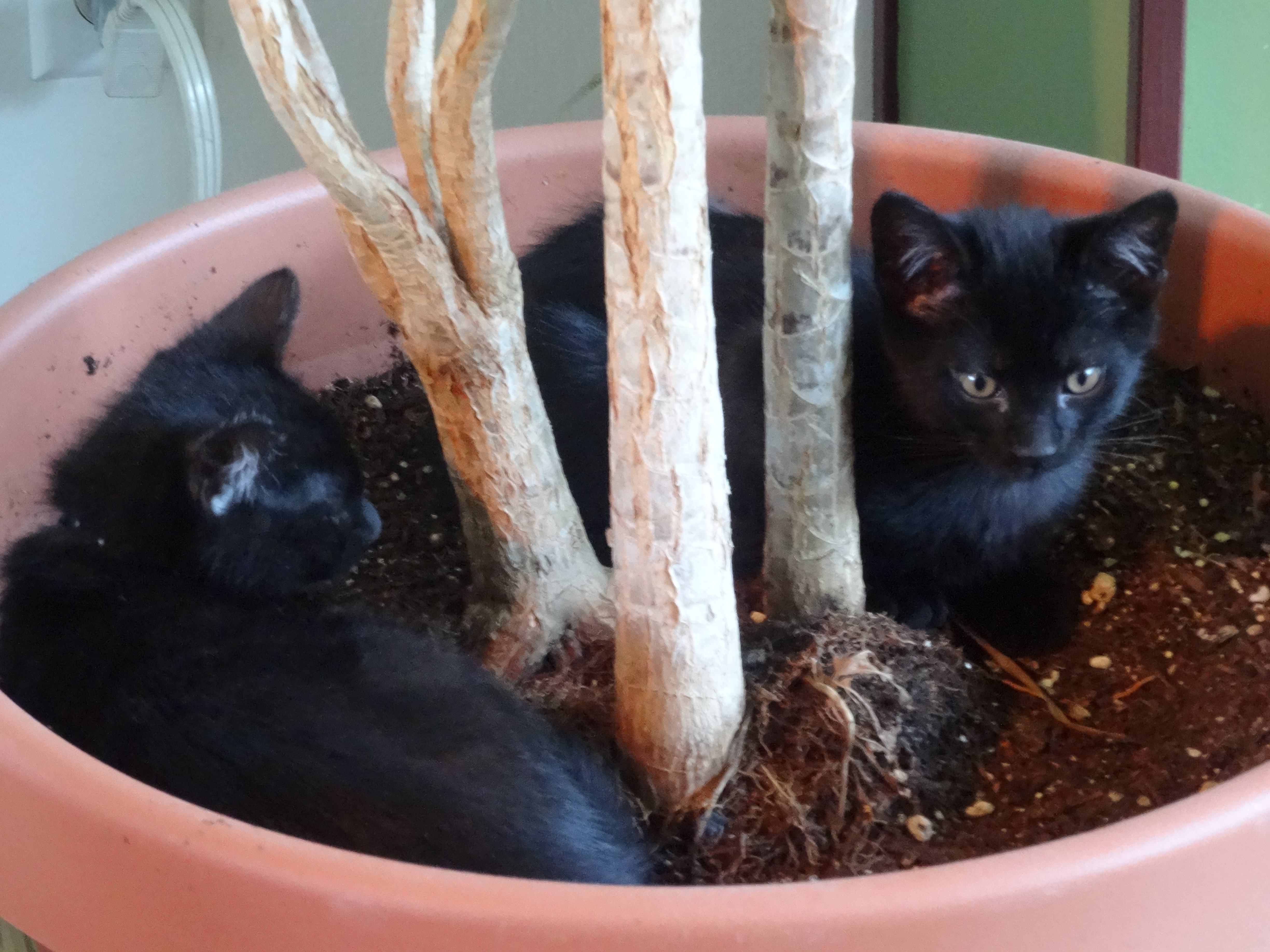
Last Saturday, we brought home two 8 week old kittens, a brother and a sister. Our daughter is thrilled. They are bringing lots of new energy into the house, to say the least. She named them Leeloo, after Milla Jovovich’s character in The Fifth Element, and Basie, after Count Basie. These are perfect names from a teen who loves science fiction and jazz.

I love this photo and when I show it to people I like to say, “Look, my houseplant had kittens!”
DSC01055

Something has changed. I’ve started needing less sleep for the past couple of weeks. Now I am sleeping 8-10 hours a night instead of 10-12. This is freeing up time in my waking hours to get things done. And another change is that I am far more productive with the time I have. And when I work a productive day, I don’t wake up the next day exhausted.

Maybe it’s the fact that our days are getting really long. I live pretty far north and we are nearing the summer solstice. It is still light out at 9:00 pm.

Maybe it’s a fluke.

Maybe I’m actually recovering and healing. I’m afraid to even write this in fear of tempting fate or that I will start relying on myself to function at a higher level than is possible for me to sustain.

Whatever it is and however it happened, I am happy about it for as long as it lasts. I have started to be able to work in my garden again. I am thinking about projects. Actually, I am thinking about one project in particular and I’ve already started it. I am working on reclaiming my house. By that, I mean organizing it and rescuing it from the cluttered mess it has become in the last two years. It wasn’t pristine before, mind you. Cleaning and organizing has long been a struggle. I can be very organized but my house can be like working against entropy. I am the neatest in the family, which makes me the neatnick. For the past 3 years, I’ve hired a house cleaner to come in two hours every two weeks to clean our kitchen, living room, and upstairs bathroom. This helps me from going totally insane. But truthfully, it stays clean for about 10 minutes. I make sure the kitchen is clean and organized because that is my creative space. I am the one who uses it the most.

The reclamation project, now that I think about it, actually started last January. My husband had to remove some kitchen cabinets in order to make room for a new stove. I got rid of a lot of kitchen stuff that we didn’t need and reorganized some of the cabinets. There’s still work to be done in there but I am now able to do a little at a time. It’s so much easier for me to do things once I get started.
For Mothers’ Day, I asked for the play area of our living room be turned back into living room. Our daughter is 15 and doesn’t need this space, any more. But a lot of her stuff was on the shelves and some of it hadn’t been sorted through in many years. And there’s no room for it in her room. Now it is cleaned up. I moved the art table out of there, moved John’s grandmother’s platform rocking chair there from my office and voila, we now have a reading nook. There’s a china cabinet we don’t like and I am going to go through that, move the contents to other locations and get rid of it. This will open up some space in our dining area.

Last Sunday, I started taking on the bathroom cabinets. We have a medium sized vanity with one sink, two small drawers, and two cabinets. People, there were still baby toys in there! And a ton of empty boxes and bags. I found three pouches of instant coffee. Why was that in the bathroom? (I have also found an open box of powdered sugar in there, in the past. I’m just trying to give you a glimpse of the scope of this project.) I sorted through everything and got rid of a tall kitchen bag worth of stuff.

If you haven’t noticed, the theme of my reclamation project is getting rid of stuff. We have waaaay too much stuff and some of it is ridiculous like empty boxes in case we have to return something. Or bags full of things cleaned out of our car that are placed in the garage and not sorted through for years. I found a bag full of unopened boxes of crackers in there once! Why were we storing five year old boxes of crackers in the garage?

I have asked John to help me take on the basement after school is out. (He is currently spending lots of time helping our daughter with her homework.) There’s a rec room, John’s office, a laundry room, and a bathroom down there. The rec room used to double as a guest room. We haven’t been able to have guests stay there for the past two years because it is too awful down there! I avoid our basement as much as I can because the level of mess down there made by other people, who shall remain nameless, overwhelms and angers me. But I have a plan.

Watch out world, I’m getting my mind back and I’m going to use it for as long as I can.


Lindbergh High School Reunion '82, '83, '84, '85

Join us this summer for our reunion in Renton, WA!

George Lakoff

George Lakoff has retired as Distinguished Professor of Cognitive Science and Linguistics at the University of California at Berkeley. His newest book "The Neural Mind" is now available.

KomenWatch

Keeping our eyes and ears open.....

4 Times and Counting

Confessions Of A 4 Time Breast Cancer Survivor

Nancy's Point

A blog about breast cancer, loss, and survivorship

After 20 Years

Exploring progress in cancer research from the patient perspective

My Eyes Are Up Here

My life is not just about my chest, despite rumblings to the contrary.

Dglassme's Blog

Wouldn't Wish This On My Worst Enemy

SeasonedSistah

Today is Better Than Yesterday

The Pink Underbelly

A day in the life of a sassy Texas girl dealing with breast cancer and its messy aftermath

The Asymmetry of Matter

Qui vivra verra.

Fab 4th and 5th Grade

Teaching readers, writers, and thinkers

Journeying Beyond Breast Cancer

making sense of the breast cancer experience together

Entering a World of Pink

a male breast cancer blog

Luminous Blue

a mother's and daughter's journey with transformation, cancer, death and love

Fierce is the New Pink

Run to the Bear!

The Sarcastic Boob

Determined to Manage Breast Cancer with the Same Level of Sarcasm with which I Manage Everything Else

FEC-THis

Life after a tango with death & its best friend cancer