I met with a delightful teen boy recently for a reassessment of his ADHD.He was in nearly perpetual motion, fidgeting, tapping his fingers on the arm rest, tapping his toes, and switching from one seat to another every 5-10 minutes or so. Although friendly and polite otherwise, he also interrupted frequently and I could tell that if I laughed too much at his jokes, I might lose him in a fit of giggles, non sequiturs, and additional jokes. It was hard because he was really funny!  Although delightful, the behaviors I described are signs of hyperactivity and impulsivity. He also had a long history of difficulties with inattention.

His symptoms were first noted when he was in kindergarten and he was subsequently diagnosed with ADHD in grade 3. There are three subtypes of ADHD: Combined presentation (significant inattention and hyperactivity/impulsivity), predominantly inattentive presentation (significant inattention but not significant hyperactivity/impulsivity) and predominantly hyperactive/impulsive presentation (the reverse pattern of predominantly inattentive).

There was no report available of his ADHD diagnosis. I saw him practically rolling around my office so I said with a slight wink in my voice, “I see that you were probably diagnosed with combined type ADHD?” His mother, a physician, replied with some surprise but non-defensively, “No, purely inattentive type.”

I said, “I see that your 11 year-old son also has ADHD. What is he like?” Not surprising to me, younger brother is a major fireball. And as the frame of reference, older brother is comparatively sedate. Also, older brother does not have a history of behavior problems. In many people’s mind, ADHD is synonymous with behavior problems like arguing, fighting, and having anger control problems. The truth is that a large proportion of children with ADHD do have behavior problems but what’s little known is that behavior problems are not part of the diagnostic criteria for ADHD.

ADHD is really complicated. It’s presentation varies widely from person to person as well as across development. People with ADHD display a different pattern of neuroanatomy as well as neorophysiology. When I am explaining ADHD to a science-minded teen, this is the time when I geek out and start drawing diagrams of presynaptic and postsynaptic neurons as well as relative differences in dopamine re-uptake in people with ADHD verses those without ADHD. I will spare you this part of the presentation. If ADHD, based on our current understanding, could be boiled down to one problem, it would be difficulty attending and persisting on tasks that are not interesting and/or fun.

ADHD also does not define a person. They have other strengths, weaknesses, skills, aptitudes, and personality attributes. Treatment response also varies from person to person. So, people with ADHD are not one person. They are all individuals. So why do I often hear people argue that someone definitely has or doesn’t have ADHD based on a limited frame of reference. And I’m not just talking about people with a vested interest in the diagnosis. I include casual observers, some extremely sophisticated, but who treat diagnosis and treatment like common knowledge. These folks also love to give advice and unsolicited opinions to the parents of my patients, to my patients, or to me if we’ve just met and I’ve answered the question about what I do for a living.

Does this sound familiar to any of you out there? It’s kind of like how everyone is becoming an expert on breast cancer. How they might tell you what kind of treatment you should get because they know someone who had breast cancer and it is assumed that all breast cancer treatment is equal. There may also be people who assume that they can predict another person’s breast cancer prognosis. There are assumptions about how people with cancer should look, act, or feel.

I know there are a lot of breast cancer patients who feel blamed for their disease. It’s not that I have not felt empathy for people with that view, it’s just that it didn’t resound for me because of my frame of reference. In my professional life, I work with children who are often blamed for their disease, even children who are in preschool. As a cancer patient, I had a much different experience. No one told me, “You need to stop having cancer right this minute!”

So the sense of being blamed did not fit into my immediate frame of reference after being diagnosed with breast cancer. But I am learning from all of you, from our shared and unique experiences. I am very thankful to be part of a community that “get’s it”. A community where it is okay for me to reveal faults and fears without being seen as wrong in some way. I appreciate your adopting a very wide frame of reference, one that accommodates personal choice, individuality, and the fact that breast cancers impact us but do not define us.

As I continue to heal from the stress, the meds, the surgeries, and all the rest, I am taking on more and more of my responsibilities. My life is getting to be less about me and more about work, marriage, and parenting. Not to worry, friends I am still working hard to take care of myself because I know that moms in particular can be kind of bad at that.

The public part of my blog, however, is going to be more about me. Last weekend, a member of my family was verbally attacked in the comments section of an old post, a post that I HAD WRITTEN. My writing has never been about hurting anybody, least of which about exposing my family to abuse.

Consequently, some of my posts will be password protected. I have contacted a number of you privately, through other social media or email with password information. But I don’t know how to contact all of you who have been regular and respectful readers, leaving thoughtful comments over the years. I hope you will understand.

I was in line at my bank last weekend, waiting to make a deposit. There was a customer talking to one of the tellers:

Teller (politely): I’m sorry ma’am, we now require picture ID to make cash deposits. May I see your driver’s license.

Customer (annoyed): I never had to do that before. I don’t want to do this every time. Can’t you just use visual recognition?

T: I’m sorry, ma’am but I don’t know you.

C: But you gave me two piggy banks last week!

T: I’m so sorry. I’m new and I have not learned everyone’s face yet.

C: How long have you worked here?

T: I started at this branch in December, ma’am.

C: By my recollection, you’ve worked here five months! Did you work here intermittently?

T: Yes, ma’am.

The customer left having taken 10 seconds to produce photo ID and far longer in first arguing with the teller and then using up time to prove her wrong that she was “new” to the branch.

As a cancer patient, I am asked to produce my insurance card all of the time, so frequently that I keep it in a very accessible pocket on the outside of my purse, right behind my driver’s license. I was tempted to show this lady my purse and say, “Look, instead of digging your ID out of the main compartment of your overnight bag-sized purse, you could have this handy dandy purse that makes it so easy to prove your identity!”

I said nothing. It would not have done any good. I suspect that having the inconvenience of digging her ID out of her bag every time she made a cash deposit was not the issue. She wanted to be recognized. She wanted to be seen, to be important, and to matter. We all want to be recognized from time to time.

Having cancer can be a challenge to one’s identity. It can impact us in different ways from person to person and change over time. Treatment can be so physically, emotionally, and spiritually altering that it can be hard to recognize oneself.

A lot of us dislike the pink ribbon culture because we don’t recognize ourselves in it. That is the biggest disconnect for me because the corporate presence has made it about making money, not about breast cancer.

Other associations are murkier. For example, many people do not like the war metaphor in fighting cancer. For others, it rings very true. I don’t have strong feelings about it as long as the metaphor is used as a coping strategy that makes sense to the person at the time and is not used as an explanation for why some people die from cancer and some don’t. Coping strategies should not be used to blame people for dying. Coping strategies are ways to make the best of a bad situation.

A lot of people do not see themselves represented in the breast cancer research, especially as reported by the media. A lot of people feel like research findings are blaming people for having gotten cancer. I have a hard time with that. I don’t feel blamed by research but then again, I was a researcher for many years. My particular case of breast cancer fits some research on risk factors. For example, I have a history of obesity and did not breast feed until after I was age 30. I understand the evidence against women under 50 getting mammograms and even agree with it. However, I was 46 and invasive cancer was uncovered by a routine mammogram. I did monthly self exams and annual clinical exams with my physician. Even after I knew I had cancer and the location of the tumor, I could not feel it. I know that there’s a concern about over treatment of breast cancer but as it turned out, I had four invasive tumors. Given that the growth of cancer is progressive, I would have preferred to learn about my cancer earlier rather than later.

I suspect that just as we do during different identity transformations in our lives, as breast cancer patients, we try on different concepts and struggle against outside definition from others until we feel weave a new spider web that makes sense, one in which we are connected with others but recognizable as the unique individuals we are.


His eyes were wide and near tears. He is a pre-teen boy who I first saw when he was a 3 year-old. He said, “I can’t talk about it. If I talk about it I will have to run out the door.”

The kids, I see, however, are not typically good at keeping their thoughts to themselves. I waited for less than a second and he talked about it. He talked about it a lot. His mother was diagnosed with cancer last fall. He hates that his mother’s chemotherapy makes her so sick. He blamed her oncologist. I told him that a lot of people feel that way but explained how the drugs work and their side effects.

At one point he said, “The side effects of cancer treatment have affected my behavior and my attitude.” He also noted that his mother is less patient when she is sick from chemotherapy and observed, “I’m a person who needs people to be very patient with me.”

This wonderful boy has wonderful parents. He has a unique set of challenges and strengths. He works hard to help himself and his parents work hard to support him. Cancer does not give anyone a pass. And it doesn’t give our children, even the most vulnerable among us, a pass.

The more time I spend with cancer in my life, the more I re-encounter my friend, Nancy’s statement, “Cancer has tentacles. It affects many people.”

In some ways I am very sensitive, squeamish even. I hate scary movies so much that I just won’t see them. When I was young, it felt like I was the only one who refused to see these movies or to go on amusement park rides. I don’t like visual gore. I don’t like to watch violence.

Perhaps surprisingly, this squeamishness does not translate to physical health issues. I used to find watching surgeries on television fascinating as long as there weren’t “sound effects”. As I recall, I often turned the sound off. I used to work in a medical lab at a hospital where they did dissection. It was not my favorite thing to view, but I handled it okay and I liked the job.

I know that some people have a hard time handling their surgical drains, looking at their surgical incisions, or the aftereffects of a mastectomy. I am not one of those people. My natural curiosity about the human body as well as how surgeons work to help fight disease and sculpt the body distracted me from any revulsion I might otherwise feel.

A week ago I had a set of surgical procedures as part of my breast reconstruction. Part of it was the liposuction of small amounts of fat from my hips and thighs, which were injected into my natural breast to improve symmetry. It was something I had planned to do after my TRAM but had held off for a year because I needed a break from surgery.

As I’ve previously written, I was actually kind of looking forward to this surgery in an odd way, because it would take me off of the treadmill that was tiring me. The treadmill of responsibility to others and of expectation.

Who was I kidding? That surgery was no break. One of my friends told me recently that she was having a major surgery. Being the multiple surgery veteran that I am I said, “Surgery was not that bad until I’d done a lot of the healing and I realized how much it sucks. But by then, I felt a lot better.”

When I’ve had surgery, I’ve taken it day by day. I’ve discovered that I have a somewhat high pain tolerance.The worst pain I’ve ever had was as a teen and a young adult. It was menstrual pain and it could knock my onto the bathroom floor into the fetal position. That is probably the reason why when in labor, I asked for an epidural early and often. As it turned out, even childbirth did not replicate those years of pain that I had. I was wrong about my pain tolerance. The truth was that I had crazy painful and bad periods.

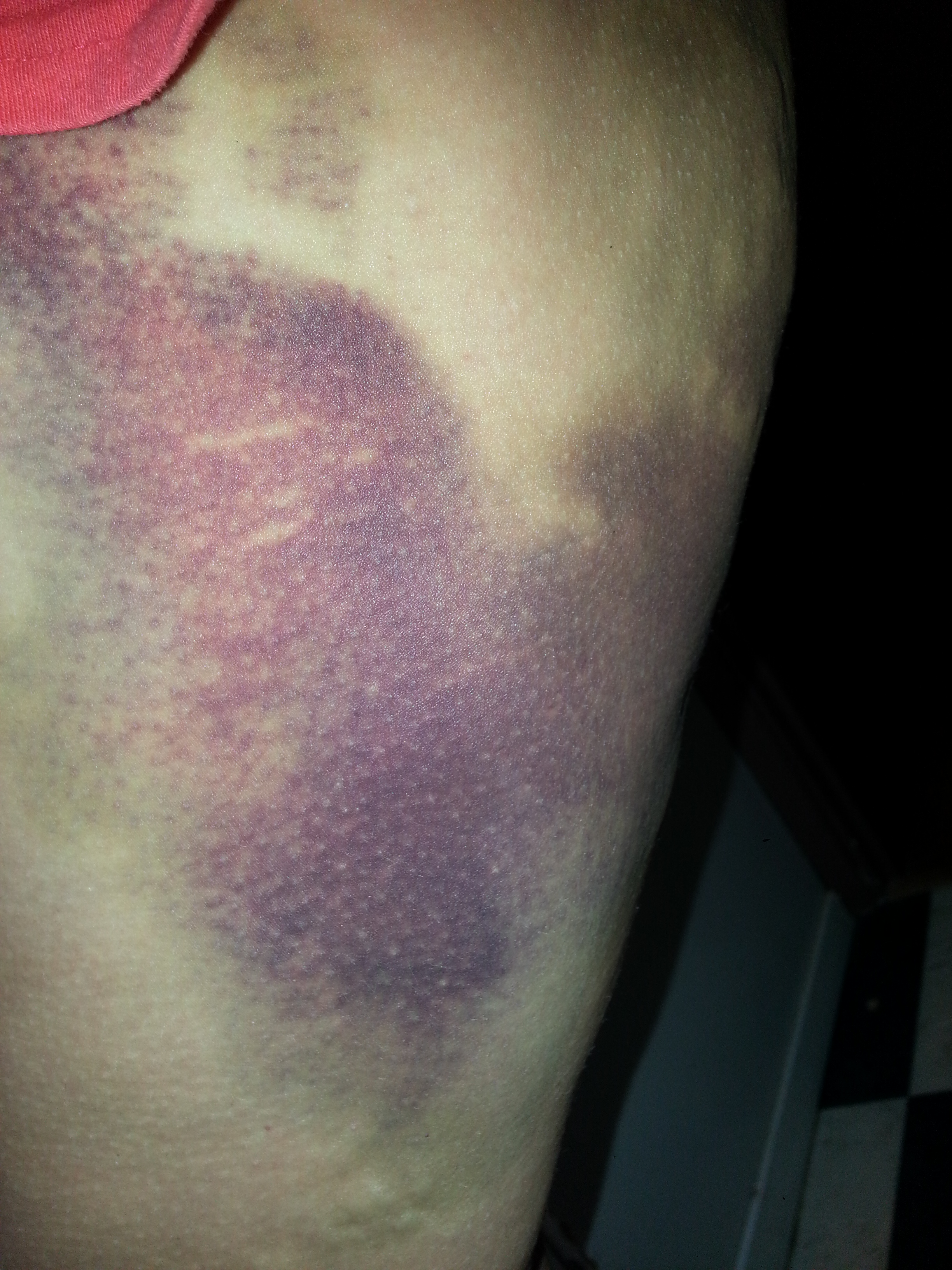
So here I am after my last surgeries, with a high pain tolerance and being low on the squeamish factor, at least when it comes to real life blood and gore. I was told that the liposuction would create bruising. There wasn’t much right afterwards but then they bloomed like creepy black lagoons on my body. They were tender but didn’t hurt as much as a bruise caused by an injury. But they were big, they grew for a couple of days, and they were just ugly and nasty.

Think I’m exaggerating? Here’s the biggest one, located on my inner right thigh. It has actually healed considerably in the last few days.

20140326_093521

Looking at these bruises has been like being knocked upside my head. This one is like an emblem of cancer. It’s big and ugly and crept up on me. Looking at it, I know that I am done with reconstruction. So unless there is a complication that needs to be addressed or new disease, I am done.

The fact that not long ago I was in part, looking forward to these surgeries gives me great pause. I am typically very self aware and deliberate in my decisions as long as I am reasonably calm. Surgery sucks. It really does. At this point, it is not worth it to me to do more but because I had kind of forgotten this recently, I have begun asking friends to remind me of how bad surgery is in the event that I start toying with the idea of more reconstruction. I can already see that I would need at least another couple of surgeries to be fairly symmetrical. I look fine in clothes but my breasts are not only of different sizes but they are also of different shape. It is less so since the surgery last week but they still look mismatched. Today, I think that is just fine and I want to keep being satisfied with this and not do any more to my body.

I am not sorry I had these surgeries. I’m just a little shaken up because I’d forgotten what a disruption that they are to my energy, my concentration, and my ability to take care of myself, even if only feeling out of it for a few days. I have people in my life who I want to be present for. I have things I want to do and feel and say.

I have my post-surgery appointment tomorrow. I think I am healing well. I don’t expect any surprises. I am at peace with where I am going to be when these bruises heal.

I am bruised but not broken.

I am humble but not humiliated.

I am strong but not invincible.

A plastic surgery waiting room can be a very interesting place. I remember how uncomfortable I was the first time I visited Dr. Welk’s office in July of 2012. I didn’t want people to think that I was one of “those” women who are chronically unhappy with their bodies and will go to great lengths to achieve the impossible goal of physical perfection. Further, the plastic surgery office is unsurprisingly swanky. It’s not like the cancer center isn’t nice but in the plastic surgery office, patients dress better and so do the people who work there. For my first several visits, it was as if I could hear an imaginary cash register, “cha ching!” over and over. There were so many patients in the waiting room. Later, I would learn that this is only true toward the end of the year when people are trying to get the surgeries that are covered by insurance finished before the start of the new year when they have a new annual deductible. In other words, they are trying to save money.

I didn’t know until recently that my husband hated going to my plastic surgery visits with me. John didn’t want anyone to think he was one of “those” men, the men who want their wives to look better and are willing to pay money to get a prettier wife. He was ashamed on behalf of men who believe their wives to be defective after mastectomy. At the time I was making a decision about whether I would have reconstruction or not, John was pretty clear that he wanted whatever I wanted. He was absolutely sincere.

I haven’t felt uncomfortable in Dr. Welk’s office for quite some time. A big part of that is I made peace with the fact that I opted for reconstruction and as part of that, I made big strides forward in making peace with the imperfections of my own body, including my imperfect mind that wanted to have my lost breast replaced.

A couple of weeks ago, I saw a woman in the waiting room. I immediately noticed the unnaturally tight skin on her face. She was greeted by a woman in a white lab coat whom I’d not previously seen. I thought to myself, “That must be the Botox lady.” (I think a more accurate and respectful title is “medical esthetician”.) The patient smiled at her across the room and said, “You’re my secret weapon!”

I immediately felt sad for her and if I am being completely honest, a tad superior. I know I had a tip off being that we were in a plastic surgery office but really, the unnatural look of her face was no secret. If she had a secret weapon, Botox is not it.

I think a lot of us kid ourselves about things we don’t feel good about. When I’ve been overweight, I’ve used long duster length cardigan sweaters to cover up lumps, bumps, and wide hips. But really, adding clothing doesn’t hide size. I may have been hiding a fat roll or two but I wasn’t hiding the fact that I was overweight any more than that woman was successfully hiding the fact that she wasn’t 25 any more.

I have some vanity. I dye my hair because I don’t want to be gray. I wear make up, stylish clothes, and moderately impractical shoes 3-4 times per week. I like it when people assume that I am younger than my actual age. When I find myself, as I was, judging people in a plastic surgery office, I find myself in a dilemma. There are lots of people who would question my values, how I live my life, and how I spend my money. With reconstruction, I find myself asking, “At what point does my seeking breast symmetry become elective surgery?” And I mean “elective” in the figurative sense. Insurance would cover subsequent surgeries if I were to decide that my breasts were not “matchy matchy” enough in my own view. Intuitively, I believe that I am done with this unless I have a complication that needs to be addressed. But I have been swimming in gray waters. Reconstruction is done when I say it is done and there is no hard boundary. I imagine that there are people who opt for surgery after surgery after surgery in the quest for putting things back to right.

Almost all of us engage in excess. When is the excess balanced out by sacrifice and altruism? When is a little vanity balanced out by respect for oneself or others? When is wanting to feel pretty self expression and when is it self-oppression? There are no formulas for identifying the precise tipping points for these questions. We have the extreme examples on each side. The rest of us live our lives in the gray areas.

Today I had a liberating thought. I just have to make my own decisions as a person, a mother, a wife, a friend, a psychologist, a writer, a consumer, and a voter. Worrying about a woman getting Botox is not going to help her. She may be using her “secret weapon” in an unhealthy way. I will likely never know for sure. But I don’t have to because I can focus my efforts where they count.

Minding my own business is the secret weapon that I am working on, to protect myself from the negative self judgment that ripples out toward other people.

Today’s blog is informational. In other words, no photos of the woods! I figure that some of you out there might be interested in knowing some details about the surgeries I had yesterday in case you consider them for yourselves. If one chooses breast reconstruction, there are a surprising number of subsequent choices to make.

As you know I had a TRAM a year ago to reconstruct my right breast following a mastectomy and tissue expander placement. Often but not always, women have additional procedures done following the TRAM (or implant placement) to increase symmetry between the reconstructed and natural breast.

Yesterday, Dr. Welk made a revision to the fold underneath my reconstructed breast. That was actually the biggest surgery in my view, because it required the largest incision and it is the most painful of the incisions. He also used liposuction to get fat to inject into two places on the upper half of my natural breast. (Well actually, fat is not injected into the breast tissue, it’s injected into the subcutaneous fat to reduce the likelihood that the injection will make cancer scans harder to read.)  He also injected fat above the TRAM to fill the space left by my mastectomy as Dr. Beatty removed a lot of tissue all of the way up to my right clavicle, due to the location of the cancer. Consequently, I had a little hollow spot there, certainly something I could live with but when he offered to fill it in, I agreed.

Dr. Welk took the fat from two places on my abdomen (on the TRAM scar so no new scars there) and two places on my thighs. The incisions were symmetrical, one from each side of my abdomen and one from each thigh. I counted all of my bandages when I came home yesterday and there were 10 incisions. Woo hoo! A new record! Nine of them are tiny. The one under my right breast is not, which is why my right side was super achy yesterday and pretty achy today. I have been taking over the counter pain reliever since I got home yesterday afternoon and not very diligently. It’s not painful unless I stand up and I figure that pain is a good deterrent for me against exerting myself too hard. Hubby will tell you that I am not a good patient in this regard. I don’t ENTIRELY agree but I get his point.

Ah yes, there are also the needle sticks to my left arm, all three of them. I have what they call in the IV placing biz, “small, deep, and rolly veins”. The successful poke was to a vein on the back of my hand. I had an IV placed there when I was in labor with my daughter. It hurts more, I think. Good thing I was soon asleep. I am pretty bruised up in both the fat harvesting sites and in the injection sites. The bruises don’t hurt a lot. They are just purple, which is not my favorite skin color. Finally, I had difficulty getting up from the couch yesterday. I had my husband help me up the first time and then I was able to get myself out from then on, just not very quickly. This morning, I was able to get out of bed pretty easily, which is harder than getting up from the couch.

Even though I am pretty swollen, I can tell that I am also more symmetrical. Fat can be transferred in only small amounts at a time, so one has the option of subsequent procedures to shape an area. For those of you taking score at home, here’s a list of my surgeries:

1) Lumpectomy2) Lumpectomy (re-excision)
3) Right side nipple sparing mastectomy
4) & 5) Delay procedure (to my surprise, this hurt like Hell, by the way) and tissue expander placement.
6) Skin graft to repair necrotic tissue.
7) Pedicled TRAM reconstruction.
8) and 9) TRAM revision and a medley of fat transfers.

Yeah, that’s a lot of surgeries. One of my patient’s moms, who has a wild sense of humor said, “Dr. MacKenzie, don’t go all [Heidi] Montag on us. We don’t want you to get addicted to plastic surgery.”
I got a good laugh from that one. Not everyone would have and that’s just a reminder that there’s no one way to be a breast cancer patient. Your coping style may be different than mine and your treatment decisions may be different, too. Even with all of my bruises today, I am happy with my choices. Also, my husband is waiting on me during my convalescence, which is pretty darned sweet. Though I think if I asked him to feed me grape one by one, he might balk a little. 😉

I am home resting. Still high and a bit sore. Thanks for the prayers and well wishes. 

Here is my pre-surgery shot.

image

Going to sleep now.

Tomorrow I am having my last planned surgery. It’s what I hope is the last step in my breast reconstruction. In my mind, and I’m not trying to be funny, I think of it as getting “realigned”.

This type of physical realignment seems pretty straight forward really, compare to mental and emotional realignments that I’ve done throughout my experience with breast cancer. I’ve made adjustments to my expectations, my hopes, and my view of life in general. I have made adjustments in my relationships as well as the places and people to which I look for support. I have adjusted my tolerance for unnecessary drama in my life. My world has gotten both larger and smaller.

I’m hoping that this set of procedures to be no big whoop compared to what has transpired in the past. And I certainly hope it is my last surgery for a good long while.

I’ll let you know how it goes.

Love,

Elizabeth


“May you live in interesting times” is said to be a Chinese curse. However, the origins of this saying are according to my Googling, debatable. But let’s go with the message, shall we, despite it’s possible impure origin.

I’m no shrinking violet but I am not a big risk taker or as we say in the biz, a “sensation seeker”.  I like an interesting life but for the most part, I live within the box. I use vibrant colors but I draw within the lines.

By nature, I do not get bored easily. I mean I get bored sometimes, but typically I don’t get bored a lot. Until stupid cancer. The stress, the upside-down sleep habits, the weeks away from work for surgery recovery, and the drug side effects. I can’t believe the fatigue and I didn’t even have chemo.

I had horrible boredom for months. Painful boredom. The kind of boredom that my patients with ADHD grapple with. And if you were to know only one thing about ADHD, know that to a person with it, boredom is extremely painful. That’s where I found myself. BORED. OUT. OF. MY. GOURD.

Yes, having a health crisis bored me out of my gourd. Well, some parts were actually exciting and truthfully, I found them to be times of creativity as well.

But I’ll let you in on a secret. ADHD is not about not being able to pay attention. It’s about not being able to pay attention or to persist on tasks that aren’t interesting. The flip side to this is that interesting tasks can be extremely rewarding. And that’s how I found myself for many months. It was not that I couldn’t pay attention or persist at all, it was that I could not regulate my attention or persistence as I once could. That’s why I’ve written frequently about feeling as though I had functional ADHD during a good part of my cancer treatment.

I am happy to report that my sleep has improved, I continue to heal from the acute stress of cancer as well as the nonstop surgical train. I still need a lot more sleep than I used to need. But when I am alert, I am very alert, very energetic, and my concentration is excellent. I am happy to be able to be more productive in my work. I have taken on my work and my life is, by and large, a lot more interesting.

But there are costs to my workload. I am getting cranky with my family. I find it more challenging to find times to do my daily walks. I am currently walking 5-6 times a week instead of 7 times a week. Five times a week is still really good. Of greater concern, I find that it is harder for me to eat a good diet when I am stressed. I gained weight over the holidays and have not been able to get it off. I am still in the healthy range of weight for my height but just barely. I know this is the way that my weight can creep up on me. You may think this is overreaction on my part but I have lost and gained weight so many times in my life that I know I have to really really be mindful of my dietary and exercise habits.

I am very happy to not feel bored and numb during a good part of my day, as I once did. I am happy to live in interesting times. But interesting times, like boring times, bring their own set of challenges.

Lindbergh High School Reunion '82, '83, '84, '85

Join us this summer for our reunion in Renton, WA!

George Lakoff

George Lakoff has retired as Distinguished Professor of Cognitive Science and Linguistics at the University of California at Berkeley. His newest book "The Neural Mind" is now available.

KomenWatch

Keeping our eyes and ears open.....

4 Times and Counting

Confessions Of A 4 Time Breast Cancer Survivor

Nancy's Point

A blog about breast cancer, loss, and survivorship

After 20 Years

Exploring progress in cancer research from the patient perspective

My Eyes Are Up Here

My life is not just about my chest, despite rumblings to the contrary.

Dglassme's Blog

Wouldn't Wish This On My Worst Enemy

SeasonedSistah

Today is Better Than Yesterday

The Pink Underbelly

A day in the life of a sassy Texas girl dealing with breast cancer and its messy aftermath

The Asymmetry of Matter

Qui vivra verra.

Fab 4th and 5th Grade

Teaching readers, writers, and thinkers

Journeying Beyond Breast Cancer

making sense of the breast cancer experience together

Entering a World of Pink

a male breast cancer blog

Luminous Blue

a mother's and daughter's journey with transformation, cancer, death and love

Fierce is the New Pink

Run to the Bear!

The Sarcastic Boob

Determined to Manage Breast Cancer with the Same Level of Sarcasm with which I Manage Everything Else

FEC-THis

Life after a tango with death & its best friend cancer