Archives for posts with tag: mindfulness

One of my sister-in-law’s hosts Easter each year. She is a competent cook. She is also able to have people in her kitchen while she cooks. I could say that one reason for this is that she has a large kitchen with places for people to sit at a table, out of the way. I could also note that most of the things she makes are not hot and can be made ahead of time and taken out of the refrigerator. I could also point to the fact that she does not make something that requires the making of gravy. But the fact of the matter is that she is able to concentrate on entertaining people and making food all at the same time.

I am not like this. I can talk to people up until about the last 30 min before Thanksgiving dinner is done. Thanksgiving is the holiday that I host. I have done it for all years except one for the past 10 years. Before the last 30 minutes, I feel relaxed and confident. My apron is typically still clean. I am able to avoid burning myself on the oven’s heating element.

And then half of the food is ready and the other half of the food needs to be finished. The turkey is cooked and needs to be lifted out of the pan to rest on a carving plate. Meanwhile, I place the roasting pan on two burners, pour in alcohol to deglaze it, scraping the fond from the bottom of the pan. I add flour (now a gluten-free blend) and turkey fat and stir constantly. It always gums up immediately and the first worry is that the gravy will turn out clumpy. And it will if I don’t keep my head in the game. I add poultry stock, bit by bit, until I start to see a beautiful brown glistening sauce develop. Then I keep adding stock while I am plating vegetables, side dishes, and heating things up at the last minute. I have to work quickly so that the turkey does not rest too long and become cold. When the time comes, I call my husband to the kitchen to carve the turkey while I finish the last 500 details.

If you are a guest and you ask me what you can do to help, I will ask you to please sit down and enjoy yourself. If you ask me during the last 30 minutes, I insist that you sit down and enjoy yourself. My husband and my mom have both gotten into the habit of running interference for me and helping shoo people out of the kitchen. Even if I am not in the last push of frenzy, my kitchen is small and not a good place for people to hang out to visit with one another. My mother knows this because people congregate in her kitchen when she is cooking, standing in front of the stove or the sink, not realizing that they are setting off her rhythm. My husband shoos people out because he has empathy for me and knows how my brain works.

I love to cook but I am a person who cooks in deep thought. I have a hard time socializing and cooking at the same time. Both socializing and cooking are high interest for me and I have a hard time focusing on anything else when I am deeply engaged in one of these activities. So doing both of them is really really hard. As for those that want to come in to help, unless they know exactly what to do and how to do it, delegating is a chore for me. A chef is a boss of a kitchen and has training to do this. I don’t. I am a home cook with a small kitchen. I have a schedule and a list in my head. I am working at full capacity and the wheels are already in motion. This is also why, if you come to my house with a dish that needs tending to or oven space, I will use my powers of reasoning to tell myself that you have probably not considered that all of the burners and all of the oven space have already been accounted for. I will smile tightly and problem-solve. I may think of the time that friends had a potluck and a mutual friend showed up with a grocery bag full of unwashed vegetables and raw tofu and exclaimed, “Look, I brought stir fry!” That story always makes me smile.

I live my life at a certain pace. I try to live a lifestyle that is not only manageable, but healthy. Sometimes I even think I know what I am doing. I feel relaxed and can coordinate the different spheres of my life. And then there are the times when everything happens at once. I need to be in multiple places to do multiple things, all at once. And the consequences for failure are far worse than lumpy gravy.

I am working my best to be the kind of parent my child needs. So is my husband and so is my child. It seems that we get to the frenzy frequently and often without notice. This is the way our lives have been for the past 4 years. Cancer happened in those years, too. The normal real life bumps and reorganizations have occurred, as well. Last week, I learned that my colleagues and I need to find new professional office space. We’ve been in the same place for 10 years. I don’t like moving. It’s a lot of work. We are working to find the least disruptive and expensive solution to the problem.

During these times when I am racing in my life, I find it harder to talk about the details of my life. Not so much because it is emotionally hard but because my brain is working at capacity. I am finding myself in that mode lately. It is easier for me to organize my thoughts in writing than in conversation but even writing has been hard to organize in the past couple of weeks.

I recently wrote that I was looking forward to this week because I would be able to concentrate on cooking an spending time with my family. And I have done just that. Although I awoke this morning fairly pooped out from entertaining, I think it says something that I am finding writing to be easy again.

Simply live.

I am trying.

As I parked my car at my cancer center last Friday, I thought to myself, ‘This is my last “double-stick Friday”!’ Friday is not a day I see patients so it is the day I typically choose to be a patient. The first stick is a blood draw, which marks the beginning of every medical oncology appointment. Two vials of blood are drawn. Most of the phlebotomists are amazingly adept, which is very important when working with cancer patients, who have veins that are no stranger to the needle. My blood is always drawn on my left arm because I had lymph node removal on my right side. Prior to cancer, I’d had one I.V. placement when giving birth to my daughter 16 years ago and blood draws on a very infrequent basis for some of my annual physicals. Since cancer, my left arm and left hand have been poked and prodded many times a year for blood draws and surgeries. I didn’t even have I.V. chemo and I can tell the difference.

My name was called by an unfamiliar phlebotomist. But they have all been good so I didn’t worry. Then I noticed that it was taking her a very long time to find a vein. I have what they call “difficult” veins. This is why I often get the I.V. line placed in the back of my hand, which by the way, which is kind of ouchie. I could also tell that she was getting nervous. I close my eyes during blood draws because it helps me relax and also because I like to give people privacy to do their job without my staring at their work. I kept feeling the tap tap tapping of her index finger on the inside of my arm and some whispered nervousness. She stuck the needle and then the draw was taking a really long time. Usually, the phlebotomist lets me relax my fist once the needle has been placed. But she didn’t. She kept apologizing and then finally gave up. It wasn’t an adequate blood draw. Then she peered at my arm again, anxiously fretting as she did so. I kept saying, “Don’t worry about it. It’s okay.” She found a vein on the outside of my forearm. This was a new sticking spot.

Again, more time passed than usual. I didn’t mind the extra needle sticking as much as her distress and repeated apologies. Finally, the vials were filled. She fretted over the bruise she knew would be left and in attempt to prevent it, wrapped my arm tightly with medical tape.

I walked upstairs for my oncology appointment with two bandages on my left arm. It would be “triple-stick Friday”. The last stick would be a Lupron shot into my left hip. I have been getting Lupron shots every three months for over two years. Their function is to disrupt the signal from my pituitary gland to my ovaries, which respond by producing progesterone and estrogen. This is a non-surgical way of “shutting down the ovaries” and putting a woman into a near instant and possibly reversible menopause.

And yes, over two years ago, I entered menopause. At the time, Lupron was more commonly used to treat prostate cancer. There was a photo of a smiling middle aged man on the package that held the pre-filled syringe. This struck a few of us in the breast cancer community as funny. The man on the package looked far too happy with his cancer status and the fact that his testes were going to be “shut down” by Lupron.

In three months, the Lupron will wear off and I will wait and see what kind of change ensues. I asked my oncologist what I might expect to happen. It was quickly clear to me as she explained the possible factors (my natural menopause time and the fact that both Lupron and tamoxifen, which I am still taking can cause irreversible menopause) that this was a hard outcome to predict. I said, “Ah, there are many factors involved and they are all DYNAMIC.” Then I covered my eyes and pantomimed throwing a dart. Dr. Rinn replied, “You got it, it’s like throwing a dart at a moving car.”

Like throwing a dart at a moving car.

A great deal of life is like this. My health, parenting a teen.

Mindfulness is like throwing a dart at a moving car with my eyes open.

Wide open.

I remember as a little girl looking through my mother’s photos of her family. I looked at her and said, “Mom, I am so sorry that you did not have color when you were growing up.” I assumed that the world was in black and white because that’s what the photos looked like. A world devoid of color other than black, white, and gray was less than. I expended all of my 5 year-old empathy skills in feeling the sadness of a world that really didn’t exist.

My husband and I share many interests, one of them is photography. When I met John, he did his own photo developing, in the bathroom of his apartment. He had taken black and white photos for many years. I was more of a Technicolor type person. I shot my photos with color film. This, my friends, was back in the day when people were enslaved to the choice of black and white vs. color. We took a five week long honeymoon to Italy and to Egypt. We both took about 2500 photos. My honeymoon was in color. John’s was in black and white. Both trips were amazing and beautiful.

With digital photography, things changed. Switching between color and black and white was accomplished in a single key stroke. Nonetheless, I found myself NEVER looking at my photos in black and white.

I don’t dislike black and white photography. My husband, whom I adore, has taken wonderful black and white photography. I love Imogen Cunningham, Alfred Stieiglitz, Ansel Adams, and Man Ray. I love their work. But I never saw the absence of color as being MY best way of showcasing the world.

I love color. I love blooming, buzzing, and confusing color. Bright and saturated hues that might scare ordinary mortals. That is what I am drawn to and I  would hope that this this reflects my blooming and vibrant personality.

Then it happened. I was CHALLENGED on FACEBOOK to showcase black and white photography by someone with whom I attended high school.

I love a good challenge and this was an interesting one But my first thought was, “No color, oh no.” But again, I love a good challenge s it was not hard to shift from my “oh no” in the space of about 5 seconds.

I love color, I really do. It is seductive. It’s just gloriously beautiful. But without it, there is an upsurge of form, light, shadow, and line.  I started looking at my photos stripped of color.

It was like discovering a new universe, a universe comprised of an even smaller collection of essentials.

DSC01822 (2)

DSC01841 (2)

10749964_10204977258141573_1751703953928988237_o

DSC01117 (2)

DSC01646 (3)

I am an extroverted person. I love color, I love sound, I love movement. But I am more than that. Life it more than the exclamation points, more than the aspects that are easily noted. My life has structure, line, and light. There is gravitas and a lot of it.

Sometimes I live life too much on the edges, on the flourishes. Then I get the message from life that it is time to strip away, to get back to basics.

I am listening.

I am seeing.

I remember the beginning of my face to face relationship with my daughter. The nurse put her in my arms. “Welcome to the world,” I said as I placed a tender kiss on her forehead. She was an utterly perfect clean slate full of infinite possibility.

As she grew, she changed and so did our relationship. By the time she was a four year old, she was lively, happy, brilliant, confident, independent but connected, and as sweet as could be. “This little girl is going to change the world someday,” I found myself thinking. She was a slate full of infinite happy and healthy positives.

Many parents of challenging teens rhapsodize about their children when they were younger and perhaps even exaggerate. But I can tell you, I was not alone in being in awe of this child and no, I’m not just talking about her loving father, my husband, John.

A major parenting challenge is when the slate of possibilities changes, for some children earlier than others but for most it certainly changes in adolescence. Teens create consequences, short and long-term than they can’t really fully appreciate as they are putting actions in motion. In other words, a common part of growing up is making foolish decisions that could make adulthood much different.

The slate gets dirty. There are still good possibilities but some scary painful possibilities join them. When we love our children and hold their happiness and dreams in our hearts, it can be all too easy to focus on the dirty parts of the slate. Plus, since adolescence is even harder for the teen than the parent, we get the punched in the gut feeling as we watch them struggle through tumultuous times.

I love my girl. She is still brilliant and lively. She is not always happy. She has highs and lows of confidence. She is still super sweet deep down and it is not rare for it to bubble back up to the surface. But to be honest, it is sometimes anxiety-provoking to introduce her to my friends. There is that worry that she will be obnoxious, provocative, anxious, or lacking in manners. She doesn’t really adjust her behavior much based on whether she is with adults or peers. You could be the Queen of England and there would be a chance that she would greet you with a brain rattling belch.

But the truth is that as unpredictable as she can be, adults actually tend to like her. I know that part of the embarrassment on my part, is the common sense that one’s child is the product of parenting. But that’s not all of it. I think that another piece is that she is different than she used to be and as she moves forward, her fate is less and less subject to my influence and protection.

The slate I see when I view my daughter is no longer clean. It is full of known positives, known negatives, and much gray that has not yet been elucidated by time. I look at her and I just don’t know. She is not like the joyful curious 4 year-old for whom my husband and I were the center of the universe. Time can take her away from her wishes and dreams. It can take her away from her own compass of right and wrong. It can take her away from us. It is very scary.

As a breast cancer patient, I have often felt like an adolescent. I have oft written about how the integration of cancer into my identity calls back to the original phase of my identity development during adolescence and early adulthood.

I have been reflecting a lot about my long time relationships and how breast cancer, and how I have changed in response to it, has impacted them. I am not the same person as I was before. And the slate of possibilities for my life has been dirtied by breast cancer. I realize that some have responded to me like a changeable teen. It is not a constant, but there is strain on some of my relationships and it is palpable. With some people I can feel it in my gut, even over two years past diagnosis. I am engendering fear through my association with cancer.

I have made a number of new friends through my breast cancer blogging. Sometimes these friendships seem like a vacation away. There is ease to them at times that is rare in most of my close relationships. I have been very grateful for this but at the same time, it’s seemed a little odd. And I think given how much writing there is in the breast cancer community about the perceived realness of cyber friendships, I believe I am not alone.

One of the reasons that it feels odd is that I feel small but perceptible twinges of disloyalty to my long time friends. Whee! Cyber-friends all the way!! Mostly, I have tried to appreciate and nurture friendships regardless of their origin and focus my efforts on those that are mutually supportive.

It occurred to me today that one of the reasons that new friendships have been so important to me is that none of them knew me before cancer. None of them have had to incorporate this into a pre-existing concept of me. So even though cancer is on my slate, I started with a dirty slate.

During most of my adult life, I have introduced myself to others with a smile and a handshake. I may talk about the weather or about casual pleasantries. As a blogger, I introduce myself to others with my illness. “Hi, I am a cancer patient. I write about personal and painful things. To relieve my anxiety about this, I sometimes make boob jokes.” Despite the the fact that I lead with my disease in this way, I have become part of an amazing community of people, which has led to other connections outside of the community. What a wonderful gift indeed.

Summer is the driest season in Seattle. With the long days and rarity of extreme heat, it is absolutely glorious. I love the summers here. It is also the time of year when I take vacation and when my daughter does not have the stress of school.

This year, the summer seemed longer because I took two short vacations in October. One in Seattle where I acted as tour guide for a friend and the second, a trip to North Carolina from which I returned just a few days ago.

While I was gone, the rains returned in a very big way. It was raining before but we had a major wind and rain storm while I was gone. Our power went out and after trying to fix our land line phone, which I assumed was not working because it was off the hook, I have discovered that it has been out of order for the past week and no one noticed! (Note to friends: It is always better to call my cell, anyway. Note to telemarketers: Bwahahahaha!)

The weather in North Carolina was delightful. The company and sights were rejuvenating. I visited many more different people and places than I typically do on a trip. Part of this was because I had a lot of people to see and I needed to work around their availability. (I actually used a scheduling application to get everyone’s availability so that I could more easily determine the best times to see different people.) I was worried that I would tire myself out traveling, but it wasn’t nearly as bad as it could have been. I had a wonderful time. And then I came back to Seattle to inclement weather, inside of my house.

I am consistently aware that my family life is stressful. I often forget how very stressful it can get, how much energy daily living can take. And after being welcomed with a drizzle in my house, by the next day there was a storm with ebbs and flows. And although I am still mopping up the extra water and wringing out my clothes, we may have narrowly missed a tsunami last night.

One f the lessons I have learned from walking outside year around is that most bad weather is scarier from the inside of the house. It looks threatening. The rain looks grim and relentless. And just like the summer seems likes it will never end, the shortening fall days can be so disheartening.

Yesterday, I relearned the lesson of the weather. It rained constantly for a good portion of the day. I did not want to walk in it. I looked outside and thought, “How depressing. Bleh.” But I have been off of my exercise routine with plane travel and getting caught up at work so I suited up and ventured outside with an umbrella in my rain coat pocket.

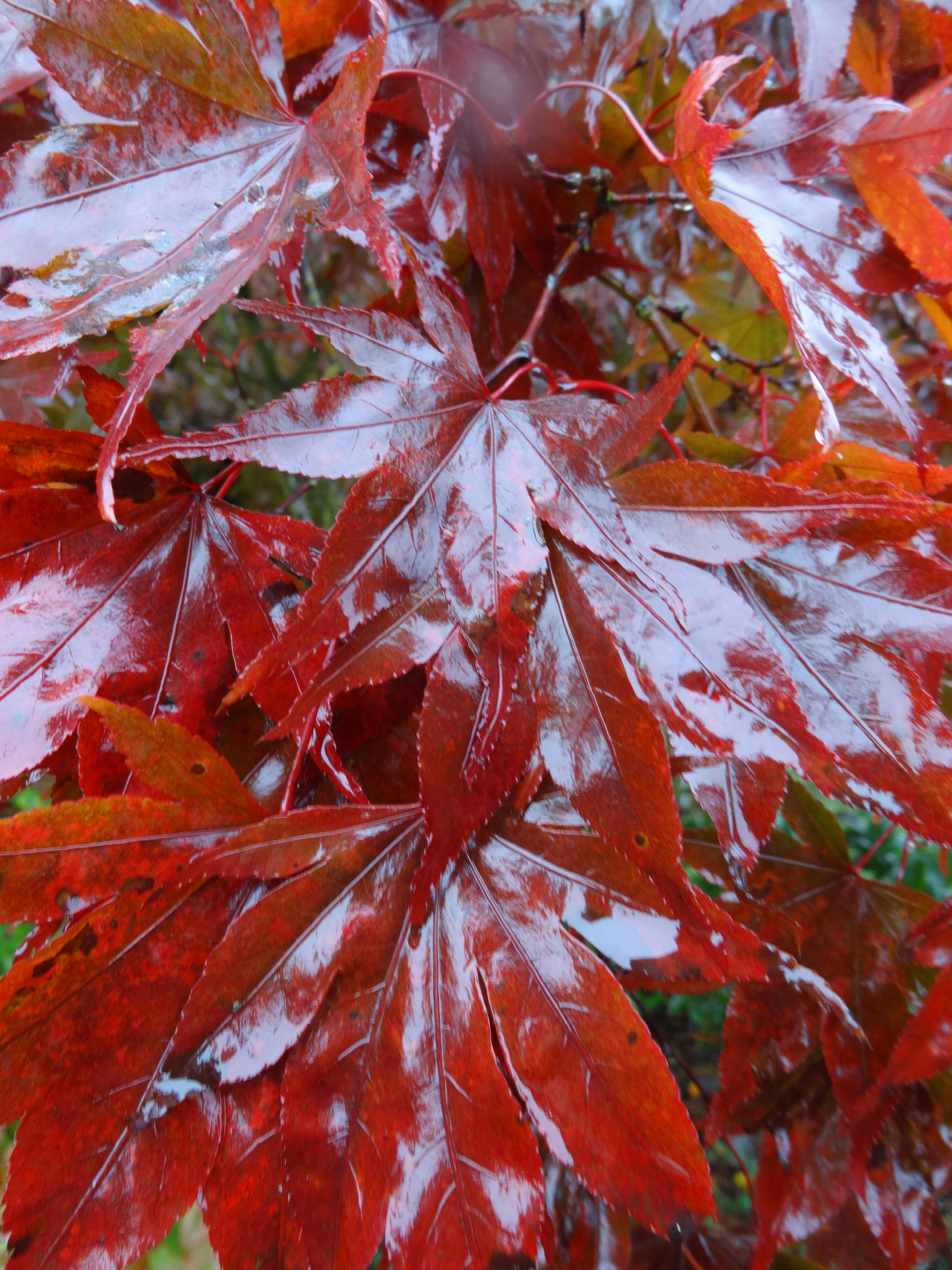
I walked outside. Yes, it was raining but I immediately felt better. There was fresh air. I was moving. There were trees, grass, and flowers. The rain actually made some things look better. The leaves were glossy. There were beautiful water droplets creating light effects and textures on the plants.

I typically feel so much less vulnerable when I put myself into the situation that I am trying to avoid because I fear it. By putting myself in the situation, I can be mindful of it because I can experience it fully. I can see, hear, feel, and taste things that I can’t from within my own home, standing still, looking at the window and feeling stuck, like I belong no where.

I have to be honest. It was hard to come back home after a trip of fun and little responsibility. It is tempting to avoid bad weather, real or threatened. Life brings change, some good, some bad. Walking in the rain is not an appealing notion to most, especially when the seasons are bringing us to cold and dark times.

But when I walk into the rain, my family is there. With them is where my life is and where I want to be.

DSC01534 DSC01558 DSC01563 DSC01538 DSC01546

Last Wednesday, I was on a flight from Los Angeles, California to Raleigh, North Carolina. It’s pretty long for a domestic flight, from one coast to another. I boarded the plane and took my aisle seat in the coach section of the plane. Passengers kept walking past me through the aisle and I expected at some point that I would be standing up to let two people sit in the empty seats to my right. And then the announcement that we were about to take off occurred. How lucky! I was going to get an entire row of the airplane to myself.

Within about 5 minutes, a man in the row behind me asks, “Is anyone sitting there?” I replied, “I don’t know” because 1) sometimes the doors are re-opened for someone boarding the plane late and 2) I didn’t want to say, “no” because HE ALREADY HAD A SEAT! WHAT ABOUT MY ROW TO MYSELF?

He let about two seconds go by after my “I don’t know” to say, “I’m sitting there.”

I got up and let him in. He took the window seat.

Meanwhile the thoughts in my head, “WHAT THE HELL, MAN? HOW RUDE! YOU DIDN’T EVEN ASK ME IF IT WAS OKAY!”

But I kept my thoughts in my head. Even though he made me get up while I was trying to write a post on my computer, so that he could use the bathroom. HOW ANNOYING!

Then it happened.  A woman walked up to the aisle, looked at the middle seat and said, “That’s my husband.” Apparently, this was her manner of communicating her claim to the seat beside him. I said, “You mean, you want to switch seats with me?” She said, “No, you don’t want my seat. It’s a middle seat.” She must not have been seated in the same row as her husband. It was a little confusing. In any event, I climbed out of my seat so that she could take the seat between her husband and me.

Meanwhile the thoughts in my head, “WHAT THE HELL, LADY? HOW RUDE! JUST LIKE YOUR HUSBAND, YOU DIDN’T ASK ME IF IT WAS OKAY TO SIT IN MY ROW!”

My row. My seats. Mine. You people are inconsiderate and have bad boundaries.

I observed my annoyance. I paid for one seat and since I used frequent flier miles, I think the total cost of this leg of the trip was about $5. I had fully expected to sit next to two other passengers when I initially sat down. But once it was announced that the plane was fully boarded, it took me all of five minutes to lay claim to an entire row on an airplane that didn’t belong to me. In fact, I was really just renting the seat that I was in.

In those few minutes, I had constructed a small web of expectation and entitlement, which gave way to irritation. The truth is, most people would think that the way this married couple spoke to me was a bit lacking in the finer shades of communication that translate as politeness. “I’m sorry, but I was wondering, would you mind my sitting in that empty seat?”

We might even think that it really would not have been so hard for either the wife or the husband to use a few extra words to acknowledge the inconvenience they were causing. What I am wondering though is why it wasn’t easier for me to initially think to myself, “It’s fair for people to move to another seat and it’s nice that this middle aged married couple wants to sit together on a long flight.”

Instead, my initial thoughts were that something that was mine was being taken from me. And this thought made me curious. I don’t think of myself as being someone who has difficulty with entitlement. I also think of myself as being helpful and generous. But like a preschool aged child who says, “mine!” when she sees someone else’s fingers grabbing for a marker, which she is not using, but is in a favorite color, I had taken ownership of seats I wasn’t using.

Children tend to say, “not fair!” when something they don’t like happens. Even if they’ve had more of their fair share of something and are asked to even things out. “Mine! Not fair!”

We don’t often notice when we have more than our fair share of something and when we do, it is usually not distressing.

I am not a little kid. I know how to take turns on the slide and share my markers. Sometimes I intentionally give myself less than my fair share of something. This has me thinking, though. It has me thinking about some of my pet peaves at home. Those tiny irritations that can accumulate into significant masses of stress. I was very excited to see my family last night after being away for five days. As soon as I walked through the door, I saw chores that needed to be done, just a few, but nonetheless things that had not gotten done while I was gone. My automatic thought was, “not fair”. But then I started commenting on the positives. My husband had gotten to the airport early because he was excited to see me. “John, thank you so much for picking me up.” “John, thank you for taking care of our daughter so I could have time away on my own.”

I started to feel calmer. I still got annoyed with some other things but I was able to get myself back on a positive plane more quickly than in the past.

Appreciation, the buffer against “mine!”, “not fair!”, and “gimme!”.

As you know, I arrived in North Carolina last Wednesday for some much appreciated vacation as well as to attend the first ever reunion of all classes from my clinical psychology Ph.D. program at the University of North Carolina at Chapel Hill. This is the first time I’ve traveled to NC on my own since my dissertation defense in 1997, which was a very short trip since I was still a psychology intern and needed to get back to work.

A five night trip with near total freedom in deciding my itinerary. A trip to a place I love. You know how James Taylor sings, “In my mind I’m going to Carolina”? He’s singing about Chapel Hill. His father was on faculty with the medical school. Chapel Hill is beautiful and song worthy. It is a relatively small city, dominated by a university, which is the oldest public institution of higher learning in the United States.

The first thing I noticed as I was driving from the airport to my friends’ house in Raleigh, was the countryside. The beautiful trees along the highway in their early stages of autumn color change. I noticed a glorious blue sky.

And then I saw them, the telltale V shape birds that pitch and rock when they glide. The turkey vultures were flying over the tree canopy. They are really interesting birds. They don’t live an elegant life. They are not smooth fliers and they scavenge for food instead of heroically gliding and catching fish that glint silver in the sun over the water.. I am not an ecologist but my guess is that despite their bad reputation, they are good for the ecosystem. In any event, with the exception of that apple tree attack in the Wizard of Oz, we don’t fear trees because they grow on decaying matter, some of it from animals, do we?

So one of my goals for this trip was to be mindful of places, people, and experiences. When I do this, I can find myself driving on one of the countless highways in the Raleigh/Durham/Chapel Hill area and waxing romantically about an ugly bird that eats dead animals. This is the power of mindfulness. I say this half-jokingly but it is true. Mindfulness can transform something ugly into something else.

Throughout my mindful trip, I noticed that mindfulness is on the mind of a good number of my North Carolina friends. Doris Ann Price, a lively, artsy, bright and fun woman was the first person I met with on my first full day in NC. Doris Ann and I met in 3-D for the first time last Thursday. She was diagnosed with breast cancer some time ago and made the awful transition to metastatic cancer several years ago. Doris Ann is famous in social media for wearing a button that says, “Cancer Sucks”, a pair of artsy/intellectual glass, her smart black and red wardrobe, and her bright red “Lady Danger” lipstick. (I learned that this is her nickname, something that a friend told M.A.C. Cosmetics about, which resulted in Doris Ann receiving a lifetime supply of their “Lady Danger” lipstick.)

I enjoyed interacting with Doris Ann on Facebook but I didn’t really know her. Contrary to somewhat popular opinion, extroversion is not a super power (nor is introversion an illness, for that matter.). I typically feel at least slightly awkward when meeting new people even when I am very much looking forward to it. Doris Ann and I hit it off right away and had a lovely time together filled with fun and meaningful conversation.

Doris Ann’s cancer has spread to her brain. This is something I knew about her. What I didn’t know it that her voice right now, is a few notches above a whisper because a tumor is pressing against her vocal cords. Her throat is also narrowed, making eating a lot process with very small bites.

Doris Ann was very genuine with me about the challenges that cancer has brought to her life. Despite this, she is a very lively woman who has found a way to keep joy in her life. She told me that she “moves forward” in life until she sees a stop sign. And then at that point, she stops, reflects, problem solves, and regroups. Doris Ann’s health is monitored quite closely by her oncologists and other healthcare providers. She is an upbeat person but certainly not a Pollyanna. Doris Ann is mindful of the seriousness of her health as well as the positives in her life. I admire her emotional strength very much. Plus she was fun and brought me very delicious gluten-free pastries as a gift!

A couple of days later, I found myself at my reunion. I immediately saw someone I knew, Don Baucom, a faculty member who had been the director of clinical training when I was a student. He was greeting people as they arrived. Don is a gracious and kind man with keen intellect and a wonderful sense of humor. He greeted me with a big hug and I felt a little less awkward about going to a party with people I had not seen for a very long time.

I loved graduate school but there was part of it that was like the longest adolescence a person can have that is actually healthy and not just living in your parents’ basement playing videogames, until age 30. The program was supportive but very rigorous and difficult. These were very smart and successful students. We had never had to work so hard to do well in school. So there was insecurity and competition on top of the competition that is part of any academic environment at a major university.

There were only two other people at the reunion from my class and very few from other classes whom I knew all that well. And only two of my professors were there. At one point, I thought, “maybe I’ll leave early.” Then I got my mind out of the past and into the present and proceeded to have a very good time reconnecting with and meeting people.

A couple of particularly lovely things happened. I heard a voice behind me say excitedly, “Elizabeth!” It was April Harris-Britt, who had worked in my dissertation lab, while she was an undergraduate student (I did not work on a professor’s project. I did an independent project, developing and evaluating a parent education program.) April was a wonderful student and I encouraged her to continue in psychology at the graduate level. She did and she entered the Clinical Psychology Ph.D. program after I left. She now has a private practice in Durham, NC.

“I was so excited to see your name on the guest list,” she said as she held my hand. “When I think about why I became a psychologist, I always think of you.” I gave her a hug, a kiss on the cheek, got a little teary and told her how awesome she was and is. Then we caught up on our lives. I saw a photo of her beautiful 4 year old grand-daughter.

This was a very moving encounter. I have found that since I started practicing mindfulness, I don’t feel as awkward showing affection that I genuinely feel. Now, I’m not going around kissing everyone’s cheek. Another part of my mindfulness is trusting that my own guesses as to whether someone would be comfortable with this, are pretty good. After all, knowing people pretty well is part of my job.

There was live bluegrass music at the reunion. They were very good. There was space for dancing but no one was out there dancing. I was sitting next to Sandra Zinn, a lively, brilliant, free spirited woman who graduated a couple of years after me. She said, “No one is dancing!” You know that I love to dance and I’m learning to get past my fears of being bad at partner dancing and just not care that I am bad at it. So I put out my hand and said, “Let’s go!” As I anticipated, Sandra accepted. We made up for lack of skill with enthusiasm, smiles, and giggling. About two minutes into the song, I started feeling self-conscious and told her, “I’m running out of moves.” She said, “It doesn’t matter as long as you keep moving.”

I have done a lot of things this month that would have been hard for me to do in the past. I have had 3 D encounters with three friends whom I met on the internet, one of whom is one of my very closest friends. (The third is the lovely, talented, and interesting Frieda Rosenburg, a retired UNC librarian. We had a marvelous time at the NC Botanical Garden and shopping at A Southern Season.) I have partner danced with two different people on two different occasions.

I am still not good at partner dancing. But it’s much more important to know how to live well than how to dance well. I still get nervous meeting new people or feel awkward in a crowd. But I am learning the difference between real stop signs and fabricated ones like the ones caused by social anxiety, perfectionism, and borrowing trouble from a future I can’t know until it gets here.

The fabricated stop signs are exhausting and when I make them, I miss out on a lot in my life. I don’t know how long my life will be or how many stop signs are coming up. In the meantime, I will live a life as mindful, meaningful, and as genuine as I can.

Doris Ann at Weaver Street Market in Carrboro, NC.

Doris Ann at Weaver Street Market in Carrboro, NC.

With Frieda Rosenberg at the NC Botanical Garden. Photo by Frieda Rosenberg, 2014.

With Frieda Rosenberg at the NC Botanical Garden. Photo by Frieda Rosenberg, 2014.

My dissertation adviser, Joe Lowman with alumna Sandra Zinn. This photo captures each of them perfectly! And do you blame me for asking Sandra to dance?

My dissertation adviser, Joe Lowman with alumna Sandra Zinn. This photo captures each of them perfectly! And do you blame me for asking Sandra to dance?

April and me. Did I mention that I am so very proud of April?

April and me. Did I mention that I am so very proud of April?

I live in the far northern reaches of the lower 48, you know the U.S. states that don’t include Hawaii or pertinent to this discussion, Alaska. During the summers in Seattle, we cannot believe our good fortune! The days that seem to last forever! The temperatures that rarely go above comfortably warm. It is true that the area in which I live is virtual Eden of during the months that are burning hot in the rest of the country. And then fall comes, in particular, “Fall back”, the adjustment from Pacific Daylight Time to Pacific Standard Time. Hello, darkness my old friend.

If I am honest with you, there has been a general trend that tells me that my adjustment to the Fall has not been good in recent years. When I was younger, Autumn was my favorite season. Summer, bleh, too hot. However, this was many years before I lived in North Carolina and learned that 75 degrees Fahrenheit is not hot. Also, 80 degrees is not so bad. When hubby and I moved to the South for graduate school, we opened the Pandora’s Box for warm weather acclimation.

For the last three Octobers, I have felt the pull toward low energy. I do not have Seasonal Affective Disorder, the depression caused by the low light conditions of winter. But I do get very tired in low light conditions. I am struggling with this, as we speak. It is ridiculously weather related. I spent last Saturday on my ass with cotton brain. The sun came out instantly and I immediately felt happier and more energetic. How predictable.

Last year, one of my doctors told me that it just might be a good idea for me to schedule fewer patients during the fall and winter, due t the fact that I had low energy during this time. Meanwhile, she gave me acupuncture treatments in hopes of raising my energy level.

I have learned to make some accommodations. I take extra vitamin D during these months. I continue to walk outside. It is particularly important for me to connect with nature and the reduced sunlight. I use light therapy for about 15 minutes in the afternoon. This summer and during the early fall, I changed the lighting in my living room. I added stronger lighting to buffer against the darkness in my beautiful part of the world. This year, I am also trying out a wake up light, an alarm clock that simulates the light of dawn at the time that I appoint rather than that dictated by Mother Nature, who is a little withholding up here during the short day light months. Since cancer treatment, my former status as a morning person has been questionable.

I may just have to accept a “new normal” that these are low energy and low mood months for me. But I enjoy being energetic and happy too much not to try a few things out.

Stay tuned.

A common recommendation that I make on behalf of the students I diagnose with ADHD is to seat them in front of the teacher.

I mean, who wouldn’t think of that? A kid who has attention problems? Where else would you put him or her?

Although most teachers figure this out on their own, the number of times it doesn’t happen is surprising.

“Next to the fish tank”, “In the back”, “Next to the open door” are the seat locations that I hear about  with alarming frequency.

Today I thought to myself, “Why would a teacher do that?” I’ve had this thought before but this time I really thought about the answer.

“Hmm, if I sat a kid next to the fish tank, he might just zone out on the fist right next to him rather than repeatedly getting out of his seat to walk to the fish tank.”

“Hmm, if I sat a kid with ADHD right in front of me, I might be distracted when I am trying to teach.”

Sometimes we move problems away from “front and center” because it is more convenient, at least in the short term. In the case of these students, the short term solution may leave them better entertained and thus less disrupted. But in the long term, they are also less well educated.

A major challenge to a happy life is to know when to move challenges to front and center and to know when they are best left in the periphery.

Last Friday, I hosted a lovely dinner party for friends, most of them new. One was a new “3 D” friend, someone with whom I have been friends via cyberspace but not in close proximity. (Read about it here.) At a certain point of the evening, we noticed that one of our six month old kittens, Basie, was missing. Since our house has been “Party City” since early September, the kittens have had lots of experience with visitors to the house. And they have taken strangers in stride, not hiding away like some cats are prone to do. So I was very worried. Our kittens have never been outside but I suspected that Basie had gotten outside. We live near a busy street. We also live in a neighborhood with many raccoons, who have been known to hurt or kill cats and small dogs. Not to mention the occasional coyote that sometimes graces our urban landscape.

In the back of my mind, as the hours ticked by, I was fairly convinced that there was a very good chance that Basie was dead. And his sister and litter mate, Leeloo was acting distressed without him.  It was already dark out. How does one find a black kitten in the dark? It’s not easy, let me tell you. I could tell that during the dinner party, John was going outside with a flashlight from time to time. And when he returned, I did a couple of outside rounds of “Here, kitty kitty kitty kitty kitty!” No response.

So I returned to my dinner party and did my best to keep my worry in the background. The party came to a close and I went to bed, with only one of our awesome kittens in bed with us. But again, I knew that worrying about it wouldn’t help. I just needed to do my best to sleep.

At 1 am: “Meow meow meow meow meow” we hear on our deck. Basie had come back! What a relief! Oh Basie, please no more adventures!

But I was so glad that I did not put my worry front and center when I had a dinner party and very little I could do about a jet black kitten lost in the night.

It is so difficult to know, at times, what thoughts, feelings, or experiences need to be at the “front and center”. Sometimes it is now, sometimes it is the past, and sometimes it is the future that needs to be there. And then it can change again in a second.

It’s a wonder we don’t all have psychological whiplash.

Recently I met with some parents to obtain background information as part of my assessment of their son. They are highly educated people, both with advanced degrees. They have three young sons, all of whom they speak of lovingly. The father charmed me with the fact that he calls his sons, “honey”. There words were measured and they described their concerns about their oldest son, his tendency at time to not to own his own actions, his quickness to anger, and his frequent use of exemplary verbal ability to argue with adults.

Despite their calm and professional demeanor, I could see the mounting fear behind their words. Their fear for their son’s happiness and safety in the world. We had had a chance to establish some rapport and I decided to take a chance on expressing an awareness of an issue that had yet been unsaid. “I can only imagine the stress that you feel in raising a Black son who has these difficulties, in our country.”

Both parents nodded vigorously and the father said with palpable relief, “Finally, someone gets it.”

I am not African American. It was chancy for me as an outsider to make the comment that I did. It was also chancy for me to use the term “Black” instead of African American. The former is more likely to be acceptable when used by African Americans, not by an outsider and further a member of a privileged race, such as myself. But I thought “Black” was a better reflection of their own thoughts and feelings about their son. I also know that due to my personality, I tend to be able to say things like this and they are interpreted in the way I intended. But I am still very careful. I will never know what it is like to be African American.

But I can try to understand the best I can and to be aware of the common challenges that African American families face. And my awareness must be more than an internal event. It needs to be linked to effective action. In this example, my action was communicating my awareness of the rational sources of their fears. These parents have three boys. The number one cause of death for African American males between the ages of 15 and 34 is murder. And one might think that the risk does not apply to these boys because they live in an educated and relatively affluent family. I think realistically, it may buffer this risk to a certain extent. However, even looking at my own life, I know there is a particular danger that cannot be eliminated. I have a lot of friends. A great number of them have advanced degrees. Two of my friends, both Ph.D.’s, have had murder in their immediate families, one attempted and the second resulted in the death by shooting of a friend’s brother, who was waiting in line to get into a night club. Both of these friends are African American women from well educated families. One of them even had an uncle who ran for president of another country.

There are many people who live with the cloud of potential catastrophe. We are often unable to fully appreciate it but we can do our best to understand.

I am awaiting the results of the routine MRI I had yesterday. I am learning to deal with the anxiety of these scans but I am anxious. My husband forgot about the MRI even though I’d told him a couple of times as recently as the day prior and had asked him to accompany me. His alarm went off yesterday morning at 6:30, his normal time to get ready for work. However, he was planning to go to work after my scan and it was not until 9:45. He was getting up too early to have remembered the scan so I reminded him and he came back to bed. My husband is more forgetful than I would like. But I understand that he is not doing it on purpose and further, he would have seen the appointment on his calendar. Plus, he doesn’t live in the perpetual state of Potential Cancer so there are some things he doesn’t quite understand about my experience as a cancer patient. Similarly, a close friend apologized to me yesterday for checking in with me about my MRI. He’d had quite a stressful day of his own and again, he doesn’t live in the state of Potential Cancer. Before I lived there, I didn’t really worry so much about my friends’ scans once they’d had no evidence for disease for a couple of years. The panic subsides. I don’t want my husband or my friends to live in the Potential Cancer state with me. I don’t wish that on anyone just as my friends with metastatic disease wish it for others. But the actions that come from understanding our situation are important.

As a world, we need to find a cure for breast cancers. But as individuals, we also need people in our lives who have an awareness of the unique stresses of being a breast cancer patient who are also able to convert their awareness into emotional support. You,  friends and family, may be helpless to prevent recurrence or to cure a loved one’s active disease, but you can provide emotional support. You can make living in the Potential Cancer state or the state of Perpetual Cancer more bearable and less lonely.

Perhaps it would be helpful to explain to you what scans mean to me. A clear scan means that I can live another six months with “no evidence of disease”. A clear scan to a person with metastatic cancer means that they can live with “no evidence of progression”.  If my scan shows evidence of cancer, I will go into the fast paced chaos of not knowing and having many tests, the perpetual “hurry up and wait”. If it turns out that I’ve had a recurrence, I will likely undergo a more aggressive treatment protocol than I did in the past and to undergo previous treatments for which I now appreciate the full impact having gone through them before. By the way, a lot of cancer treatment sucked. My family will suffer. My patients will suffer. I could go on and on.

I keep telling myself that the results of a scan, assuming accuracy, don’t tell me anything about myself that wasn’t true yesterday. I often tell my patients this about the diagnoses I give them. “You are the same person you were yesterday.” On myself, this is a hard sell. I am a clinical psychologist. Nobody comes to me unless they already know something is wrong. Something is not going well. There is a problem. I didn’t know I had cancer. I felt fine. There was no lump. Right now, due to my mental and physical health practices, I feel healthier than I have in years. But cancer can hide for  a long long time without someone even knowing something is wrong.

For me as a cancer survivor, it is surreal at times to realize that I can’t trust my own sense of my body. I can’t gauge my own health. My body can lie to me.  I try to be a very truthful person with myself and with others. Honesty and clarity are extremely important to me. This is hard.

Offer your loved ones your understanding and support. You don’t need to live with us and we don’t even want you to,  but do connect with us. And when the Pink wave  tells you that awareness is action and pink is helpful, put your money and volunteer time somewhere else. Somewhere that helps.

Gray and black clouds
hide the sky.
The light shines through
There is clarity above.

The clouds will burn off
maybe today
maybe tomorrow
some day, certainly.

I will see the sky
I’ll know if I traveled
during the quiet space
between dreams
to the terrifying place
the familiar chaos,
the Cancer Place.

This morning's sky inspired the poem, my first in nearly 20 years so be kind.

This morning’s sky inspired the poem, my first in nearly 20 years so be kind.

Lindbergh High School Reunion '82, '83, '84, '85

Join us this summer for our reunion in Renton, WA!

George Lakoff

George Lakoff has retired as Distinguished Professor of Cognitive Science and Linguistics at the University of California at Berkeley. His newest book "The Neural Mind" is now available.

KomenWatch

Keeping our eyes and ears open.....

4 Times and Counting

Confessions Of A 4 Time Breast Cancer Survivor

Nancy's Point

A blog about breast cancer, loss, and survivorship

After 20 Years

Exploring progress in cancer research from the patient perspective

My Eyes Are Up Here

My life is not just about my chest, despite rumblings to the contrary.

Dglassme's Blog

Wouldn't Wish This On My Worst Enemy

SeasonedSistah

Today is Better Than Yesterday

The Pink Underbelly

A day in the life of a sassy Texas girl dealing with breast cancer and its messy aftermath

The Asymmetry of Matter

Qui vivra verra.

Fab 4th and 5th Grade

Teaching readers, writers, and thinkers

Journeying Beyond Breast Cancer

making sense of the breast cancer experience together

Entering a World of Pink

a male breast cancer blog

Luminous Blue

a mother's and daughter's journey with transformation, cancer, death and love

Fierce is the New Pink

Run to the Bear!

The Sarcastic Boob

Determined to Manage Breast Cancer with the Same Level of Sarcasm with which I Manage Everything Else

FEC-THis

Life after a tango with death & its best friend cancer