Archives for posts with tag: mindfulness

We all move forward through time because that is the nature of time; it progresses. Due to our brain structure, we are also able to travel back in time through memory. And based on our memories, whether they are biased, fading, or correct, we think about them as well as our current experience to make predictions about the future. These predictions often inform our current behavior.

Thus, we live in the past, the present, and the future. This makes life rich, but it also makes it complicated. We get all kinds of messages about which time is the best. “Live in the moment!” “Keep your eye on the prize!”

Getting stuck in any one time can cause a lot of problems, though. For example, depressed thoughts and feelings, for example, come in part from viewing today’s misery as being a constant. The past was always bad and the future will be bad. Past joys and the possibility of joy in the future are buried under the weight of today’s despair. Impulsive behavior comes from living too much in the moment. I want this now. I feel this now. The past doesn’t matter and the future only matters in like of getting the goal I want right now, accomplished.Later, after the negative consequences come crashing down, impulsive behaviors result in regret and guilt about the past. And anxiety often comes from living in the future of “what-if’s” and “what might be”.

One of the things I have noticed in my mindfulness practice, is that I am better able to integrate my past, present, and future. I observe the present and recollect the past. I use information from both of these times to inform the plans for my future. Being able to travel through the time of my own life is a fascination to me. I don’t always travel at the right time or to the right place. But I think I am getting better at it, more frequently feeling in more of some kind of balance.

Memory makes life complicated. But without it, we would always live in the present moment. And that, my friends, would be although a simple way to live, a very dependent, sometimes incredibly distressing way to live. There’s no sophisticated learning without memory. There are no moments of beautiful nostalgia. No dreams for the future and no appreciation for the way that people and their relationships unfold over time. I could go on and on.

A life with just one time is like a story without a beginning or an end, just the middle. And the middle is the crisis, as I recall, the problem that needs to be solved. I want to continue understanding the grand narrative of my life. It has many beginnings, middles, and ends. My life has many stories, some unfolding as we speak, and they are all part of who I am and how I connect with the rest of life.

I almost always cringe when I hear someone who is not elderly, refer to their perceived decrepitude. “I’m soooo old.” “I hate getting old.” I compare it to my own internal tape that told me that I was fat for about 40 years. It was a harmful statement for me to make to myself and reinforces the pervasive negative view of overweight people. There are also pervasive negative views of old people. Our society, by and large, does not treat the most experienced of our citizens very well.

Puppies are cute. They are fuzzy and cuddly but they will also eat your shoe and poop on your favorite throw rug. Young people are also a bit like that. And during spring break, young people are EXACTLY like that.

My parents didn’t really complain about aging in the way a lot of people do.  They were happy and active people. Now they are happy, active, and elderly. In the fall, my mom will turn 80, my dad will turn 82, and the two of them will celebrate their 60th wedding anniversary on Thanksgiving. I know they have to navigate their daily lives differently than in the past and that this adaptation process continues. My parents are traveling to Yellowstone National Park this summer, a place they have gone many times over the years. This is the first time they are staying in a hotel instead of camping. This is a loss but they have found a way to visit and hike in one of the most beautiful and fascinating places on Earth.

My parents have been blessed with good health, this is true. And they do notice the effects of aging; they are not in denial and they have planned their life in a sensible way. But I wonder how different their lives would have been if they had proclaimed themselves old 30 years ago? I wonder what kind of limits they would have placed on themselves? Or how much time they would have wasted feeling badly about themselves instead of walking together every day, going camping several times a year, spending time with friends and family, and looking at the photos they both take of places and people.

Becoming really good at something takes a great deal of time. I am hoping to be around long enough to be an expert on living my life.

Joe and Martha MacKenzie, Thanksgiving 2010

Joe and Martha MacKenzie, Thanksgiving 2010. See, being as old as my parents looks like it could be fun!


As a psychologist, I work with a lot of parents who disagree about how to best address their children’s problems or often, whether there is a problem to address at all. A good deal of the time, these perpetual conflicts are a result of the couple trying to solve a different problem than the one they think they are trying to address. The real problem might be feeling like a bad parent and trying to solve it by deflecting blame to the other parent.

But what does it really mean to be good or bad? Kids often tell me that “bad kids” are the ones who get corrected by the teacher or who hit or who learn differently. In other words, “goodness” is defined by actions and abilities. A lot of the kids I see think of themselves as “bad”, which is an extremely painful state of being. I say, “I’ve worked with thousands of children in my life and I’ve never met a bad one. All children are good. Sometimes even grown ups get confused about this. They think that there are good and bad people.” When I say these things to children, I am not just trying to ease their pain. I mean it from the very bottom of my heart to the very top of my brain.

We make good and bad choices. We have skills at which we are good and those at which we are bad. We perform good and bad actions. These statements are true for all of us on a daily basis. We do good things and we do things well. We do bad things and we do things poorly. Every day. Every person. Are all of these good’s and bad’s equivalent in terms of importance? Of course not.

People are beings, not actions, skills, or decisions. Actions, skills, and decisions are capacities, not entities. I believe that every living being is a miraculous creation. A miraculous creation is a good thing. Every person is a miraculous creation. Why is this so hard to accept?

I spent a good part of my early life worrying about being “good enough”. The hardest times were when I was depressed. There were some things I learned getting myself out of those depressions, though. A very important lesson was that even having failed at happiness by becoming depressed was not the end of my life. I came back from the illness. I was more resilient than I had realized despite my imperfections. It was an important step in stepping away from the question, “Am I good?”

Stepping away from “Am I good?” is a really important part of self-acceptance. I don’t believe that self-acceptance is a absolute. It is a process toward an idea. I believe that I have traveled close enough to it to make a very large positive difference in my life.

I am discovering the freedom in self-acceptance, in stepping away from the question, “Am I good?” It allows me to more frequently see myself and others as whole people with beauty and mess. I am a messy imperfect but loving person. By accepting this, I am actually better able to make good decisions, engage in good actions, and learn good skills. I have a lot more time and peace as I learn not to berate myself. I don’t devote energy to fancy justifications for my actions.

Getting wrapped up in that question can cause so many problems. Even if you don’t believe that people are miraculous beings and inherently good, perhaps you might consider that classifying oneself and others as “good” or “bad” is really not helpful to anyone.

What does it mean to be good? It means that we are here. It means that we can move on to more useful questions, ones that bring love and compassion to our lives, instead of keeping us stuck.


When I was a girl, my younger brother, Jim frequently rode our bikes. I remember the pumping my legs furiously so that I could coast along for awhile without having to do anything to propel myself. It was exhilarating going down hills and on the flat, it created joyful stretches of ease, moments of effortlessness.

Being a healthy person, having a healthy marriage, and being a good parent are all “works in progress”. When John and I saw a psychologist for marital therapy years ago prompted by family planning issues, I asked her sincerely, “When is the time when we get to coast in marriage?” She promptly responded, “Never.” I remember my shock at her response at the time. It’s kind of funny looking back at my thoughts at that time. I do know that I was quite overwhelmed by my life and about to enter my second episode of major depression. It was a fantasy I had that after all of the hard work I had done in my life, that I would be able to coast. I would have an easy time as a wife, parenting  would get easy.

I was reminded of my wish to coast recently when I realized that after all of my hard work, I had strayed off of Weightwatchers and begun to gain weight. I didn’t gain a lot of weight and I’ve started losing again. It may not seem to be a big deal to you but I have gained and lost weight many times since I was 14 years old. And as I have mentioned, the last two periods of weight gain had put me into the clinically obese range. My breast cancer was highly responsive to estrogen and progesterone. Our adipose tissue (fat and other stuff) has glandular function and increases female hormone production. I know it is important for me to exercise and eat right. I am very lucky to not have physical issues that would interfere with my ability to exercise and to have a life situation that makes it possible for me to work part time. But even knowing these things, my weight has crept up in the past when I stopped paying attention to my habits, when I tried to coast in my life.

I have lived a good bit of my life working at capacity and feeling fairly stressed out. At these times, I have thoughts like, “It will be SO much easier, when ____________” This blank has been completed in many different ways over the years, “when I finish school”, “after the baby starts sleeping through the night”, “after my career is established”, “after my daughter is grown”, “when my husband’s job situation improves”, “after my cancer treatment is done”, “after my energy returns”, “after I start working full time again.”

But the truth of the matter is that although stress ebbs and flows throughout out lives, we are never done with it. And there are always unknowns and unexpected challenges that loom on the horizon.

In my work, I specialize in what for most children are chronic difficulties. And although many of them have loving and very skilled parents, even the most loving and skilled of the parents gets exhausted with the extra work their child or children require. There is also a period of adjustment after diagnosis that can take anywhere from weeks to more regularly, years, and sometimes, never. It is the adjustment to the idea that there will be no coasting as a parent and that one’s children will likely need more support and over a longer number of years, than other children.

I sometimes use an analogy with parents. I tell them, “Raising a child with these challenges is like running a marathon of unknown length and unpredictable terrain, with uphill, downhill, and stretches of flat. It is important to take the cups of water whenever you can.”

If I really think about it, coasting on a bike only lasted so long before I either had to brake because I was going too fast or start pumping my legs again so I could keep going. I have been working hard to take care of myself but also to nurture my relationships and carry out my responsibilities. I will keep working on the rhythm of knowing when to pump and when I can coast so I can keep moving forward and maintain my balance. And if if that little cup of water looks too small to last a lifetime, I will take them when they are offered.


“How long have you been cured?”

Her question caught me by surprise. We were riding on a school bus from a beauty salon to the venue for the breast cancer charity event in which we  were both modeling. I knew that she was diagnosed less than a year ago. She was self-employed and had benefitted from the charity first hand.

I answered, ‘I was diagnosed almost two years ago.’

I could have corrected her but I didn’t. She had also invited everyone to a potluck at her house. I could tell that she was having a powerful experience of belonging, being surrounded by 29 other women who had been diagnosed with breast cancer as recently as 9 months ago and as long as 19 years ago. I could also see the fear in her eyes, that she had transitioned from the shock and adrenaline rush of the active treatment stage to  “Now what?” I figured that I needed to respect her grief process and trust that she would progress in her understanding of her disease.

Her question reminded me of past experiences. I grew up in a politically and socially liberal Roman Catholic church. We didn’t talk about Hell or who was going there. We didn’t talk about “being saved”.

So the first time I was asked, “How long have you been saved?” I was similarly taken by surprise. It just wasn’t the way I was used to thinking about myself because my religious upbringing was different.

I talked to one of my colleagues and friends about this a few years ago. He is a thoughtful man, raised Lutheran who is now a practicing Unitarian. He was shocked that I had been raised without the reassurance of going to Heaven. He’d found this belief quite comforting while growing up.

Being cured and being saved are absolute positives. They can mark an end of struggle and an end to gray.

I don’t wish to disparage anyone’s beliefs as long as they don’t hurt others. My personal belief is that God is beyond my complete understanding but that I experience God is in the love people show each other, how we take care of our world, and the beauty of nature.

I don’t know if I am cured. I don’t know if I am saved.

I know that I am here.

I sometimes work with parents who reluctant to give their children any kind of correction or to communicate to their children they they have any kind of imperfection. Then there are other parents who criticize their children harshly. And still other parents vacillate between those two extremes.

Sometimes I tell parents that it is important not to be so reluctant to discuss their children’s less than perfect qualities. I explain, “You don’t want to give the unintended message that your child’s challenges are too horrible to speak of.”

The other unintended message is that perfection is attainable and expected. My massage therapist expresses the belief that everyone is perfect. I know what she means but to me, it seems like a cheat. If I were to think about myself that way, it would seem like a  way to avoid looking at myself fully, a way to avoid acknowledging and examining the parts of myself that underscore my membership in humanity.

I know that I write about painful topics with a good deal of candor. And I also know that I expose my faults. Sometimes I think people worry that I am too self-critical. I find that for myself, if I avoid thinking about my faults, I give myself the message that they are too bad to be observed or examined. This kind of thinking can provide a foundation for very difficult feeling states like shame and humiliation as well as the very damaging thoughts and beliefs that accompany them. I believe it can also lead to living a fragmented or compartmentalized life, the kind of life that makes it hard to see oneself as an integrated whole. To me, it is important that the way I live my life makes sense. I can’t do it unless my imperfect pieces fit together in some kind of reasonable way.

In my life, I have felt guilt, shame, great anxiety, and humiliation. It is difficult, but I try to see myself for all of who I am, the good, the bad, and the in between. In writing about myself for the past two years, I have discovered something. I have discovered more freedom from my own harsh judgment. When I confront both my positive and negative qualities, I feel better able to decide how I want to live my life and to make changes, if needed. By describing and admitting my shortcomings, I find it easy to accept myself and further to grow as a person. In turn, I find it easier to accept others.

I have yet to find anything about myself that was too horrible. I am still working on it, but almost always, I can look myself in the eye.


When I talk to my husband, he often doesn’t answer. This is not new to our relationship. It has been true for decades but waxes and wanes depending on his stress level.

Sometimes, he is just spacey and lost in thought. Other times, he is feeling anxious. He is very sensitive to rejection at these times. I may actually be annoyed or mad at him. I may not be mad, at all and just trying to get the business part of our lives done and coordinate household responsibilities. I am an organizer and a “big picture” person when it comes to administering a household. John is not. After many years, he asked me to start writing tasks on a “honey do” list, a little white board in our kitchen. I don’t really like doing this. I think he would be more likely to remember to do the task if he wrote it down himself. For some reason, that is something he just won’t do. He wants me to write it down. Sometimes this feels like a face saving move on his part. I wouldn’t mind writing it down if I didn’t know that a number of the things I’ve written down, stayed on that little board for years. So it filled up with tasks, most of which never got done. And every time I worked in the kitchen, I would see it and it was a visible sign of my frustration.

I hate the silence. The non-answers that could mean many different things. But even when my husband is merely lost in thought, the silence hurts. Relationship intimacy doesn’t just come with the package, it is something that must be continually nurtured and protected. It is important for marital happiness, for sexual health, and for emotional well being.

I nag, it is true. It is not a super power but I am also not an evil villain. I often feel caught between a rock and a hard place. John tells me that he is going to do a task and then he doesn’t do it. An excellent example might be doing the dishes. I’d say that between 1/3 of the times that John says he will do the dishes before he goes to bed at night, I wake up to a sink full of dishes. About half of the time, most of the dishes are done but some are either still on the dinner table or on one of the kitchen counters. And almost 100% of the time, either the table, counters, or the stove top are dirty.

If I say something, he probably won’t finish the job because he’s already gone to work. If I need to use the sink, then I need to clean it out. Later, when we are discussing dishes, because they are never to be taken for granted because they are not yet a habit, I might clarify that what I am asking is for him to do ALL of the dishes and if the kitchen stove top needs to be wiped, I expect him to wipe it. By this time, I am at my best, using a businesslike voice and at my worst I am doing nothing to conceal my annoyance.

The follow up discussions almost never go well. John feels criticized. And you know what? I am criticizing. I am complaining about the job he did. I understand why he doesn’t like it but he often communicates to me an expectation that a loving wife doesn’t ever criticize or complain. Although I don’t think he 100% believes this, it is an ideal he has and I even think he believes it to be attainable. These are the the times when my husband’s dreamy romanticism conflict with my pragmatic realism.

Relationships are full of noise. Some of it is like beautiful and romantic music. Some of it is not. Some of it is disagreement, some is problem-solving, some is negotiation. Relationships are also full of silence. But this kind of silence, the not answering with clear words but instead answering with confusing actions or lack of actions, is not helpful. These are the times when I feel that I am to match his silence with my own. And sometimes that is what I do because I have already tried to make my point and failed time and time again.

These are the time I feel silenced, that my job is to pick up after the many unfinished tasks in my household and not say a word. Just do other people’s work and carry through on other people’s promises. There are times in my life I am resigned to this. There are times in my life when I know that my husband has many other wonderful qualities that compensate for these shortcomings.

At other times, I feel alone. I feel like there is work that I have to do and for which I will never be appreciated. If I say something, I get a negative response. If I am silent, I get no response. To have to have no routine between the two of us to take care of these things is a perpetual stress to me. Routines can make life a lot easier and require a lot less higher order thinking. I would like to preserve my mental energy for things other than working and reworking the daily household routine as well as keeping track of so much of the family’s schedule. People who do not have organizational skills like this, the skills for carrying out and managing the most boring and perpetual household tasks just don’t get it. They don’t get the value they don’t get toll that it takes on the very most developed part of the human brain. My husband and I do not have a traditional marriage but my brain works like a housewife’s and his does not.

When it comes to managing my cancer, I am even more alone. And that’s one of the main reasons that I blog. I don’t need my husband to attend my appointments any more. He has no idea what my schedule is like and how it impacts the rest of my life. He can read about it here but he can’t experience it. And when I talk about the anger I feel, the fears I have, or my annoyance with the inconvenience of it, I know he gets afraid. He wants to do something. And there’s nothing for him to do but there’s a great deal he could say.

I empathize with him, really I do. I empathize with him when I don’t know what to say to one of my friends with mets, when they speak of incredible pain or fear or anger. Every once in awhile, I think I rise to the challenge and say the “right” thing. Other times, I just do my best to communicate the fact that I care. It never seems like enough but I also know that I can’t solve the problem of cancer. I can just do my best to be present. Sometimes, and I’m ashamed to admit it, I feel negative toward my friends’ cries of pain. I have thoughts like, “She must have waited too long to take her pain meds.” It doesn’t happen frequently but at those times, I understand why so many of us have lost the support of friends and family. Our brain tricks us into blaming someone with a painful and life ending disease to protect ourselves from our own helplessness and guilt. At these time, I am forced to stare at hard truths about the vulnerability of life and that fact that people I love are in excruciating pain and experience incredible isolation.

I am a loving human being. I am also flawed. I do, however, commit to keeping present with my family, my friends in face to face and cyber worlds. In our relationships, I will make noise.


I dreamed last night that I packing up to leave my office at the University of Washington because I’d run out of grant money. That actually happened in 2007. I thought I was all packed and then found a bunch of cabinets full of things yet to be packed. I realized I had a plane to catch to go home to Seattle. I walked around the university campus and it was actually the campus of Indiana University. The University of Washington is in Seattle. Indiana University is in, you know, Indiana.

I walked around campus trying to get someone to help my move my remaining boxes before I was due to get to the airport. A couple of men offered to help me. I finally realized that I could not be in Seattle and Indiana at the same time. And how was I going to transport all of my office stuff back home and still make my plane. And then for some reason, the men and I walked into a building. The building exploded right as we walked up to the doorway, but some how we survived. Then I woke up.

In the dream, my assumptions about where I was, what I was doing, and how I was going to do whatever it was I was doing, exploded right in front of me. We live our lives according to assumptions. Those assumptions can be challenged in gentle but persistent ways. They can also be thrown on their head.

Until May 24, 2012, I assumed that I would not get cancer in my 40’s. I assumed as a woman from a long line of long lived women on my mother’s side that I would live a long life. I assumed that I would be alive long enough to raise my daughter and to retire in my 60’s or 70’s. (Note to hubby: Early 70’s, tops, and working part time.)

Then the assumption of health that supported all of my future life plans crumbled. I have worked to pick up the pieces, make new pieces, and reworked the foundational assumptions I have about my life. And all along, I have worked to be true to the person that I was before and not define myself only by fear and insecurity.

The early part of this process focused on physical reconstruction of pieces. Surgeons have subtracted and added in many iterations. When I was home following my mastectomy in August 2012, I was looking on Ebay for clothes. I had lost a considerable amount of weight and I do nearly all of my clothes shopping online. I came across this photo.

$(KGrHqNHJEoFERYtWL6BBRJpRGhr-g~~60_12

The mannequin pieces do not fit together and the arms are placed on the wrong sides of the body. It makes the whole figure off. The large hands in particular reminded me of how drag performers can look. They have many feminine physical characteristics through make-up, body padding, binding, falsies, and good acting skills. But there are almost always clues. Things that don’t look quite right. Some drag performers take advantage of this to comedic effect. Grady West, who developed the character, Dina Martina, is a 50 something year old man with a pot belly and hairy back. He wears over the top feminine glitzy costumes that are several sizes too small and his dresses don’t zip up all of the way. Dina’s make-up makes Tammy Faye Baker look like a model for Pond’s cleansing cream. He uses the mismatched puzzle pieces to great advantage and his shows are hilarious.

Other drag performers aspire for “realness”, to be able to pass as a real woman. I was introduced to this concept when I saw the excellent documentary, Paris is Burning, which was filmed during the mid- to late-80’s in New York City. It was about the “Drag Ball Culture” in the city. (Remember “voguing”? It started there, not with Madonna.) I was fascinated by the communities that were built by the men in this culture. Most of them had been rejected by their families and by society, as a whole. But they made their own families with “drag mothers” and familial living situations. I thought the way that the men found a way to pick up the pieces and make news pieces to construct their own families was inspiring.

I know that there was a short time after my mastectomy when I was worried about “passing” for a real woman. But mostly, I have been trying to reconstruct the pieces of my mental life and to dance to the changing rhythm of my daily life.

Life has pieces that change. Life has pieces that need to be replaced. Life has pieces that are lost and cannot be replaced. But my life is whole and I belong here.

I am good at seeing patterns in my behavior, better than I was in the past when my cancer experience was new. I think I am leaning into an anxiety and grief spiral. I have been very stressed about situations that are mostly out of my control. My pattern is (1) define a current or anticipated problem, (2) develop a plan, (3) put the plan in place, (4) fall into a pit of varying depth and circumference, and (5) cope like crazy until I regain my footing.

Right now I feel myself transitioning from step 3 to step 4. But meanwhile, I am dealing with another problem. Time I spent taking care of the highest priority problem meant that I got behind in my work. Now I am shuffling around to put a plan in place for that.

Additionally, I agreed to participate in a breast cancer charity function. The proceeds go to patient assistance fund at Swedish Cancer Institute, which provides very practical assistance like emergency rent money, meals, and transportation to and from medical appointments to breast cancer patients. This is a very worthwhile cause that makes a real difference in patients’ lives, not to mention the fact that I am very grateful for the treatment I have received at the institute. Last year, this event raised $120,000.

I do have mixed feelings about the event itself, which is a fashion show. You know how I love wearing pretty clothes but also have major misgivings about the fashion industry. I also suspect that I’m going to have to wear at least a little something pink at some time but based on last year’s video, I see that pink is present but not omnipresent. The models are all normal looking people. The women are all breast cancer patients. The men are friends and family. Everyone looked like they were having silly fun. And the fun was balanced out by speakers talking about the real negative impact of cancer on patients and their families.

The rational part of me thinks, “Why throw out the pink baby with the bathwater?”  The good outweighs the bad of participation. I have wanted to get involved in a small cancer related charity and this is a chance for me to see if this is an organization with which I would like to continue to develop a relationship. There are lots of things they do and a variety of events that are put on over the year.

Did I say, I was starting to spin? I spun at least a full revolution on my walk in the woods this morning. I’ve started having abandonment fears. I have been stressed and relying on my friends to give ear to my distress. This morning I was worried about being a burden and losing my friends because the sum of the negative parts of my life are really scary. I know this is irrational but I also know that my behavior can still be motivated by irrational fear even when I am aware of it. This is when I start flailing and apologizing to my friends. I try to solicit their support in an overly sparing manner.

And the fashion show? I was worried about that, too. I was afraid that I would lose some of you out there because you would believe that I was “pimping myself out” or that I have been pink washed. Then I thought, “I just won’t say anything about it.” I wouldn’t be able to get the word out about the event so that the charity would make more money and more patients would get real, every day assistance. How silly and counterproductive. In my efforts to reduce the attention to the aspect of participation that I don’t like or am unsure about, I would contribute less to the part to which I feel clearly committed. And the biggest flaw in my “avoid it” plan was the fact that the only person I need to convince about whether this is right for me or not is myself.

When I was a little girl, I used to spin in circles until I got dizzy and fell to the kitchen floor. I would get up and do it over again and again. I remember how the pattern on our linoleum floor used to bind together into a blur. It was mesmerizing and fun.

I don’t spin for fun any more. But I still know how to get up after I’m done.

In some ways I am very sensitive, squeamish even. I hate scary movies so much that I just won’t see them. When I was young, it felt like I was the only one who refused to see these movies or to go on amusement park rides. I don’t like visual gore. I don’t like to watch violence.

Perhaps surprisingly, this squeamishness does not translate to physical health issues. I used to find watching surgeries on television fascinating as long as there weren’t “sound effects”. As I recall, I often turned the sound off. I used to work in a medical lab at a hospital where they did dissection. It was not my favorite thing to view, but I handled it okay and I liked the job.

I know that some people have a hard time handling their surgical drains, looking at their surgical incisions, or the aftereffects of a mastectomy. I am not one of those people. My natural curiosity about the human body as well as how surgeons work to help fight disease and sculpt the body distracted me from any revulsion I might otherwise feel.

A week ago I had a set of surgical procedures as part of my breast reconstruction. Part of it was the liposuction of small amounts of fat from my hips and thighs, which were injected into my natural breast to improve symmetry. It was something I had planned to do after my TRAM but had held off for a year because I needed a break from surgery.

As I’ve previously written, I was actually kind of looking forward to this surgery in an odd way, because it would take me off of the treadmill that was tiring me. The treadmill of responsibility to others and of expectation.

Who was I kidding? That surgery was no break. One of my friends told me recently that she was having a major surgery. Being the multiple surgery veteran that I am I said, “Surgery was not that bad until I’d done a lot of the healing and I realized how much it sucks. But by then, I felt a lot better.”

When I’ve had surgery, I’ve taken it day by day. I’ve discovered that I have a somewhat high pain tolerance.The worst pain I’ve ever had was as a teen and a young adult. It was menstrual pain and it could knock my onto the bathroom floor into the fetal position. That is probably the reason why when in labor, I asked for an epidural early and often. As it turned out, even childbirth did not replicate those years of pain that I had. I was wrong about my pain tolerance. The truth was that I had crazy painful and bad periods.

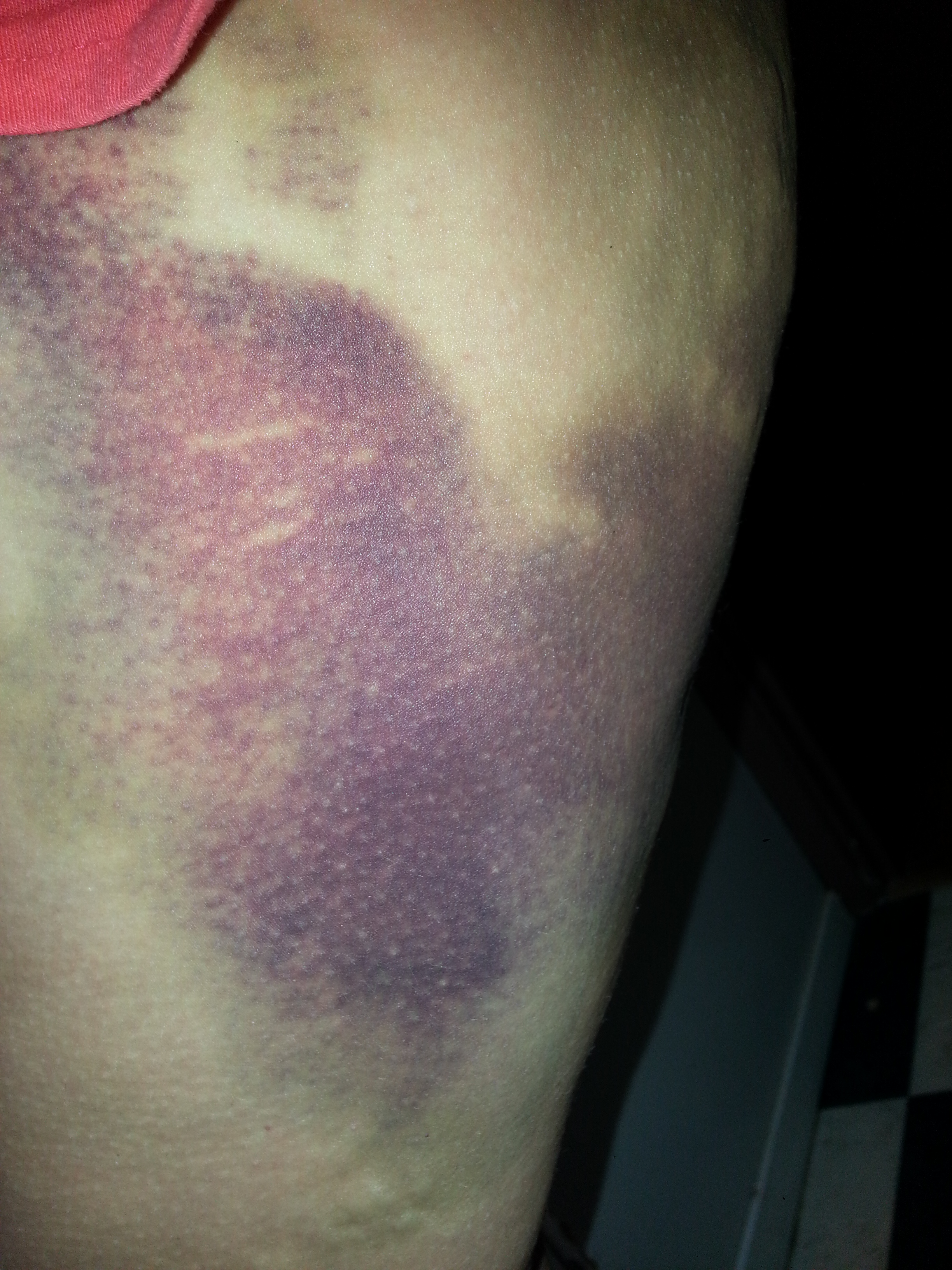
So here I am after my last surgeries, with a high pain tolerance and being low on the squeamish factor, at least when it comes to real life blood and gore. I was told that the liposuction would create bruising. There wasn’t much right afterwards but then they bloomed like creepy black lagoons on my body. They were tender but didn’t hurt as much as a bruise caused by an injury. But they were big, they grew for a couple of days, and they were just ugly and nasty.

Think I’m exaggerating? Here’s the biggest one, located on my inner right thigh. It has actually healed considerably in the last few days.

20140326_093521

Looking at these bruises has been like being knocked upside my head. This one is like an emblem of cancer. It’s big and ugly and crept up on me. Looking at it, I know that I am done with reconstruction. So unless there is a complication that needs to be addressed or new disease, I am done.

The fact that not long ago I was in part, looking forward to these surgeries gives me great pause. I am typically very self aware and deliberate in my decisions as long as I am reasonably calm. Surgery sucks. It really does. At this point, it is not worth it to me to do more but because I had kind of forgotten this recently, I have begun asking friends to remind me of how bad surgery is in the event that I start toying with the idea of more reconstruction. I can already see that I would need at least another couple of surgeries to be fairly symmetrical. I look fine in clothes but my breasts are not only of different sizes but they are also of different shape. It is less so since the surgery last week but they still look mismatched. Today, I think that is just fine and I want to keep being satisfied with this and not do any more to my body.

I am not sorry I had these surgeries. I’m just a little shaken up because I’d forgotten what a disruption that they are to my energy, my concentration, and my ability to take care of myself, even if only feeling out of it for a few days. I have people in my life who I want to be present for. I have things I want to do and feel and say.

I have my post-surgery appointment tomorrow. I think I am healing well. I don’t expect any surprises. I am at peace with where I am going to be when these bruises heal.

I am bruised but not broken.

I am humble but not humiliated.

I am strong but not invincible.

Lindbergh High School Reunion '82, '83, '84, '85

Join us this summer for our reunion in Renton, WA!

George Lakoff

George Lakoff has retired as Distinguished Professor of Cognitive Science and Linguistics at the University of California at Berkeley. His newest book "The Neural Mind" is now available.

KomenWatch

Keeping our eyes and ears open.....

4 Times and Counting

Confessions Of A 4 Time Breast Cancer Survivor

Nancy's Point

A blog about breast cancer, loss, and survivorship

After 20 Years

Exploring progress in cancer research from the patient perspective

My Eyes Are Up Here

My life is not just about my chest, despite rumblings to the contrary.

Dglassme's Blog

Wouldn't Wish This On My Worst Enemy

SeasonedSistah

Today is Better Than Yesterday

The Pink Underbelly

A day in the life of a sassy Texas girl dealing with breast cancer and its messy aftermath

The Asymmetry of Matter

Qui vivra verra.

Fab 4th and 5th Grade

Teaching readers, writers, and thinkers

Journeying Beyond Breast Cancer

making sense of the breast cancer experience together

Entering a World of Pink

a male breast cancer blog

Luminous Blue

a mother's and daughter's journey with transformation, cancer, death and love

Fierce is the New Pink

Run to the Bear!

The Sarcastic Boob

Determined to Manage Breast Cancer with the Same Level of Sarcasm with which I Manage Everything Else

FEC-THis

Life after a tango with death & its best friend cancer