Archives for posts with tag: mindfulness

I have been focusing on a particular kind of mindfulness meditation lately, the body scan. It is a form of “simple awareness” in that the focus of the meditation is on basic bodily sensations such as warmth, itch, pressure, and pain. Although I practice formal meditations, I also adapt them at times, as a form of experimentation. Last week, I decided to see what it would be like to meditate on bodily sensation while I was in my hot tub.

It was the end of a long day. I was tired and it was near my bed time. My husband did not want to join me.  At the end of the day, I need a little momentum to do things. On top of this, it was rainy, dark, and cool outside. Despite this, I went out there, perhaps in part because I had set the intention earlier in the day to do so.

The tub water was warm but the rain was cold. My initial response was disappointment followed by a sense of vulnerability to the elements. Then I closed my eyes and started my meditation. My attention drifted, as it often does, between simple awareness and drifting off into thought. When I became aware of the drifting, I redirected my attention to the awareness. Mindfulness is not keeping your mind blank and it doesn’t only occur when our minds are laser-focused on the exercise. It is a process.

I carry a good deal of tension in my neck, shoulders, and upper back, which are exacerbated by my work on the pottery wheel. I observed the pain in this area of my body. As frequently occurs with the body scan, when I observe a sensation such as pain or itch, the quality of the sensation changes and often subsides. I sat in the tub, allowing myself to move to the different areas of it, as I wanted, and with intention. I spent most of the time sitting in the middle of the tub, sitting up with my legs crossed.

I felt the rain. I observed the rain. It was cool. It was refreshing. I was safe and warm. It rains frequently where I live. Rain is associated with spoiled plans, canceled baseball games, indoor recess, uncomfortable hikes in the mountains, and yes, being cold and afraid. It is true that weather can be dangerous. Weather can kill.

As my body and mind were drifting, I thought of all of this, about how scary the world can be, but also how much scarier I make it when I worry about the safety of myself and my loved ones when we are actually all safe.

I am learning to reduce the burdens of my own making. More importantly, I am learning that this is a practice rather than an endpoint. Mindfulness is iterative. It is repetitive. But it also changes. It is like saying, “I love you” to my husband each day. It is always true but the shades of meaning each day can differ.

DSC04400

As I mentioned in my last post, I let my home office turn into black-hole during my cancer treatment, and it stayed that way until I cleaned it a couple of weeks ago. I found that is was a bit of an archeological site. Everything my former cat, Ollie, had knocked off of the desk onto the floor and then batted way underneath, were still there. Ollie died shortly after I began cancer treatment, coincidentally from metastatic cancer. I thought of the fact that he’d touched the pen caps, binder clips, Post-it notes, and push pins. I thought fondly of him, but I didn’t have trouble getting rid of the pieces that were garbage and putting the rest of it away.

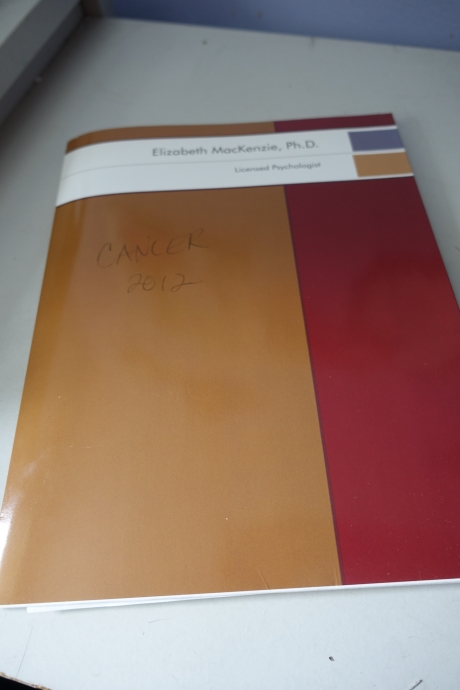
At the bottom of a pile on my desk, I found the folder in which I kept my cancer paperwork, labelled, “Cancer 2012”.

DSC04621


I opened the cover and saw a set of post-surgical instructions. I also saw Explanation of Benefits forms from my insurance. A year ago I many have put it back on the top of my desk thinking I might “need” it some day. That day, however, I threw it into the recycle bin and made a plan to write about it, as I am doing right now.

Another thing I found was the tote bag I was given by the Swedish Cancer Institute with their name and logo on the side. For the first several months of treatment, I carried a binder, also provided by Swedish, containing all of my pathology and blood work reports separated with tab folders, “Initial diagnosis”, “Lumpectomy #1”, “Lumpectomy #2”, “Mastectomy”, “Oncology reports”, etc. I called it, “my big bag of cancer.”  Eventually, I stopped using the bag but continued to use the binder, which was extremely helpful in keeping my treatment organized and making some kind of sense. It was actually a very handy reference guide to take with me to my appointments.

I looked at the bag and considered getting rid of it. I have a ridiculous number of tote bags due my past as an academic researcher. I did a lot of conference travel and typically, the conference catalog and registration materials are put in a tote bag. Some of them are very nice, very sturdy, and have, as a result, never worn out. Clearly, I did not need my cancer bag in order to lug stuff around. Honestly, I don’t need most of them. They just sit around, “just in case” I need them in the future.

However, one of the first thoughts to come to mind when I saw it was a visual memory of my wonderful breast surgeon, Dr. Beatty, carrying a tote bag just like mine, holding the things he needed for that day. He was the first of my many physicians with whom I developed a doctor-patient relationship. He and his staff were wonderful. I felt so taken care of when I went to his office.

The image of being held, not as an embrace, but as being supported and cared for came to mind. I decided that “my big bag of cancer” is a holder of good things. For now, I am keeping it. Next year, who knows?

I am amazed at the significance that objects have taken on through their association with my cancer treatment. Some of the associations are comforting. Some of them are painful. All of them are part of the truth of my experience, an experience that continues to evolve over time. Experience changes; at times, it changes a lot. But the past, the future, and the present all hold their truths and are all part of me. In my mind, this is the string that holds my life together and gives me great comfort.


During my two years of intensive cancer treatment and reconstruction, I cut some corners in my life.  During this time, I had eight surgeries and, at least, three medical appointments per week.  I also worked in time to deal with what was happening to me. There was also the rest of my life, working, mothering, making healthy lifestyle changes, being a wife, and finding time to take a break from it all.

It is only natural that some things did not get done. In some cases, I learned that whatever I’d taken the time to do before really wasn’t that crucial to begin with. With mindfulness meditation, I found myself taking up less time worrying and not having to take extra time recuperating from worrying. If you haven’t noticed, worry is exhausting.

But there were other corners that I didn’t want to keep cutting because doing so created overwhelming consequences like an overgrown flower garden full of weeds. Slowly, the front and back yard have gotten back into shape. I initially got help from friends and neighbors. Later, I just ended up hiring help a couple of times a year. Recently, I found out that I could get my yards maintained for a surprisingly reasonable price from a local landscaping/gardening business. So I am doing that.

The biggest mess, however, was my home office. This is where I store my patient files. To protect patient privacy, the door is always kept shut with a finger-tip sensor lock. After 15 years of private practice, I had never gone through my files to see what ones could be legally disposed of. I had also not set up my filing system with a future in mind that included storing several hundred healthcare records. They were just all arranged alphabetically and some were just shoved into boxes because I had run out of filing space. When I mean “some” I mean about three years’ worth of files were shoved into letter sized cardboard file boxes. Most of my records are kept electronically. The electronic portions of my records are organized very well. This is because electronic records do not have to be physically moved around to make space for new records. Consequently, it was easy for me to respond to requests for copies of reports or progress notes that I had written. In other words, the impact of my out of control home office was not detrimental to patient care.

However, it was detrimental to me because I knew that I could not sustain this way of doing things. It was just getting worse and worse. I stopped using my office as a work space. It was too stressful to be in there. Since I wasn’t using it as a work space, it quickly became a surplus storage place. Two weeks ago, it was difficult to walk around in that office.

I found aLast week was spring break for my daughter’s school. I decided to take the week off to take on my office. I had also seen it as a time to hit a “reset button” as the previous weeks had been particularly stressful. As it turned out, the job was bigger than I anticipated. It was also mind numbingly boring. But I now have an organized work space, files organized with the future in mind, and a whole lot less stuff that I didn’t need. I also got over my resistence to transitioning to fully electronic files. Some friends had ideas that got around some of the problems I had not discovered solutions to and having spent a whole week dealing with paper and cleaning has increased my motivation considerably.

I had a hard and boring week. Nonethless, I woke up this morning, with the full feeling of the “reset button” having been pushed.

This won’t last forever.

It won’t be the last time that I need to re-set.

Nonetheless, it feels extremely satisfying.

I’ve been trying to do a lovingkindness meditation each day of March. I have done one most days. I did one of them while I was taking one of my neighborhood walks. It is true that the meditation is designed as a sitting meditation but I was curious and decided to play the 30 minute-long meditation during a walk. It was actually quite a nice experience. The birds seemed to be singing more loudly and sweetly. The air had the scent of flowers.

As is typical of all mindfulness meditations, I was instructed to examine my current experience. It was suggested that I might be feeling physical or emotional pain. The instruction was to pay attention to the uncomfortable aspects of my life but also, “to see if there is something else.”

“Something else.” There is always something else. The suggestion in the meditation struck me as one of the most powerful aspects of mindfulness meditation, which is the consideration of the “something else” in addition to what is weighing heavily on the mind, body, or emotions.

There are those of us with a cancer experience who wince at words such as, “Cancer is a gift.” That statement omits the “something else”. The something else is life changing and painful in a way that merely writing the words, “life changing and painful” seem to discount the way that cancer changes everything.

For me, however, there is  another side. There is the side of not everything about my life as a cancer patient is awful. Not everything I made of my cancer experience was awful. Although I think about my breast cancer every day, it does not encompass my life.

My life is full of the “something else” in addition to the pain, discomfort, and loss in my life. My life is full of the “something else” in addition to the joy and emotional health I experience.

Life is full. I have long known this. It does seem that a gift of mindfulness is the opportunity to experience more of the “something else” and to get more aware of and engaged in the expansiveness of life, while not getting lost in it.

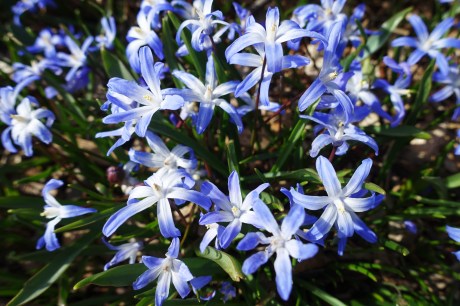
Today, the “something else” was experienced with by me with my camera. The small gems of beauty mean so much.

DSC04463

As part of the Mindfulness-Based Stress Reduction program that I’ve been completing, I’ve been doing yoga.  One of the positions is  “the chair”.  It is basically adopting a near sitting position, using the air as a seat. This requires the use of my leg muscles, particularly the muscles on the backs of my thighs. The psychologist on the video does a number of repetitions of the pose. The last pose is held for the longest amount of time. She says a number of things at this time, one them being, “sit back into that easy chair…” As soon as I hear the word, “easy”, I start feeling the burn more in the backs of my legs. The word, “easy” made it harder! Then she talks about how we might be feeling fatigued or warm. That’s part of mindfulness, noticing the sensations in one’s body, even the uncomfortable ones.

I have been doing this yoga routine for a number of weeks now. At first, I thought, “Why does she have to say that? She’s making it harder.” I soon learned that if I tuned-out her words and focused on her body language, which was relaxed, it was easier to do the pose. I soon became mindful that tuning out the words also meant tuning out my attention to the sensations in my body. I was merely distracting myself, which can be an effective coping technique at times, but it is not in keeping with my intent to do a mindful practice. I redirected my attention back to my body.

Today when I did this pose, I felt the temperature of my body rise. I felt the fatigue in my legs. But I also felt something else. I felt strong, strong enough to be my own chair. Every moment in life is different. Some of them are actually easy. Many of them are very difficult. Most of them are somewhere in between.

I don’t always have to provide my own chair. It gives me great peace, however, to know that when I need to do so, I can support myself, by myself.

As you may know, I have been taking pottery classes with my husband. The class meets one evening a week. The pottery is also available at other times of the week during “open studio”. Open studio doesn’t cost any extra. It is free time that is available to continue working on projects or getting additional practice. During the first quarter of the class, I didn’t use the open studio time at all. I thought about it, in passing, and then quickly told myself that I didn’t have time.

When presented with a new opportunity, I often tell myself that I don’t have time. I feel stressed and hurried. I am waiting for the other shoe to drop, something unexpected and bad to happen. I’d better keep on the look out!

I find, however, that at the times I am most mindful and aware, there is a space between the opportunity and my decision. It is a space that says, “Why not?” It says, “That sounds fun.” Or, “This is a good chance to do x, y, or z.”

These are the times I treat time in a doctor’s waiting room as time to put on my earphones and listen to a guided meditation. I don’t have to spend that time being prepared to jump up for my name to be called. I will hear my name, open my eyes, and go to my appointment.

A couple of week’s ago, I was making yogurt in my pressure cooker. I knew that it had about a half hour left before I had to tend to it. My meditations are 30 minutes. At first I thought, “But I won’t be ready when the pressure cooker beeps!” Then I laughed at myself thinking, “I’d better keep myself ready for yogurt!” So I meditated for the 30 minutes and walked to the kitchen. The pressure cooker beeped as soon as I got to it. See? No yogurt was harmed in the making of my sanity.

As I continue to make meditation a regular practice, I find my life slowing down. I find myself more productive at work because my concentration is better. My first inclination is to fill that time with more work. Aren’t we supposed to be busy and overworked? Doesn’t that make us worthy and competent? Doesn’t this keep the bad things from happening?

I find that it makes me tired, anxious, and irritable. I am happy to report that this quarter, I find myself working at the pottery wheel during open studio about once per week. I even went twice last week, once on Friday afternoon. I had actually gotten my work done for the week so I took the opportunity of extra time to do something fun. Bad things have and will continue to happen in my life but not during every moment or even most moments.

There are opportunities every day and sometimes the sense of having no time is just a feeling. Feelings are real and they have something to say. But they don’t always communicate in the most straight-forward fashion. Sometimes, they are telling you to slow down, pay attention, and enjoy the moment. And having the thought, “I have so much to do!” is actually not the same as getting something done, no matter how many times I repeat it to myself.

When I am throwing a pot, I look down at the clay on the wheel. Sometimes it reminds me of the Earth spinning day after day. My hands and fingers are engaged in every rotation. Today you might get an opportunity to try something new. Put your hands on it, feel it, see it, be in it.

Why not?


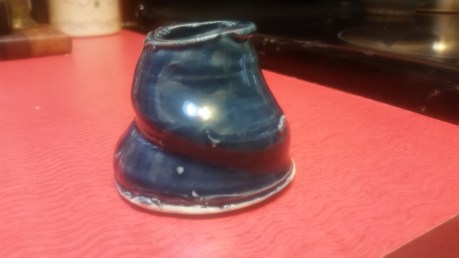
My first pot, started in September, was not what I had envisioned but then again, it was a step forward.

20160210_121401

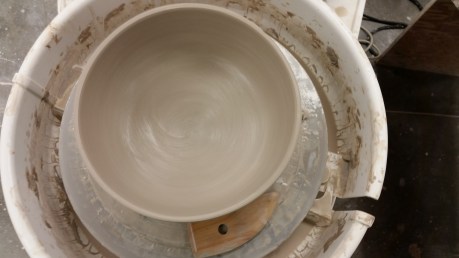
Here’s the pot I threw during last Saturday’s open studio.

20160206_142919

Can you imagine if people said everything on their minds? It is believed that there was a time in human history when this was the case. However, I don’t think we said a whole lot back then, either. At some point, human brains became developed to a sufficient extent that the motor cortex was able to suppress the muscles involved in speech so that we could have what we now refer to as thoughts. (Did you know that researchers have put tiny measurement devices on speech muscles and that they are able to detect movements, not discernible to the naked eye, while people are thinking? This fascinates me to no end.) Once we were capable of thought, we gained an important level of privacy and capacity for introspection.

We also gained significantly in the capacity to tell lies. Lies to avoid punishment, lies to seize power and dominate, lies to survive, lies to protect the feelings of others, lies for attention, and lies to self enhance. All of us have told lies, sometimes out of politeness but other times for very unhealthy reasons. I consider myself one of the most honest people that I know but even I have told unhealthy lies.

Right now we are surrounded by bald-faced liars on the national stage. It has become popular among a segment of our politicians to tell a lie after lie and not even pretend to be telling the truth. If the lie is repeated enough and has the “zing” factor or stirs up enough hate, it becomes truth. I find this incredibly sad, frustrating, and frankly, terrifying.

I abhor dishonesty that hurts people, including the unhealthy lies we tell ourselves. Yesterday, a story broke in my neighborhood newspaper citing “reliable sources” that a young women who lives in my community and who has been an extremely hard working fund-raiser for the Komen Foundation, has admitted (to the reliable sources) that she faked her stage 4 breast cancer.  I do not know her but I know some of her friends and she is well known in the community. I am not printing her name here because 1) the story has not been confirmed (I believe it will be national soon enough), 2) if true, she is someone with an extremely pathological need for attention, among other issues, and I will not feed that, 3) if true, a public shaming will not treat her mental illness, and 4) if false, oh, that would just be horrible for her.

If this is true, she has committed fraud and has done the unconscionable, over and over. Her alleged deeds cannot be undone by the amount of charity money that she has raised. People who fake cancer, especially those with a high profile such as hers, wear away at the trust of the very people we need to support each other. They encourage suspicion and cynicism.

Anger, outrage, hurt, sadness, grief, you name it. All of these emotions are justified. I have read some comments on the news story that have given me pause, however, most notably a suggestion that the only right thing for her to do would be to “commit suicide”. There were other comments by people who know her, people who even participated in supporting her at a very high degree. These were comments expressing shock and disbelief as well as the inconsistency between the alleged acts and their experience of this person. These comments contained a great deal of hurt but they also contained compassion.

I was more impressed by this compassion than I was with the hateful comments since comment threads are the convention sites for people to spout hatred. None of these folks were saying, “We should have compassion and she should not be held accountable.”  They also weren’t saying, “This is understandable and excusable.”

I have a lot of gratitude when I am able to function from a position of compassion. When the compassion is directed toward someone who has wronged me, it helps me operate more effectively and I am better able to maintain my own priorities, priorities of effectiveness, self-respect, and/or maintaining a relationship. The highest priority can be different for a given situation.

Compassion is active rather than passive. It is extremely powerful and I strive for more each day.

When I was still in my 20’s, I decided to give yoga a try. Maybe it was my age, but I had the idea that it was a bunch of gentle stretching and meditating. Yes, I’d seen photos of women doing challenging looking poses requiring great strength, balance, and flexibility, but surely beginning yoga would be a breeze. Plus I was young and strong. I signed up for a class at the student recreational center.

Oh, how wrong I was. Yoga, even beginning yoga, was hard! For one thing, it can be aerobic exercise! What????? I thought all of the deep breathing would be for meditation, not survival!!! It also required a great deal of strength. By the end of the hour, my arm muscles were in a spasm of fatigue. What was not surprising was my lack of balance. I am athletic but I am better at balancing while in motion than while still. I am also afraid of heights so the idea of doing a back bend freaks me out. That was true even when I was a much shorter and fearless kid.

The biggest surprise in yoga, however, was how incredible I felt at the end of class, lying in the corpse pose. Even though my body was exhausted, I felt a warm ease and comfort. I have returned to yoga a few times, but for whatever reason, I’ve had trouble making it a habit of more than 3 or 4 lessons, even though I very much enjoyed it each time.

I suspect some of my difficulty has to do with the fact that I need a class in order to get good at it and I am historically self-conscious about being “bad” at something for too long. Although I’ve flailed my way through many aerobic dance classes with my initial difficulties following choreography, especially trying to mirror a teacher whose right and left is opposite mine, I am able to get the steps eventually and by that time, I would be one of the stronger students in the class. Meanwhile, flailing is very effective at getting one’s heart rate up. Flailing will get you a good workout.

I don’t know what a yoga class would be like for me now that I’ve gone through cancer treatment. So much of it is flailing, trying to move forward, having everyone look at me in various stages of undress, and not knowing what the Hell I was doing except trying to follow directions and make some kind of sense. Everyone is different but I found having vulnerability and my body on display over and over as a person going through frequent and invasive medical treatments, I broke through some anxiety and self-consciousness. In clinical psychology, we call this exposure, meaning that I repeatedly put myself in anxiety provoking experiences, and each time with the world not coming to an end or anything, I learned to deal with it. But as I said, everyone is different and what is the appropriate level of exposure (literally or figuratively) for one person could be traumatizing to another person.

This is a personal blog and one of the things I try to convey is the fact that my life is highly fulfilling but also highly messy. My life is not an inspirational poster. I am not perfect and I am getting more and more okay with that. In fact, the more okay I get with it, the more okay I am with everyone else. So this is perhaps a very good time to give yoga another try. In fact, it is the latest practice in the Mindfulness-Based Stress Reduction (MBSR) program that I am doing.

Knowing what I know about MBSR, I did not expect the yoga to be super hard. I mean, after all, MBSR is used frequently with individuals with chronic pain problems. Also, I learned that yoga as a mindfulness practice is more focused on being mindful of breath and bodily sensations than on doing fancy poses. The video that accompanies my program is taught by a health psychologist and if you are keeping score at home, she uses Hatha yoga poses.

The poses are mostly stretching with a couple of strength and balance poses. The stretches are sublime, hitting every spot in my body that gets tight and achy. My favorite thing that the instructor says after saying that her motto is “No pain, no pain” is that we are to find “the sensation that is delicious”. That is exactly the way those wonderful stretches feel, too.

The strength and balance moves are a bit more challenging for me though not frustratingly so. A particular challenge are the poses that rely on abdominal muscle strength. Historically, I had naturally strong abdominal muscles. With my TRAM breast reconstruction two years ago, I lost one of my abdominal muscles. I haven’t done abdominal crunches since right before my TRAM surgery. I was instructed to a lot of walking and daily crunches to prepare for the surgery. I was already walking three miles a day and I got up to a pretty high number of crunches, at least for someone who does not hang out in a gym.

Imagine my surprise, when I was lying on my back with my knees bent and my feet on the floor, and I was unable to lift myself to a sitting position without putting my hands on the floor. My core is not working the same way as the yoga instructor’s core. My core got gored. By the end of the 30 minutes, I got that same delicious sense of relaxation and time well spent that I got at the end of the more rigorous classes of the past. I felt present, engaged, and exactly where I wanted to be. In spite of my flailing, my bobbling, and my imperfect strength, I felt great.

I may need to learn this lesson of strength, peace, and balance through imperfection, a million more times. And how wonderful would be? To learn this lesson a million more times is to live a long and mindful life.

For a few weeks now, I have been doing sitting meditation as part of the Mindfulness-Based Stress Reduction course that I have been completing.

I expected to have trouble sitting still.

I do.

I expected to be distracted by noises, thoughts, and sensations.

I do.

I expected to be bored at times.

I do.

What I didn’t expect was the small bits of anxiety triggered by stillness and silence. The meditation I do is guided, meaning that I listen to a 32 minute long audio file. However, as the meditation goes along, there are periods of silence, which seem to get increasingly longer. There are two spots in particular, somewhere past the 20 minute mark. Even as recently as two days ago, I opened my eyes, figuring that the audio had gone off on my smart phone. It hadn’t. It was just silence. And the silence passed. Then the voice came back on.

Today, I made an intention at the beginning of the meditation not to check for operating difficulties with my phone and to just treat the silence as if it belonged. By sitting with my anxiety and impatience, I learned that they went away by themselves without my having to do anything.

Another thing I have observed during sitting meditation is that I stop feeling certain physical sensations. This is natural, and in psychology, it is referred to as habituation. Sensory experiences fade when they are constant after a time. For example, when I visited Venice, I only noticed the city’s infamous sulfur scent for the first twenty minutes right after I awoke each morning. Then my perception of it was gone until the next day.

I meditate with my hands clasped on my lap. Today, after 20/25 minutes, I noticed that I could not tell if my hands were touching one another. It was almost like they were asleep except that they weren’t. In the past, I have moved my fingers slightly and I can feel again. There is something vaguely anxiety provoking about not being able to sense my own body. I don’t know if this is related to the vague unease caused by the numbness on my torso from multiple surgeries. My sensation is returning rather slowly over the years. It still doesn’t feel right to feel less.

Today, instead of moving my fingers, I just observed the numbness and my anxiety lessened. I have also observed itch and it has decreased.

I am so grateful for these small experiences, the lessons that most problems are not really problems, and much discomfort subsides if I don’t do anything to it, it I just let it run its natural course.

Stillness has a way of seeming like a problem because I am a person who yearns for feedback on my actions. But sometimes a still moment is just that and perhaps in time, even when unexpected, something to savor or just let be.

The Winter Solstice was three days ago. It has been so dark, which is to be expected at this latitude but it has also been persistently gray and rainy for weeks. Yes, there have been a couple of clearings in the sky, “sun breaks”, as they are called in these parts, but it has been pretty gray around here. Oh yeah, it has also been pretty windy, too windy for me to carry an umbrella during my last few walks.

As unpleasant as the weather has been, we eagerly anticipated the Solstice. This is the day when the pit of darkness finds its deepest point. On the 23rd, I took another walk. It seemed that I could actually tell that there was one more minute of morning light we had gotten. I knew that we’d get an additional minute on the end of the day.

Two minutes. Two more minutes of sunlight. I thought about it as I walked in the rain and wind. I thought about it even as the rain soaked my gloves and my hands grew cold.

Two minutes of light is noticeable.

Two minutes is meaningful.

I fixed my gratitude on those two minutes.

Thinking of this, I took another two minutes to do a visual mindfulness exercise. I turned my head to the left and looked at the plants and rocks that ran along the sidewalk. Turning away was a natural thing to do as during these moments, a rainy wind was pelting me in the face. I saw some interesting patterns and lovely colors.

In between these mindful minutes, I had a few thoughts of, “Wow, it is nasty out.” But those thoughts did not last long. I just returned to walking.

I got where I wanted to go. I found meaning. I found beauty. A couple of minutes at a time.

There are times in my life when those moments and small bits of time, the time that is not awful, provide a glimpse into a fuller reality. I find them anchoring.

Today I had more than minutes of not awful. Today I had a lovely Christmas with my family.

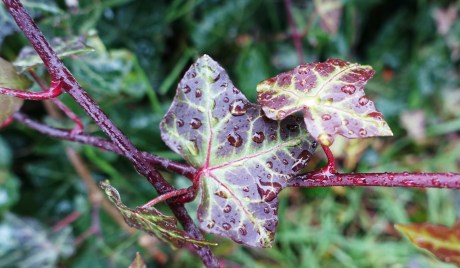
Ivy enjoying an extra minute of morning light. 12/23/15

Ivy enjoying an extra minute of morning light. 12/23/15

Lindbergh High School Reunion '82, '83, '84, '85

Join us this summer for our reunion in Renton, WA!

George Lakoff

George Lakoff has retired as Distinguished Professor of Cognitive Science and Linguistics at the University of California at Berkeley. His newest book "The Neural Mind" is now available.

KomenWatch

Keeping our eyes and ears open.....

4 Times and Counting

Confessions Of A 4 Time Breast Cancer Survivor

Nancy's Point

A blog about breast cancer, loss, and survivorship

After 20 Years

Exploring progress in cancer research from the patient perspective

My Eyes Are Up Here

My life is not just about my chest, despite rumblings to the contrary.

Dglassme's Blog

Wouldn't Wish This On My Worst Enemy

SeasonedSistah

Today is Better Than Yesterday

The Pink Underbelly

A day in the life of a sassy Texas girl dealing with breast cancer and its messy aftermath

The Asymmetry of Matter

Qui vivra verra.

Fab 4th and 5th Grade

Teaching readers, writers, and thinkers

Journeying Beyond Breast Cancer

making sense of the breast cancer experience together

Entering a World of Pink

a male breast cancer blog

Luminous Blue

a mother's and daughter's journey with transformation, cancer, death and love

Fierce is the New Pink

Run to the Bear!

The Sarcastic Boob

Determined to Manage Breast Cancer with the Same Level of Sarcasm with which I Manage Everything Else

FEC-THis

Life after a tango with death & its best friend cancer