Archives for category: Mindfulness

Separation anxiety is common for children. And some of them have it really bad. They follow a parent from room to room. They won’t sleep on their own out of fear that robbers, bogie men, or bad guys from t.v. will get them. They have nightmares with separation themes like being kidnapped, one of their parents dying.

Separation anxiety is treatable but it is intense because the way to break it’s spell is to prove it wrong. Children (and their parents) need time away from one another. They need separations. They need practice being alone and finding out that the world did not end and that everyone is okay. It takes a lot of practice to do this and you start with really tiny separations and work your way up. I typically have kids rate the stressfulness of different separation scenarios (ex. being alone for 10 seconds versus a minute versus ten minutes) on a 1 to 10 scale (10 being most stressful.) I tell them that with relaxation methods and the right incentives they should be able to face a situation as high as a 6.

A 6 can seem like a lot. So with little kids, I might have them give mom and/or dad a hug to “fill up the love tank.” Then it is his/her job to use whatever coping strategies they have to keep it full and stave off the anxiety that typically makes them run back to Mom or Dad, thereby reinforcing the spell of irrational anxiety.

I have been applying this concept to myself, not so much that of a “love tank” but to no longer think of myself as some limitless supply of energy, emotions, and thoughts. I need to do things that fill me up. It is part of my mindfulness practice and my commitment to better self care.

There are plenty of things I can do that fill my time. I don’t have the bandwidth I used to have. Maybe it will come back and maybe it won’t. Although I am getting stronger, there’s still a discrepancy between the amount of mental stamina I need to function the way I used to and the amount I actually have. I have not yet been able to return to my normal reading habits. I used to read a book everyday. I’ve done this since I was a young girl. Every once in awhile, I would have a couple of week period or even a month when I was not reading a novel or a work of non fiction. I have read very little besides blogs for the past couple of months. It is too hard to concentrate after I’ve completed everything else on my to do list.

After my brief barrel of monkeys experience with hyperactive Facebooking, I find myself striving for balance, once again. You know what one of the harder things about balance is for me? It’s not black and white. It’s about having some but not too much of one thing so I can have some, but not too much of another thing, and so on and and so on. It is simpler sometimes just to go without. I spent about 4 years of my 20’s never eating sweets. I just thought it was easier that way. It helped me keep down my weight. But I missed out on some good grub. Four years is a long time. I still don’t eat a lot of sweets but I eat some and have learned to be more moderate about it. And a little chocolate is good for the soul, people.

A problem with excessive use of electronic media is that it doesn’t fill people up. We can’t be healthy with chocolate all of the time, even if it is that tantalizingly delicious Dagoba chocolate. Excessive screen time just occupies minds. I see this with kids with ADHD all of the time. Contrary to appearances, they are actually typically under-stimulated. All of the daydreaming, screen use, jumping around, etc serve to increase alertness by increasing dopamine activity. And screen time is the easiest way to keep their minds busy and occupied. And they will play them forever if allowed to do so. And when the plug is pulled, there’s often acute distress. “World, stimulate me! I am depleted! This is too hard! I can’t entertain myself! Give me back my screen!”

 
There are so many aspects of blogging, social media, and just the Internet in general that are extremely valuable to me. But others, not so much. And too much makes me unable to deal with the quiet of my mind. “Entertain me, world!” But the quiet of my mind is important. Silence is important. It is important for me to be alone with my thoughts and to not fear where they will take me in this very uncertain time in my life. I can’t occupy my mind to fend off the what if’s and the what could be. I know that the more I avoid these silences, the harder they will be for me and the more I will try to avoid them. Avoidance of being alone, just alone with my thoughts, even the scary ones feeds a spell. It feeds the spell of separation anxiety, not just the fear of being separated from my family by death but the fear of being bored. That’s sounds ridiculous, right? But I ask you to look at a bus stop full of people tomorrow morning. You will see that all of them are looking at their Smartphones!

I don’t want an occupied mind. I want an active and creative mind that also knows how to tolerate the slow parts of life, the parts we need for restoration and peace. I am not leaving the land of screens. I am just trying to be more careful about how and why I use them. So I am now asking myself, “Does this fill me up or does it just occupy my mind?”
Being a breast cancer patient has tested both my physical and emotional privacy. Although I have no alternative frame of reference, being a psychologist with breast cancer has added another precarious layer of tricky boundary issues.

The physical exposure is obvious but I don’t think most people, unless they have been pregnant or have had a serious medical issue, can fully appreciate it. You’re asked to be naked all of the time or in the case of a breast cancer patient, half-naked all of the time. You get handled, prodded, squished, injected with radiation, pierced with needles and wires, sliced open, and flooded with chemical warfare. I’ve met so many O.R. nurses while climbing onto an operating table in a flimsy gown, only seeing the hazy outline of their faces because I am so near sighted without my glasses. During four surgeries, while unconscious, adhesive electrodes were placed on the front and back of my torso. A part of every first shower following surgery was finding one or two that were left behind. In addition to the bandages, drains, and incisions, this was another reminder of the way my body was cut, pasted, and manipulated while I was unconscious.

Emotionally, I have been vulnerable and scared in front of so many strangers, wonderful strangers, the healthcare providers from whom I have received my assessment and treatment. Many of them are strangers no more but there are a number of folks whom I’ve met only once.  Walking in with my husband to the Swedish Cancer Institute for the first time, just my being there broadcasted the very private information that I had cancer. Before I even handed over my insurance card or gave the patient coordinator my name, she knew that I have cancer because I was at the Women’s Cancer Clinic. Everyone in the waiting room knew, too, if they happen to notice me. The second scariest thing about my life (told you, parenting is scarier), a very private matter was revealed to so many whether I wanted it to be or not.

As you know, I am child/adolescent psychologist with a private practice. At the time of my diagnosis I was booked out for three months. I didn’t know my treatment plan except that I would have at least one surgery and probably take tamoxifen. I didn’t know whether I would have radiation treatment or chemotherapy. I knew very little about the logistics of my life and how they would impact my practice.

I don’t know about you, but if I wait three months for a doctor’s appointment, I don’t really like it to be cancelled at the last minute. And I particularly wouldn’t want to reschedule for another couple of months only for it to be cancelled again. I figured that the families of my patients would feel the same and if I appeared to flake out on them, not only would the needed services be delayed, but my reputation could be harmed. I am a small business owner. A bad reputation threatens my livelihood.

After talking with my colleagues in my psychologist consulting group, I decided that I needed to tell the parents of my patients something. (As an aside, this group, along with my own psychologist, helped me continually assess whether my illness or the stress surrounding it were significantly impacting my competence, in which case I would have to transfer all or a portion of my caseload, as is required by law.) I initially decided to tell the parents that I had “a serious but treatable medical issue.” I tried this a couple of times and the acute anxiety in the faces of the parents was rather distressing to me. So I ended up telling parents that I had breast cancer, a very good prognosis, and as much detail about how it would impact my schedule as I knew. That actually worked a lot better. Fearing that some parents would under-report issues to avoid burdening me, I also told them that they had to tell me if they were not able to get from me what they needed so that I could refer them elsewhere.  Since I do a lot of assessment, it meant telling people I’d not even met about my health. I wanted to them a chance to schedule with someone else if they didn’t want to take the chance that I would be unavailable. Fortunately, out of about 18 assessments, I only needed to refer one family. I was able to carry off all of the others, many of them during the month between my diagnosis and my first surgery. As a frame of reference, for the type of assessments I do, completing two per week is considered a lot and I was writing about three reports per week during that month. (I’m getting a little off topic but I am kind of amazed that I was able to pull that off.)

And sometimes the physical lack of privacy crossed into my experience with parents of patients. Guess what? Some of the parents of my patients work in hospitals, my hospital. And one of them works in one of the pre-op areas where I hung out in a flimsy hospital gown, sometimes with my ass hanging out and other times mercifully clothed in a pair of hospital pj bottoms. And that person was really nice about it, allowed me as much dignity as possible, gave me a hug before each surgery, and gave me extra pillows.

So how did I deal with having my ass hanging out, literally and figuratively? As for the physical privacy, although I am somewhat modest, I knew I had no choice and got over it. When nurses, physicians, or technicians apologized to me about the discomfort of procedures, I just said, “I know you are trying to help me. Just do what you need to do.”

In my practice, I learned to deal with inquiries about my health with appreciation and a short and positively worded reply. The only time I initiated the subject was when I had an upcoming surgery that would impact scheduling or require a long absence. When parents emailed me during my medical leaves inquiring about my health,  I gave them a short and positively worded reply sometimes followed by the statement, “Now I am going to take a nap” just in case there was any question that I was not available for clinical consultation.

Although I believe that I have navigated all of this quite well, the lack of privacy has gotten me too used to not having it. I also share much of my inner life on this blog and for the most part, I navigate the privacy boundary in a way that may not be comfortable for everyone but that is comfortable for me as well as for my husband. And I have reaped so many benefits from my blog. I have met incredible people and become part of a powerfully supportive community. And I wouldn’t have them if I hadn’t written about my experience, sometimes in intimate detail. But sometimes I wonder if I disclose too much on my blog. Other times I know I disclose too much about my thoughts and feelings to friends and acquaintances. For example, I believe I have told a substantial portion of my life story to the new psychologist that joined our office a few weeks ago. She still likes me and is pretty chatty herself. But still, this is not the way I want to conduct my life, spilling my guts, every 10 minutes.

In another one of my “duh moments” I realize that I can’t keep acting as if everyone is entitled to and interested in hearing my life story, just because an incredibly scary part of my life, my breast cancer, is out in the open. The parents of my patients needed information and reassurance. I’ve told my healthcare providers, “Do what you need to do.” And that course of action worked for the most part. But I am at a different stage in this process, one that allows for more privacy than I am currently allowing myself to have.

How do I keep my boundaries in check? What is my touchstone? Although my life is more settled it is still very intense. The positives and the negatives stand out in sharp relief. What keeps me grounded while I experience a technicolor world with the bluest sky, the strongest joy, the most heartfelt gratitude, love that is surrounded by birds and flowers, and the scary cliffs of opportunity or ruin?

Your own touchstone may be different. I think mine is a question, which must first be answered before any additional questions are posed or actions are taken.

“Elizabeth, what do YOU need?”

This content is password-protected. To view it, please enter the password below.

I’ve been thinking about a mother and her teen daughter with whom I’ve worked in my psychology practice. They had lost their husband and father ten years previously to cancer. What I remember most was the mother’s comments about their grief as a mother and daughter, that they loved their new family (she had remarried and had another child) and that they were capable of happiness. But each day they grieve for the loss of a father and husband and the grief co-exists alongside the happiness.

I feel in my own grief process regarding my breast cancer that my efforts to integrate it into the rest of my life experience is resulting in this kind of accepting co-existence. I am still working on it, but I feel close to the next place I need to be in this. And I know that I will additional opportunities to grieve my experience. (Our brain is kind and often gives us breaks in between periods of grief.) And I know that I will have other losses and challenges in my life that will test my fortitude and serenity.

But today, I am reminded of my favorite hymn. I don’t really write about my religious beliefs. And part of that is because people fight about it. I don’t need to have people fighting on my blog. Another part of it is that I really haven’t managed to hammer out all of the details of my beliefs. And suspect that I never will. That God is love and that we are here to care for one another, are my central beliefs, which I suspect will never change. And I will always love this hymn. I hope that whatever you believe that you will appreciate the message of hope, love, and resilience.

My life flows on in endless song;
Above earth’s lamentation,
I hear the sweet, tho’ far-off hymn
That hails a new creation;
Thro’ all the tumult and the strife
I hear the music ringing;
It finds an echo in my soul—
How can I keep from singing?

What tho’ my joys and comforts die?
The Lord my Saviour liveth;
What tho’ the darkness gather round?
Songs in the night he giveth.
No storm can shake my inmost calm
While to that refuge clinging;
Since Christ is Lord of Heaven and Earth,
How can I keep from singing?

I lift my eyes; the cloud grows thin;
I see the blue above it;
And day by day this pathway smooths,
Since first I learned to love it;
The peace of Christ makes fresh my heart,
A fountain ever springing;
All things are mine since I am his—
How can I keep from singing?

(The history and text for this hymn can be found here.)

(Enya recorded a lovely version of this hymn in the 90’s though I prefer to hear my mother’s and perhaps I will be able to twist her arm into singing it for my blog.)

This content is password-protected. To view it, please enter the password below.

My dear friend, Rachel, just posted a comment on Facebook, “I think I’m about to get in trouble on a friend’s page. Best shut my yap.” My response was the following comment: “Do a cost/benefit analysis and then proceed accordingly. I saw my comment in print and thought, “And to think I used to write poetry.”

But when it comes to sticking our necks out and debating, it is probably pretty good advice. As I have described elsewhere, I am naturally argumentative and love a good debate. You may recall from an earlier post that my fellow grad school mate, Penny once described me in her amazingly wonderful Appalachian drawl, “Elizabeth would argue with a post.”

Some of those arguments were transformative and some were just fun. At other times, they were draining, left me in a lingering state of emotional turmoil either because I felt hurt and/or that I felt that I had hurt someone else. I am not a mean person but I am a quick thinker and when hurt or angry, I can use my verbal ability in a very aggressive way. This was particularly true in my teens. One of my high school teachers wrote in my senior year book, “I will miss your acid tongue.” I don’t think he missed it because he ignored my Facebook friend request when I put it out there a couple of years ago. And I could see that he was active on Facebook and friends with other students.

An excellent lesson I learned during the horrible work situation that led to my first of two major depressive episodes was to trust myself and choose my battles carefully. I spent nearly three years at that workplace, surrounded by some amazingly competent and dedicated people and others, well not so much. And since the folks in the “not so much” category were in management, even us amazingly competent and dedicated underlings misbehaved. I spent a lot of time in conflict with managers and coworkers because I felt both personally and professionally attacked and unable to do my job. I was given two managers, with totally different training, and totally different goals. In other words, it was a structural set up for failure. Before I fully realized how futile my situation was I spent a lot of time questioning in my head, “Is it me or is it them?”

Sometimes arguing for me is an intellectual exercise or sport. At other times, it has been a way of seeking reassurance when I am anxious. I did a lot of that kind of arguing at that place of employment. The illogic and chaos of the place was so disorienting. If only I could explain my ideas logically or counter criticisms in a reasonable manner, the universe would become organized again.

The universe didn’t reorganize itself until after I was laid off from the job in a very nasty way. But it was freeing. I got my depression treated. I got my Washington state psychology license and planned to start a small private practice in case my research career, the one I had fought to achieve and maintain over the span of 20 years, wasn’t viable. I wrote a small grant with a software company that designs web-based training, using a rather ingenious curriculum design developed by a professor at mid-west university. The grant was from the U.S. Department of Education to develop a pilot educational program. This was truly exciting as I had been working in computer-based parent education program research and development since my doctoral dissertation. Telehealth was a new, growing, and much needed research area. I live in a metropolitan area but I spent my training years, six years in North Carolina, one year in northern Florida, and two years in southern Indiana, working with rural families with very little access to even the most basic parent education on how to help little kids learn to cope with the difficulties in life in ways other than hitting, kicking, or throwing tantrums.

For my doctoral dissertation, I had carried out an independent project (as opposed to working on a professor’s project) a clinical trial evaluating a parent education program that I developed along with my husband, who is a software engineer. The results of the trial were modest, but positive and statistically significant. Working with an established professor translating parent education to his web-based instructional design meant continuing a line of research using technology as an additional mental health service delivery method.

You know I love writing about context. This is why I am not making a long story short. If you have not yet gotten my message, I was REALLY invested in my line of research. Getting help to under served populations. Preventing the really treatment resistant mental health problems that can develop in folks who don’t get early intervention, many of whom end up being “treated” in our penal system. This may sound overly self-important or idealism bordering on delusion, but I really viewed it as a vocational calling of sorts.

Back to the grant. We spent the $50,000 the government provided very very well. The pilot project was a success and something of which I will always be extremely proud. The parents who used the program loved it and they also provided me with very positive feedback regarding the email-based discussion thread moderation and coaching I provided to them as they completed our little program.

Although I enjoyed working with my co-principal investigator, the Big Time University Professor, I was extremely unhappy with a key staff member at the company, with whom I interacted daily. I think it basically boiled down to his taking a different role on the project than the one that he had been accustomed to, which was being in charge functionally if not officially. In other words, management had been very hands off. He really did not like this and fought me over everything including the program content and learning objectives.

I also disliked managing a project being carried out in the Midwest while I lived in on the west coast. It was time to write the “big grant” the one that was the follow up for the pilot grant (the granting mechanism was defined as a two-stage grant, the little grant followed by the big grant.) If the government were to funded the second grant, it would have been a $250,000 grant, which is not enormous in the research world but it is significant and a huge amount for a researcher at my career level.

I knew people in Seattle with relevant production and project management experience. REALLY GOOD PEOPLE WITH WHOM I’D WORKED WELL IN THE PAST. I’d contacted nationally known researchers, primarily psychologist and they had agreed to serve as consultants on the grant with no financial compensation. (That is standard, by the way. Psychology professors do a lot of stuff for free.) The pool of possible Internet programmers in Seattle was huge compared to a small university town in the Midwest. The professor and I set up a meeting with the company C.E.O. I wanted to request that I hire a Seattle crew to carry out the project, should the grant be funded. Big Time University Professor thought this was a grand idea, in fact I think he was even the one who suggested it.

C.E.O.’s response was a surprisingly loud and angry, “You work with the team you’ve got or we part ways.” I REALLY wanted to write that grant. But I was clear about what I was and was not willing to put myself through in order to get that chance. He had made a bold and seemingly bullying move. I calmly replied, “If the only choices are to keep this team or to part ways, then we will part ways. But I think there are other solutions to this problem. Let’s discuss those.”

I didn’t argue but I stood my ground. The small grant was over. I was back to collecting unemployment. My family needed for me to make an income. It wasn’t just about my idealistic goals or my career. It was about putting food on the table. The meeting ended on an ambiguous note something along the lines of “Let’s keep talking about this.”

My gut told me to get out and that what looked like a wonderful possibility would not be in reality. The C.E.O. was not a bad guy but he was disrespectful and I had no confidence in his ability to treat me like someone with something of value to offer the company. They were also struggling financially, had been through a number of rounds of lay-offs, and a few years later, the company folded. So he was also trying to protect existing staff rather than to expand the company into Seattle.

My husband agreed with me and I declined to write the grant. It was disappointing but felt like the exactly right decision. I ended up getting on research staff at the University of Washington and starting my psychology practice. I ended up loving both jobs, the former as long as it lasted, which was three years.

These days, I keep my arguments with posts (figurative or literal Facebook posts) to a minimum. I try to think about the costs of acting as well as the costs of not acting. I think about what things I will not get to do if I am busy arguing. I think about the fairness and strength of my argument. I consider the other side. I consider other solutions to the problem. I think about whether I am trying to solve the right problem.

Conflict is a fact of life. Some conflict is even necessary for life, especially if one has relationships with at least one other human being. But conflict as a way of life? No, thank you. I’ve got too many other things I want to do with myself.

My husband built a deck off of the second story of our house. To say that it is beautiful is an understatement.

July is the driest month of the year so he waited to stain it until now. We also have a large wooden patio off of the ground floor, which is in need of refinishing. John got some stain samples, which he carefully applied to samples of all three types of lumber he used to construct the upper deck. We chose the stain color together.

He started staining last weekend. He ran out of stain on Sunday. The kind he purchased was not available at any of the stores that are open on Sunday. Additionally, this stain is quite expensive. He decided, after consulting with me, that he would buy a similar color, more economical stain for the lower deck. However, this time, he did not test the stain on wood samples. John just started staining away.

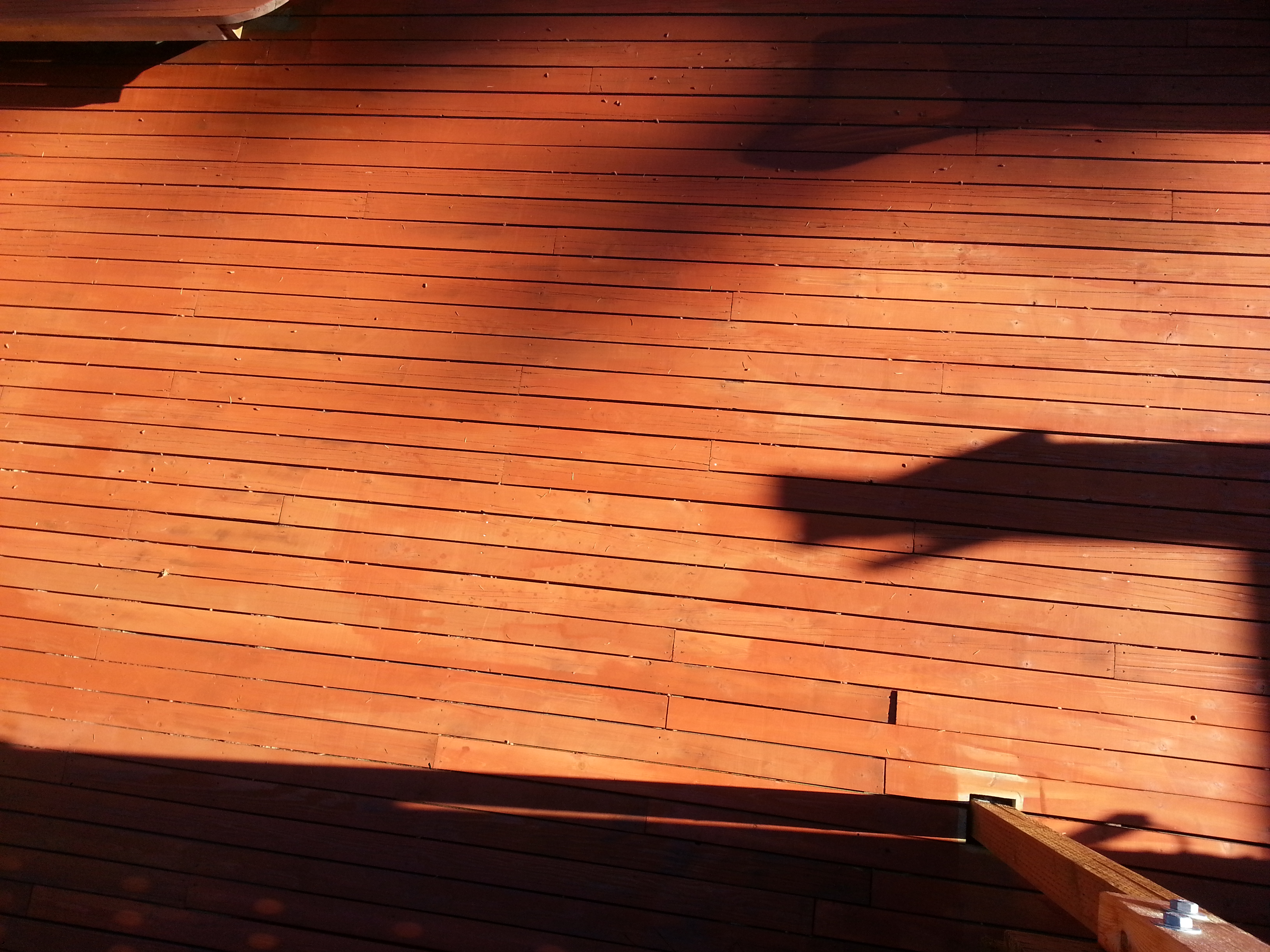
By the time I looked at it, here’s what I saw.

20130715_081910(1)

When John asked for my input on the deck color I said, “No orange.”  There it was, a sea of orange. And I felt irrationally anxious and angry, not so much with my husband but with the color.

I may have asked John to sand off the finish.

I may have even characterized it as “looking like ass.”

I may have said, “Maybe I can learn to live with it but it looks like BREAST CANCER!”

I have had a couple of run ins with Oompa Loompa orange during my time as a breast cancer patient. I tried to make light of it and I actually enjoyed writing posts like Wonky Wonka Boob. During the initial placement of the tissue expander, betadine was used to prep my skin for surgery. I also had trouble with some tissue necrosis after that surgery. Since the betadine was not removed during surgery, I was left with a Oompa Loompa orange “breast”, complete with tissue necrosis. When I had a skin graft the following month to correct the necrosis, I was awake. I saw the nurse put betadine on my skin as she was prepping me for the surgery.

And guess what? Betadine is a liquid, just like deck stain. And it stains the skin just like deck stain puts color on wood.

What’s the big deal about having orange skin, Elizabeth? You’ve had a wire in your nipple, been injected with radiation multiple times, had each boob squished for 7 minutes at a time for a PEM, and had a mastectomy that made your chest wall look like Craters of the Moon.

The difference is that my first two plastic surgeries took place at a time when I was mentally and physically exhausted. I was working too many hours upon my return to work following my mastectomy. It was hard to know how much work I would be able to handle and I guessed too high. And even trickier is predicting the times when the strong emotional consequences of dealing with breast cancer will come crashing down. And in the fall of 2012, there was about six weeks when theo accumulated stress and grief that came crashing down over me.

So orange has become associated with a really low scary time of cancer. Some might even say that it is a trauma cue for me. Stress can cause trauma but not all stress is traumatic. And not all people who’ve been traumatized developed Post Traumatic Stress Disorder (PTSD; I mention this just for clarification because I don’t think I have PTSD).

I knew I was stressed. I knew that I was experiencing grief. But trauma, that was news to me, until I went off on that orange deck.

I’ve got a lot more emotional work left to do on breast cancer. I’m going to keep digging. Fortunately, I have a big and strong shovel.

Last week I had one clinic day (Monday), followed by six days of painting and redecorating my private practice office. My daughter was also gone on a band trip during this time. So this week has been about transitioning back to my normal roles and routines. It was really hard, much harder than I expected. My brain was fragmented for several days.

Even more distressing was the fact that I felt really anxious and unsure of myself outside of work. This was particularly difficult socially, especially with my cyber friends. Cyber relationships do not have the same familiar codes and handshakes on which I gauge other social interactions. My cyber buddy, Greg Smith, wrote about the limitations that electronic communication put on his “Spidey Senses” in navigating his interactions with patients via Skype. He is an emergency department psychiatrist who practices telehealth in his job to provide consultation to patients who live far away from services. (As an aside, although my psychology practice is in Seattle, a “little big city”, the majority of my training was done in rural areas. Access to care is a major big deal.)

Earlier in the week, I found myself anxious that I’d written the wrong thing to one cyber friend or worrying that another cyber friend thought that I was a creepy stalker because a compliment I’d paid to her did not seem to go over in the way I had intended. I worried that I was being too flirtatious with cyber friends, male and female. I thought about what I might do to repair relationships that may have been damaged by my electronic awkwardness.

I have not felt that way for a VERY long time. What the heck is going on? I’ve had cyber buddies for awhile now and although I am sometimes frustrated by the limitations of this form of communication, there are benefits as well. When I write, I can communicate without interruption, for one. That is a major gift to me in this time of my life when some level of introspection is needed for health and healing. But I do miss the body language, tone of voice, or even hearing any of my cyber buddy voices. And I know in my own communications, the parts of me communicated beyond the words that I write or by my smile in the photos I post, are lost.

Last week, I dredged into some painful past experiences to write the post, Predator, about my own experiences with sexual harassment as a teen and how they relate to the sexualization of breast cancer.  If you’ve read the post, you know that the experiences I wrote about are very typical for women my age and most of the experiences still occur with girls and women today. The post resonated with a lot of women and I was very glad to have written it. I also suspected that it would help me integrate the vulnerability I have felt as a breast cancer patient to another time in my life when I felt scared and vulnerable.

I knew this would be a hard post to write and even waiting until my mother went on vacation to post it. I know that by the time she comes back home and reads it, I would have processed through the hard emotions and she would not have to worry about me so much. She had already suggested to me a couple of posts prior that I needed to take a break and write something light and/or funny. It’s hard to see one’s child in pain, even when she is 47 years-old.

Writing the post was harder than I expected and was like taking a time machine back to the worst parts of my adolescence with the extra layers of breast cancer and being a mother of a vulnerable teen girl.

Actually, let me put it this way. It was like being 16 again.

There are folks that rhapsodize about their youth and feel that they have lost something. Don’t get me wrong because I had a generally happy childhood and adolescence, but I am happy where I am. I have never had a stronger combination of individual, familial, and professional satisfaction than I have experienced in middle age. Emotionally, I feel so much more solid, as well. And this is not because my life has been easy in middle age. It is a benefit of maturity. My parents are very happy people who love their family, friends, and each other. They help me look forward to my future, should I be so lucky to live a long life.

Back to being 16 again. Do you all remember what your teens years were like with your peers? I don’t know about you, but although I had good friendships, they involved a frenzy of unnecessary activity. Worrying, “Did I say the right thing?” “Should I have said that?” (That was a popular one for me. I am loud and chatty.) “Should I have looked at him that way?” “Did I hurt her feelings?” Then I would go and try to repair things. Later in my life, a good friend would characterize my repair attempts as, “Elizabeth, you flail.” Now she has more of a passive, slug like coping style but in respect to the situation she was describing, I was totally and completely flailing when I should have been leaving things alone.

These days, I typically feel solid as a communicator. There are parts of me that can be perceived as being “too much” (see “loud and chatty”, above). This was particularly true in the past. I have learned to be myself with confidence and I think part of what bothered people about the big parts of my personality was the anxiety and lack of confidence that were sometimes underneath. Now I get a lot of compliments about my loud laugh and I can tell from patients and their parents that for the most part, they enjoy the fact that I am a happy person, eager to help, and a lover of my fellow human beings, especially the small ones. But I also know when I need to scale things back and tone them down. It’s a dance of a sort and in my profession, I am usually extremely good at it.

To be 16 again, was no fun. I saw Rebecca, my psychologist yesterday. The session may have only lasted an hour but by the time I left, I’d aged 31 years.

So cyber and face-to-face buddies, I am ready to play like a grown-up again.

Photo by Aaron Eidinger, 1983-ish. I am 17 or 18 in the photo.

Photo by Aaron Eidinger, 1983-ish. I am 17 or 18 in the photo.


As a child/adolescent psychologist, I work with a lot of moms. They often express feelings of guilt for their children’s challenges. I often respond by saying, “You have the rest of your life to feel guilty as a mother. Save some for later.”  This statement usually gets a laugh and often the guilt although not gone, is small enough for us to move forward in our conversation. It is often, however, not so easy. People get stuck. Even psychologically solid, reasonable parents can get stuck on guilt. Several years ago, I worked with a wonderful mom of a very young child who was showing signs of significant developmental challenges in multiple areas. She had professional experience working with children and was acutely aware that her son may have handicaps that would greatly change the future possibilities in his life.

Although there was no evidence that she had done anything to contribute to her son’s difficulties and further, it was yet unclear as to whether his difficulties would be short-lived or chronic, she felt guilty. She felt guilty and stuck. During one session I asked, “What do you think you are getting out of this guilt?” She looked at me understandably with a confused expression. I went on, “It may sound backward but sometimes people hang onto guilt because it gives them a sense of control in situations in which they feel totally out of control. We cannot have guilt without a sense of power, even if the power we feel is to harm.”

She was dubious but I had planted a seed. She came back a week or two later and basically told me that she had thought what I had said made no sense but upon careful reflection, it actually made sense. It was a turning point in her grief process.

Guilt is blame turned inward. It can also be turned outward. In Atom Egoyan’s 1997 film, The Sweet Hereafter, a town grieves for the loss of a busload of school children in an accident. Ian Holm plays an attorney who travels to the small town to file a class action law suit against the bus company. He has his own grief back story, which is his adult daughter’s drug addiction. Holm’s character tirelessly pursues blame. Someone must be responsible for the tragedy. That someone must pay. Things don’t just happen. They happen for a reason. He was going to find the reason at all costs. I won’t spoil the ending for you but let’s just say that letting go of blame and accepting the loss of control is a major theme of this film.

As for myself, I have had issues with letting go of anger. There is a release that comes with losing my temper and in the moment, it feels good. But because I am at heart a peacemaker and an empathetic person, I feel regret at having hurt other people, especially my husband. My anger is usually rooted in anxiety, anxiety that a problem can’t be controlled or solved. Anxiety that my house will never be an environment that I can control and make a sanctuary. Fears that my cancer will return. Fears for my family, especially my teenaged daughter. I have fears of not being a good enough psychologist when my patients are having particularly treatment-resistant struggles.

Most people would consider me to be a very disciplined person. One exception to this has been my life long struggle to eat healthfully and to exercise regularly. I love food. I am an excellent home cook and I love good restaurants. I love to eat a large amount of food. The act of eating is an amazing, highly enjoyable, sensory experience. It is also a wonderful social experience. And I know when I am overdoing it and often in my life, I just keep eating. And at these times, it seems too hard to put the time into preparing healthy meals. Quick and easy is convenient but not nutritious.  The rest of my health suffers and I just don’t feel as good during the non meal parts of the day. It also feels good sometimes, not to exercise. “Ah, I can just sit here and rest.” This is particularly true when I let my work and family life burden me. I work too many hours at work and at home, doing things and worrying about people. I am tired and I feel that I deserve to rest even though I know that I deserve the kind of treatment that promotes good health. But like many caretakers, I put my self-care low on the priority list even though I have counseled countless moms to avoid this. But putting my health at lower priority made my daily to-do list shorter. It made it seem like I was juggling fewer balls in the air. It was a false illusion.

In my 20’s, I gained and lost the same 20 pounds over and over. By my 30’s and 40’s, I have gained and lost the same 40 pounds twice. Right now, I have given up the convenience and the joy of eating to the point of indulgence for healthier foods. Yes, it is work to plan my meals, to make entrees ahead and freeze them in reasonably-sized portions. I take the time to make sure that I always have healthy vegetables on hand. I love vegetables and you know what, eating a large volume of vegetables is actually good for me. And I’ve gotten so that I look forward to my daily 3 mile walks. The key for me was realizing that I was self-employed and could therefore set my own hours! I am better at exercising in the morning and had been trying to add it to the end of long clinic days, which didn’t work at all. So, I just started seeing my first patients at 9:30 am instead of 8:30 am. What a rut I was in to not think of that solution years ago!

Letting go of these things has required patience, which does not come naturally. But I have grown and changed over the years. I have learned to manage my anxiety pretty well and with my mindfulness practice, I am learning to practice acceptance and further, that acceptance is not the same as doing nothing. It is not accepting that can spin me in circles, feeling like I am doing something but getting no where. Endless anxiety and anger can be a trap where you expend so much energy that it feels like you are doing something productive and your are not. And as a person who has been clinically depressed twice in my life, I can tell you that the helplessness and hopelessness of that passive state is one of the loneliest places in the world. I can’t tell you how thankful I am that I have not been near that place for over 10 years.

It can be hard to let go of anger, of grief, of impatience, or anxiety, of sadness, of guilt, at the point when I need to move on. Emotions are vital to our lives, even the “bad” ones. They motivate, protect, and educate us. But they do not always work in a healthy way with our thoughts and behaviors. I know that I will be working and reworking this balance for the rest of my life. I try not to think about how things “should” be in respect to things over which I have little control. I got breast cancer when other people with similar lifestyle and risk factors did not. I got it when people with more risk factors did not. Disease is part of the natural world and it doesn’t make sense to me to be mad at the universe. That just doesn’t work for me and the cost is too high.

We all have to make our own paths in life. In my life, I feel pretty unstuck right now but know that the cost of each day is a different set of gains and losses. Yes, I have lost the illusion of control but I have gained so much. I write this to reflect. I write this to remember the peace I have in my life at this moment.

I let go to gain freedom. I let go to go on.

When faced with cancer or any other serious illness, it is only natural to think about the uncertainty of our futures. Lately, I find myself thinking about this more frequently. A year after diagnosis, I find myself finding more and more room for non-cancer related life, “the new normal” as it is often called.

I find myself thinking that I have no way of knowing whether I have cancer in my body or not. Frankly, this is the truth for everyone with “no evidence of disease.” I don’t know if it will come back. I also know that just like everyone else, I may have a different serious disease or injury in my future. And my family and friends will face illnesses and other hardships. We often think about disease and death as the enemy, but they are part of the natural world, and we will all face them.

By nature, I crave certainty and dislike ambiguity. In my job, I help kids and families reduce the chaos in their lives. I am the family administrator at home. I may have even been described as a “control freak”, maybe just maybe, once or twice in my life.

The last two years have been the most challenging in my life. I been been mired situations that I’d hoped I’d never have to face, full of ambiguities and dire possibilities.

What I have been noticing the most in the last month or so is the fact that I am not freaking out. Even in the scariest, grayest parts of these years, I’ve found a constant. There has always been love. Love from family, love from friends, love from healthcare providers committed to help. And the love I have for others is stronger than ever.

Life can be murky, ambiguous, and downright scary. But love is clear and love is always beautiful.

XOXOXO

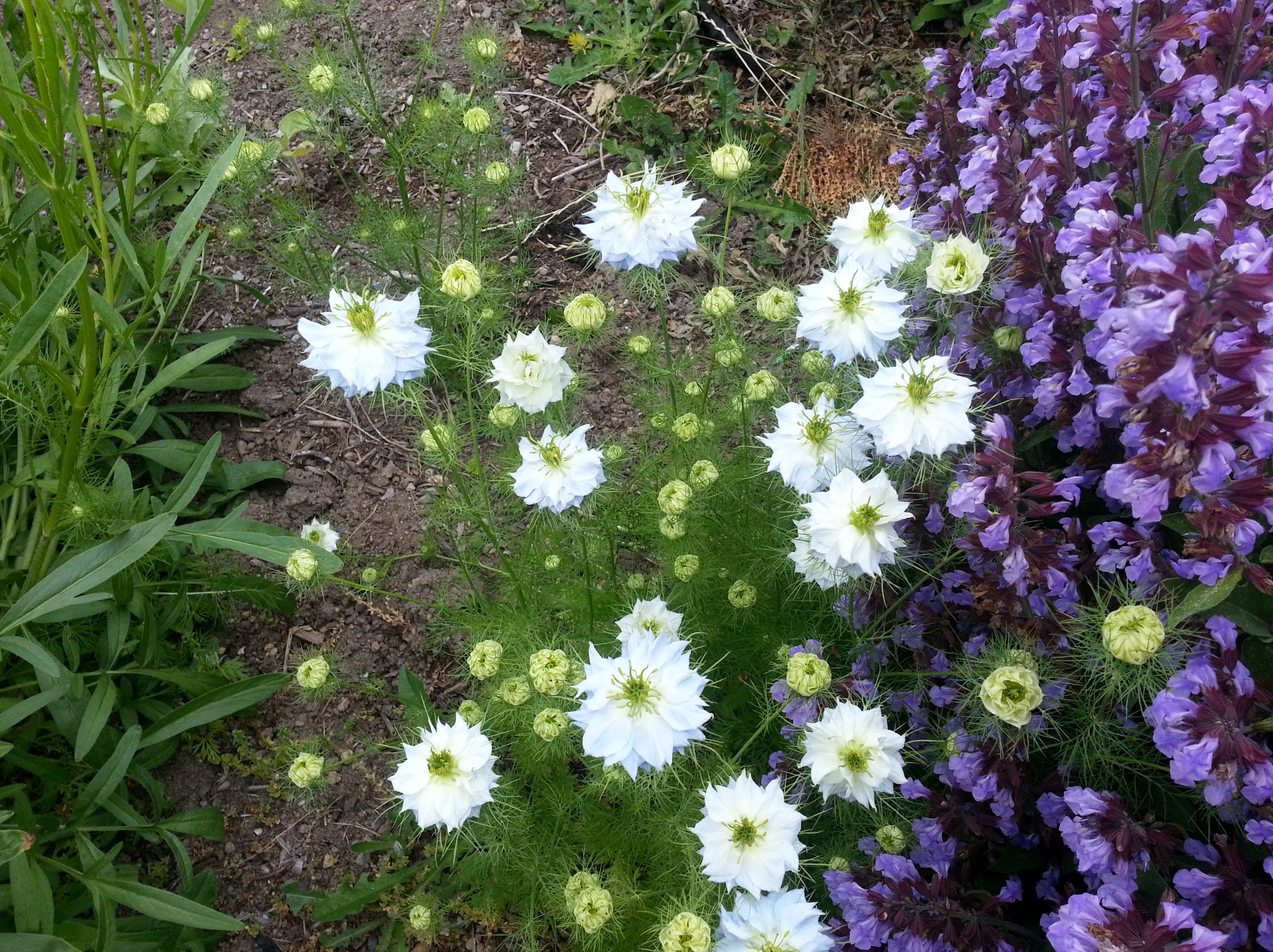
Love-in-a-mist is a lovely but tough flower. If you plant it in your garden, you will have it forever.

Love-in-a-mist is a lovely but tough flower. If you plant it in your garden, you will have it forever.

Lindbergh High School Reunion '82, '83, '84, '85

Join us this summer for our reunion in Renton, WA!

George Lakoff

George Lakoff has retired as Distinguished Professor of Cognitive Science and Linguistics at the University of California at Berkeley. His newest book "The Neural Mind" is now available.

KomenWatch

Keeping our eyes and ears open.....

4 Times and Counting

Confessions Of A 4 Time Breast Cancer Survivor

Nancy's Point

A blog about breast cancer, loss, and survivorship

After 20 Years

Exploring progress in cancer research from the patient perspective

My Eyes Are Up Here

My life is not just about my chest, despite rumblings to the contrary.

Dglassme's Blog

Wouldn't Wish This On My Worst Enemy

SeasonedSistah

Today is Better Than Yesterday

The Pink Underbelly

A day in the life of a sassy Texas girl dealing with breast cancer and its messy aftermath

The Asymmetry of Matter

Qui vivra verra.

Fab 4th and 5th Grade

Teaching readers, writers, and thinkers

Journeying Beyond Breast Cancer

making sense of the breast cancer experience together

Entering a World of Pink

a male breast cancer blog

Luminous Blue

a mother's and daughter's journey with transformation, cancer, death and love

Fierce is the New Pink

Run to the Bear!

The Sarcastic Boob

Determined to Manage Breast Cancer with the Same Level of Sarcasm with which I Manage Everything Else

FEC-THis

Life after a tango with death & its best friend cancer