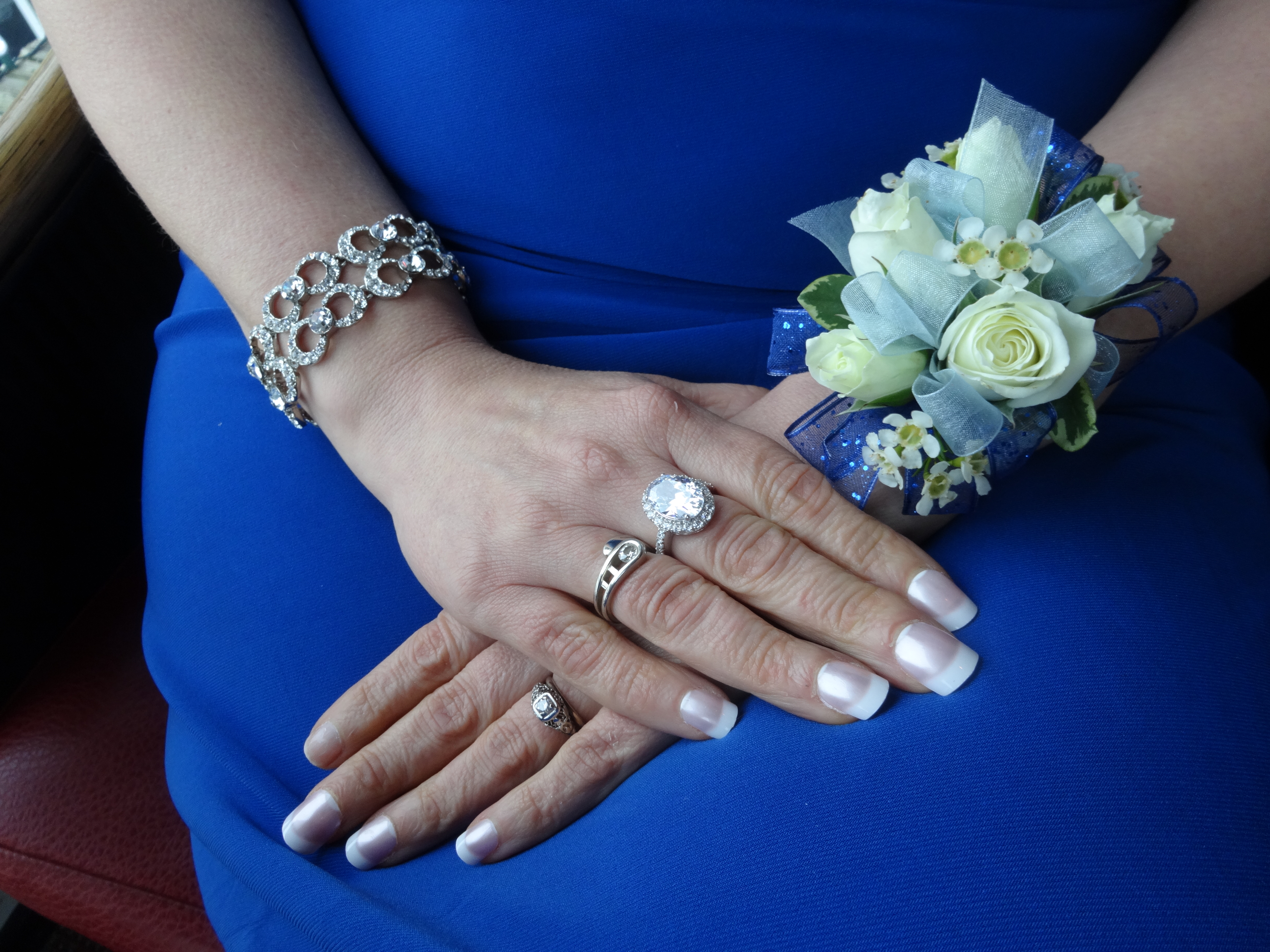
My husband, John and I were married in the late winter of 1990. It snowed that morning, creating a slight but unnecessary panic. I remember waiting A LONG time in the bride’s room. My niece, Tricia, who was about 5 or 6 years old at the time, kept unwinding the greenery from the rose she was to carry in the ceremony. She picked off the leaves and then dropped a couple of them down the front of my dress, in the space between the satin lining and the lace overlay. Tricia also entertained us with comments like, “I wonder what would happen if a MAN came in here while we were all getting dressed?” She seemed to find the whole bride’s room experience to be titillating.

I remember a few other things but honestly, I remember so very little from the actual ceremony and reception. My friend, Lisa, who had gotten married a few years previously had advised me to try to pay attention to what was happening so that I would remember my wedding day. I remember feeling nervous being the center of attention especially when I realized that my butt, clothed in a form-fitting mermaid style dress, was going to be facing the guests for nearly the entire ceremony. Yes, this was silly. And you may be thinking that this was an awful lot of self-consciousness for a 10 minute long ceremony. However, it was a Catholic wedding and an hour long! My butt was on display throughout Bible readings, songs, and candle lighting. Go ahead and judge me; I just want to make sure that you have your facts straight. Kidding aside, although our wedding was very meaningful, it was also very stressful. I was not as present as I could have been.

That wedding day 25 years ago today. A lot led up that that day in March. We had dated for three years. We were young but we did not rush into anything. I was ready to get married, as ready as I could be. After all, I’d caught six wedding bouquets! It was my turn! I’d also purchased my dress before John proposed. (There is a reasonable explanation for that. Just believe me.) Seriously, we were seriously in love and although like any relationship, ours was imperfect, I was confident that John was the man for me.

I have thought a lot about what to do for John for our silver wedding anniversary. We exchange gifts, though typically not lavish ones. I thought I might write some wedding vows for him to cover the next 25 years of marriage and post it here.

I started thinking about a lot of promises, old and new. I started thinking about the challenges were are likely to have in the next chapter in our marriage. Every marriage is different. Our marriage is built on a foundation of love, honesty, and genuine fondness for one another. Even a foundation made from the strongest materials needs, mortar however. Ours is being engaged with one another.

My vow is to work my hardest to be present. And when I find myself stuck in a past that will never change or in a future that I will never know, I will find my way back to you as fast as my legs will carry me.

wedding picture


This is where we celebrated our anniversary last weekend, Salish Lodge at Snoqualmie Falls. This is about a 45 minute drive from Seattle.

DSC03880

On the drive back home, we stopped on Mercer Island for a walk along Lake Washington.

DSC03896

Lisa Bonchek Adams died over the weekend, at age 45. This is a repost of the letter I wrote to the Guardian, following the publication of an online article about whether it is appropriate or ethical for people with stage IV cancer to use social media to communicate about their illness. Lisa was called out as an example in this article.

I was not a personal friend of Lisa’s but I am very thankful to her for her advocacy. I am very sad about her death and I hope for healthy healing for her friends and family. It will likely be a very long process of grief, especially for her three young children. My hope is that her advocacy and the meaning that it added to her life, will also provide a positive touchstone for them.

My letter, dated 1/12/14,  follows.

Dear Editor,

I am writing in response to Emma Keller’s article, which was published by you on 1/8/2014. The author used Lisa Bonchek Adams, who uses social media to communicate about her life with stage IV breast cancer, as an example of a possible unethical use of social media. I am angry about the journalist’s position as well as how the article stimulated a number of negative comments toward someone who needs no more negativity in her life. I have many objections to this piece and I will delineate a few of them here.

First, I believe in freedom of speech. I also believe in personal and professional responsibility. With all of the corruption and violence in the world, why target a mother of three with stage IV breast cancer, just for using social media to communicate about her experience with a horrible disease? This tact makes no sense at all to me.

I object to the characterization of Ms. Adams’ communication as “TMI”. Journalists cover natural disasters all of the time. They cover earthquakes, famine, hurricanes, and more.  The photos and the written stories describe the devastation that people suffer. They describe the resilience and the heroism. Although not everyone is comfortable with the sadness of these stories, the stories are sympathetic and not considered TMI. Cancer is a kind of natural disaster. It is a disease that ravages and impacts countless numbers of people. Is it TMI because Ms. Adams is reporting on herself instead of being interviewed and photographed by “proper” journalists? If a hurricane survivor decided to get support and communicate about his/her experiences in dealing with a natural disaster, would we call this TMI? Would we as fellow human beings make so many negative comments about this person? I think not.

As a psychologist, I understand that distancing ourselves from an illness that can strike anyone, especially a young mother of three children, is a way we deal with the realities we don’t want to consider. They are too close. We can’t think about potential personal disaster every second of every day and function as healthy people. But it is also true that we can’t constantly deny the possibility of disaster and be healthy people. We have to incorporate potential malady into our lives. Understanding and accepting that bad things happen to good people is a building block of compassion. Without it, we let our own fear lead to unfairly assigning negative qualities to people, who are ill through no fault of their own, and doing their very best to manage under truly difficult circumstances.

As a breast cancer survivor, I understand how cancer has changed my life and my relationship with the outside world. I don’t know why I got breast cancer. I am a responsible person, a loving wife and mother, and a professional dedicated to improving the lives of children. I don’t know that I will have a recurrence. I am doing my best to live a healthy life but there is no guarantee that cancer, some other disease, violence, or an accident will end my life. I could say that it’s not fair that I got breast cancer and have had to endure its treatment, which even in this day and age, is brutal. Breast cancer, like a hurricane, is not fair. It is a natural disaster. People afflicted deserve compassion. We live with cancer and its threats in one way or another, every day.

I am also an active blogger about my own breast cancer experience. In doing so, I have enriched my life immeasurably in having made connections with wonderful people such as Ms. Adams. Having cancer is very isolating. It creates a juxtaposition of grief with a deep appreciation of the gift of life, which many people don’t understand. And there are aspects of breast cancer that make it particularly isolating. The breast cancer social media community is a very powerful network of women and men. I have drawn strength through the true friendships that I have made as well as the support of an amazing group of people, who live all over the world.

We will all die. Most of us do not know precisely when or how this will occur. People with stage IV cancer know that they are likely relatively near the end of their lives and that further they are likely to die from cancer. So many people with terminal disease spend their last years in isolation, even if when they are still able to work and carry out many daily responsibilities. Many of them don’t even “look sick” until much later in their disease progression. But their lives can be lonely and arduous. Social media can serve as a way for people to connect with others who understand. I have friends with stage IV breast cancer. I don’t know how much longer they will live or how much longer I will live. But I know that I will stay with them even through the cybersphere until our dying days. I so appreciate learning how to be a better friend to someone who is losing abilities while respecting their humanity and resilience. It is scary to know that I will likely lose more friends than I would have as a function of being part of the breast cancer community. But it is worse to think of us not having each other; there is real joy, love, and shared grief over the Internet. I consider it an honor to be trusted as a friend and to be relied upon to be there during the darkest times.

There are a lot of problems with our electronic age. Many products aimed at children, in particular, are harmful. There is nothing “virtual” about the breast cancer community. It is very real. Lisa Bonchek Adams is a real woman with real connections. This community is one of the very best and real things about our virtual age.

Thank you for your kind attention to my concerns.

Sincerely,

Elizabeth P. MacKenzie, Ph.D.

Back when I was a researcher, I used to travel to conferences to make presentations. One of them was the meeting for the National Association for the Education of Young Children (NAEYC), which was held in Anaheim, CA. Yes, the largest conference devoted to the education of young children was held at Disney Land. The conference attendees were offered a special rate to go to the park. It was less than half the price and since it was for admission, after hours, there were no long lines for the rides.

Since this was a professional conference, I was attending with other people from the not-for-profit for which I worked. One of the people from work did not like me. She was the director of one of the other departments in the organization but since my position involved work in her department, she was one of my direct supervisors. And when I mean that she didn’t like me, I mean that she pretty much actively disliked me. She also did not like my work. As you could imagine, it was awkward hanging out with a group of people, one of whom had a lot of power over my job not to mention constantly emitting, “I don’t like you” vibes.

As I have mentioned previously, I do not like to go on scary amusement park rides. The group I was with wanted to go on the “Indiana Jones and the Temple of Doom” ride. Ordinarily, I would have just said, “No way!” But my boss was there and I knew how much she believed in employee togetherness. I asked an employee how scary the ride was and she told me that it wasn’t. So I agreed to go on the ride.

The ride began and within about five seconds I realized that it was way too scary for me. I closed my eyes and started doing deep breathing. Soon, I felt calm. I was aware of the way the air felt on my skin as the ride accelerated in speed. I noticed smells of liquid vapors and of machine part lubricants. I could also hear the gasps and yells of the people who were experiencing the ride. I noticed sounds of surprise, fear, and exhileration. These are all strong emotions. I felt no strong emotions but I noticed and observed.

As a child and adolescent psychologist, I often work with children and families when they are in distress, experiencing strong emotions, mostly painful ones. It would not be helpful for me to join in with the distress. “Oh no! That’s terrible! What are you going to do?” I need to be present and engaged but not swept away. I need to avoid adding drama. I am there to carefully observe, interpret, and to provide assistance.

It is a complex process. Clinicians who do not demonstrate enough empathy and emotional connection are described as cold. Clinicians who demonstrate too much emotion are described as having poor boundaries. And the definition of what is too little or too much varies person to person. To be the right amount of present, calm, and connected is incredibly therapeutic to someone who is in distress. To be too little or too much is not only counter-therapeutic, it is also not healthy for the clinician.

I started formally practicing mindfulness nearly three years ago as a way of dealing with my breast cancer diagnosis as well as to live a healthier life. It occurs to me that many years before this time, I was already practicing it in session, with my patients. This helps me be effective and also minimizes the amount of stress I take home with me. It has been trickier to apply mindfulness to the rest of my life. But I have been doing it and I plan to continue. It has greatly enriched my life and helped me cope with the scary hurts and heartache much better. I still experience all emotions, at all levels. I experience pain. I am having more and more moments of acceptance and less and less suffering.

I have noticed some shifts in my personal relationships. Some of the shifts have been uncomfortable. I initially found myself getting annoyed at how upset people got at what I considered to be minor annoyances or future catastrophic outcomes of low probability. And it’s not all complaints or expressed fears. It’s the ones tinged with helplessness or hopelessness that really get to me. Anger turned to worry and worry turned to sadness, over time. I realize that some people in my life are on a much different ride. We are no longer experiencing the same ride. Although this is helpful as a therapist, it is harder with relationships that are more intimate and more expecting of reciprocity.

At this moment, I feel a bit sad about it. But I also know that my feelings have changed about this and will likely continue to change. I do know that I have selected the right ride for me and will try to live the healthiest way I can since that is best for me and my family.

I am not much of a sports fan most of the time, but I do love watching the Olympics, especially the winter games. One of the most thrilling of the winter sports, at least in my view, is the luge. I watch the athlete careen down the luge run at literally, break neck speed, with their legs held out in hair-pin formation. I think to myself, “Holy crap. That’s crazy.” Yes, they wear head protection but those hair-pin legs and arms are covered in space-age stretchy materials. And what about one’s neck? I know that I am not a physical risk taker, but it looks like a pretty dangerous sport major spinal cord injury potential not to mention the orthopedic horrors that could occur. Mostly, what I see on my television screen, however, is highly controlled chaos. These are highly trained athletes at the most elite level. By and large, they love what they do. They are driven to do it, to take the risk, over and over again. I imagine that mastering the luge feels like becoming a force of nature.

I love the mountains, looking at them, and hiking in them. I dreamed a few nights ago that I was driving to the mountains. There was compacted snow on the road. I was driving really fast and following very close. The car was flying along the road. In the dream I had some recognition that the conditions were dangerous but I was determined to make it to the mountains and uncharacteristically non-plussed about conditions. And I was getting to my destination.

This was not a normal anxiety dream for me. Those are the ones I have when “bad guys” are chasing me or when I am stressed about work, my anxiety dreams involve my finding myself, at my current age, back in college or high school, scrambling with my classes. “Oh no. I’ve had a class I forgot to attend all quarter! I must have failed it!” Because I have evolved, the latter dreams end with my realizing that I have a diploma for a Ph.D. Why would I need to be in high school or college?

This was a different dream. It involved anxiety but it also involved a kind of moving forward in life and enjoying it. I was really enjoying myself in the mountains. It was beautiful. And I don’t really think the dream was about my taking dangerous chances or being an Olympic level snow and ice driver. I think this dream reflects how I am coming to deal with the anxiety of my life.

In reality, I am not a very skilled or experienced snow driver. Seattle may be near the mountains but it is a temperate city, at sea level. I entrust the winter driving feats to my husband, who spent his teen and early adult years either living in Eastern Washington or driving back and forth over mountain passes, to visit his parents there. But I am learning how to drive through life, despite its break neck speed, the dangers, the hidden and out in the open.

I am not a person who seeks out danger. I am not a thrill seeker or a reckless person. The mountains can be a beautiful destination. Sometimes the mountains can be barriers to where we want to go. And some of those barriers are K2’s of our own making, towering anxiety without sufficient basis.

I don’t want to live a safe life in my own home. I want to see mountains. I want to enjoy the beauty in my life right now.

20131124_133538

As I’ve mentioned previously, my husband and I both love to write. And as luck would have it, we met in a college English Composition class. I read his short stories. He read my poetry. We talked about books. I remember guessing that he was an English major, only to be greatly surprised that he was completing a computer science degree and considering dropping the class due to his heavy course load.

Soon after our daughter was born, it was clear that she was verbally precocious. The day she turned 8 months old, it was finally clear that the “da da” she’d been babbling consistently for several days was, “Dada”. I remember the first time she said something intentionally funny. She pointed at me and said, “Baby” and then to herself and said, “Mimi”, her name for me at the times. Then she giggled like crazy and repeated the joke over and over. She was less than 10 months old at the time.

As she grew older, she regaled us with thoughts and questions far beyond her years. She “cracked the code” of reading rather early, reading her name through sight word recognition just before her second birthday. She went on to become a voracious reader.

So you would not blame us for expecting that a girl with such facility with language and so many interesting things to say would love to write. But she didn’t. I remember meeting with her 6th grade honor’s English/social studies teacher for conferences. She showed us a worksheet on which students were to answer short questions about Greek civilizations. Our daughter had originally started all of her answers to the “why” questions with “Because”. When her teacher told her not to start her answers with the word, “Because”, she just crossed out the word and left sentence fragments.

Even in high school, my daughter with an incredibly high verbal IQ would write as little as possible and use non-specific vocabulary or worse, non-words like “kinda” and “sorta”. Then there was her habit of not following the writing instructions. This was at times, unintentional and at other times, intentional. The latter writings had a definite voice and tone and it’s name was “smart ass”. Essays for final exams would start out as, “I know that this is not what you want me to write but…”

Every once in awhile, she would write something brilliant. Earlier in the school year she remarked to me, “Mom, I write two ways, really good and really bad.” I kept my response to a minimum but was encouraged to hear that there was perhaps some self-awareness in the works.

My daughter tested into a college program that allows her to take college courses to finish up high school. And she also gets to keep the college credit! This means that she takes fewer courses as one quarter at the college is worth a full year of a high school class. Winter quarter started last month. When she told John and I that she was registered for TWO English classes (creative writing and English comp) as well as advanced algebra (math is her strongest subject, along with music), our hearts sank. Getting through one semester of high school English has always been arduous for her. And she accepts no help from us on writing; this is not new. It has been the case for as far back as I can recall.

Lo and behold, our daughter has met other students in college, who like to write. They take the creative writing class together and workshop each others’ work. Her friends not only tell her when they like or dislike her ideas, they tell her when she needs to follow the professor’s instructions! (Clouds part. Angels sing.) She works on her writing for hours a day. She says, “I didn’t realize I like writing so much.”

She has actually even started letting my husband and I read her papers. They are exceptionally good with precise and vivid vocabulary, thematic depth, and particularly good dialog. We are delighted. A couple of weeks ago, her professor handed back a paper to her personally and told her, “This is excellent. You are one of only two students who earned a 4.0 on this assignment.” My daughter, a 16 year old in a college class, earned the highest possible grade on a WRITING assignment. She was thrilled.

She still doesn’t want corrective feedback on her writing but I don’t offer any, anyway. She is learning that writing is a process of planning, revising, rewriting, re-planning, etc. She asks, “Did you like it? Are you proud of me?”

Yes, I like it very much. I am so very proud of you. I am so happy that you have discovered what we’ve long known. You’ve got things to say.

I am still planning to make a book out of my blog posts and photographs. I joked to my husband, “I don’t know why I haven’t finished already. I mean the photos are already taken and the writing is all done.”

He replied, “The writing’s not done.”

“Yes, it is. I just need to decide what posts will include, in what order, and what photos to put in.” (Not exactly, I actually do have some new writing to do. But I digress.)

“Well, you need to edit it. You have at least one misspelled word in every post.”

Well, of course I am planning to proofread my writing. Believe it or not, I see the misspellings and the typos quite frequently, too. They are a lot easier to spot AFTER I’ve published a post. It’s not just because time has elapsed since the writing of the post, either. I can actually spot them better on the published post than in the WordPress writing editor. It’s something about the font size and the color contrast.

I am not a consistently good speller. If I am tired, it’s worse. If I am surrounded by family activities and chores, it’s worse. And these are the times, my friends, when I write my posts.

I am also not a professional writer. Actually, let me rephrase that. I am actually not a professional proofreader, copy editor, or editor. I am a well educated woman who blogs. That is all. I don’t have a writing degree. I have no staff or publishing house. Also, I don’t care enough to proofread my work before I post it. I learn a lot in the actual writing of each piece and then I let it go.

I can, however, turn it out when I need to do so. Part of my job is testing children with learning disorders, which involves reading and scoring their writing samples according to a standardized rubric. They are short samples and I can find the errors in writing mechanics, grammar, and syntax as well as credit students for using detail, examples, paragraphs, and transition words to organize and develop the themes of their essays.

Some of the “kids” I test are actually college students. Many of the students I test are very smart and work very hard. And you know what? My writing is about 5000 times better than most of them, even accounting for age.

Most people are not great writers, from a technical standpoint. However, most people have something to say. They may have not mastered the medium, but they have a message. This is one of my jobs as a child/adolescent psychologist; I need to use active listening to understand the message.

When children start school, they quickly learn that the “good” kids know answers and have good manners. They are good at school. This carries on in life, with some complications in adolescence, when goodness means “popular” and popularity is defined differently at different schools as well as by individual subcultures of students within a given school. It’s fair to say though that it is pretty much considered a negative for students to fail school.

Recently, I attended a meeting, during which a special education teacher, told a high school student with rather severe learning disabilities, “You are not a test score. You are not defined by grades.”

This student tries really hard and has received additional support for many years. And still, she is having an incredibly difficult time passing classes.  I knew that the intention of the teacher was very positive. But in high school, students ARE defined to a significant degree, by test scores and grades. It is asking a lot from a teen or any person, who is failing over and over at a major part of life, to separate their self-worth from their efficacy in life.

It also doesn’t help that as educated people, we can sometimes bully others based on the way they express themselves rather than simply disagreeing with their message. This is often done in political arguments. For example, a member of the Tea Party carries a sign at a rally that contains a spelling error. We point out the error and say, “What an idiot.”

I have made statements like this many times in my life. I have made fun of people with different viewpoints based on their communication errors, whether spoken or written. A few years ago, I made a concerted effort to stop doing this. It’s not that I NEVER do it, but it is much reduced.

Our country has major problems in the way that it is governed. We have a system that seems to pride itself on fighting all of the time and getting nothing done.  People do it in their day to day life, too. It’s as if we chip away at each other, makes lists of errors, treating the very tiniest like they are the most grievous possible. Because we disagree with someone. Often we disagree because we do not believe the person to be kind or just and somehow this gives us a free pass for being unkind and unfair in return. Hurt and fear often underlie these kind of angry responses. I know for myself, I sometimes use anger to justify why my unkind treatment is deserved. I am trying to do this less and less.

I don’t know how to solve these problems but I can choose to try my best to not be part of them.

Never, never, never give up.
-Winston Churchill

Yesterday was Thursday, a clinic day for me. I had scheduled an interview with a 5 year old boy, a kindergartener at one of the local Catholic schools. I went out to the waiting room to greet his mother and him. “Hello, I’m Dr. Elizabeth.”

He looked up at me and I saw a black mark on his forehead. I immediately thought of Ash Wednesday, which had been the day prior. However, this was more of a defined mark than a smudge.

“Did you get a tattoo on your forehead for Ash Wednesday?”

And he had, a temporary one, in fact. It looked like the remnants of a larger tattoo, perhaps a red race car. The boy put it there because his ash smudge had worn off before he wanted it to.

I found this to be a rather delightful perspective and one that was very different from my time smudged memories of smudged foreheads past. I remember, as a teen, feeling very self-conscious about them. Teen like to call attention to themselves but typically not when it is an authority’s idea. I was taught that it was disrespectful to take the ashes off. They were to stay on until God, gravity, or the bed sheets, rubbed them off.

I was a pretty devout child and young woman.  But I do remember taking it off once. I don’t remember quite how I did it because I would have wanted to make it look accidental or gradual. “Mom, I slipped in the bathroom and a hand towel that brushed past my forehead, broke my fall!” You know, some lame excuse like that.

Ash Wednesday is the first day of the Lenten season, which last 40 days. A strong theme of Lent is sacrifice, namely Jesus sacrificing his life to cleanse humanity of sin. As such, there are traditions of Lenten sacrifice. People “give up” meat (terrestrial animals) on Ash Wednesday and Fridays of Lent. There are fast days when people eat less, and more simple food than usual.

Then there is the question, “What are you giving up for Lent?” When my mother was a child, it was common to give up candy for Lent. She used to tell us how some kids “cheated” by putting their candy in a drawer during Lent but then binging on it as soon as Easter came. I don’t remember what I used to give up but I know that I did it. I remember having mixed feelings about the sacrifices of Lent, about giving up.

“Given up” has so many meanings. However, it typically connotes a loss or weakness.

We have given up when we make sacrifices for the greater good.

We have given up when we view ourselves as helpless and neglect our responsibilities to ourselves and to others.

We have given up when we accept painful realities, lessening suffering.

Only one of these examples involves passivity and weakness. The other two sources of “given up” require fortitude.

I no longer follow most Lenten rituals but in my 30’s, I decided that I would use it as a time to “give up” on things that were adding suffering to my life. I have attempted to give up guilt and impatience, for example. I knew that I really couldn’t totally give these things up but what I realize now is that I was working on being my mindful, less judgmental of myself and others, and thereby more accepting of myself and others.

Cancer is by no means a gift, but it certainly is a time for reflection on suffering and acceptance. When I decided to study mindfulness nearly three years ago, I had a much narrower definition and experience of it than I do currently. And currently, I believe that I have just scratched the surface.

I give up for freedom.

I give up for peace.

I give up for acceptance.

I give up to be who I am and where I am in this given moment of time.

And then I do this over and over and over. For as many opportunities that I have to repeat myself, I am most grateful.

We had our weekly “how to keep your shit together” class last Wednesday. We are currently completing a unit on emotion regulation, which basically centers on what to do when an emotion is so big that it needs to be reined in. The list of emotions that need regulating from time to time don’t include things like contentment. Instead, the list reads partly like the list of the Seven Deadly Sins with a surprise or two added: Jealousy, envy, anger, fear, sadness, disgust, guilt, shame, and LOVE, yes love. (Think of those times you may have had to break off a friendship because it was unhealthy.)

An emotion only lasts 30-40 seconds. Can you believe that? That’s not a very long time. They seem to last longer, sometimes hours or days, due to our response to them. If we are angry and start yelling, the yelling is going to keep the anger refiring in our brains. If we are sad and keep thinking hopeless and helpless thoughts, we also keep the sadness going.

We learned a particular emotion regulation skill, which is called, opposite action. It basically means finding a way to act in a way that is opposite to how your feelings prompt you to act. So if you are angry, instead of lashing out, you might be just a little bit nice by saying calmly, “I need to take a break from this conversation”, and leaving the room to calm yourself down. If you are feeling ashamed, it might mean that instead of isolating yourself, you go out in public and behave as if you have not violated whatever social norm your feelings are telling you that you have violated.

Opposite action is used when an emotional response does not line up with the facts of the situation or when our emotions are so high as to prevent us from functioning effectively. In respect to the former, have you ever felt guilty about something even though you’d done nothing wrong, but figured that you must have done SOMETHING because you felt guilty? That’s an example of an emotional response not lining up with the facts.

Opposite action also requires taking it all of the way. It means not only behaving in an opposite way but also making sure your nonverbal communication, your body language, facial expression, and tone of voice are opposite. Yes, this means faking it and there’s even the expression, “Fake it ’til you feel it.”

The acting part of this may rub people the wrong way. Personally, I kind of think about it like when we teach children to smile and thank their auntie with apparent sincerity when given a gift that they already have or don’t like. There are things we fake in order to prevent hurting other people. If we can use opposite action to disrupt the patterns we have of negative thoughts and behaviors, we can prevent ourselves from hurting our own feelings or of others. So this kind of faking makes sense to me.

It’s also kind of like a job interview. We may really want the job or we may not really want it. We may feel really nervous or unworthy. We may be struggling financially. But we put on our best face, stand up straight, act cordial and confident, and give a firm handshake. We act as though we like the person we are being interviewed by and are excited about the prospect of the job. And sometimes in the course of the interview as we learn more about the position and we may even start having some real enthusiasm or interest.

Everyday is like an interview with life. Each day I will work for jobs like compassion and  joy.


Several years ago, I visited a preschool as part of an evaluation I was doing of one of my patients. It is rare for private psychologists to include a classroom observation in an evaluation but given my specialty, I do it as much as I can because it provides quite valuable information. Although children may notice me or even ask me a question like, “Whose mom are you,” I am typically able to be pretty unobtrusive.

This observation was different. I remember sitting down in the corner of the room. And then I was promptly mobbed. I was surrounded by 3 and 4 year old’s. They were not, however, just asking questions. They were also grabbing my coat and touching my face.  It was slightly disconcerting. It made me feel badly for rock stars who are mobbed by fans, fans who act like they have a close and intimate relationship with them.

I am very good with young children. Ages 3-6 is actually my favorite developmental stage. And not the shy ones, either. I like the spirited kids, the ones who have trouble keeping their zest in check.

Unfortunately, unless their learn to manage their behavior and emotions, about half of the young kids who are considered a “handful” or “hard-to-manage” go on to develop more serious mental health problems. So that’s why I work with parents and teachers to help kids learn to control themselves better so that their zestful natures help them to be happy and connected little people at home, at school, and in the community. This kind of treatment was actually my original specialty, the focus of my dissertation and my post-doc, not to mention training with one of the national leaders in the field while an intern at the University of Florida.

About four years ago, I stopped taking new patients for treatment. I needed to keep my after school hours to a minimum so that I could be home more for my family. So, I do about 80% testing and the other 20% are long term patients with whom I’ve had ongoing treatment relationships or who come back on an infrequent basis. I never know when a kid is going to need to see me for treatment again. It can happen any time, which makes scheduling difficult. And to see kids during the school day for treatment means their missing a lot of school on a regular basis.

I evaluated a young child last fall. I provided a referral list of psychologists who do the treatment I recommended. I got an email from the boy’s mom about three weeks ago asking for more referrals. She had called everyone on my list and was unable to get in at a time that would work for her family. It just so happened that my treatment load was light right at the moment she emailed. Also, I remembered how cute the little boy was. For the first time in four years, I said, “I can see you.”

I’ve seen them 3 times now. For me, I am having the time of my life. Wow, I miss treating little fireballs! I actually don’t understand why so few people specialize in this kind of work. The treatment is evidence base and has been around since the 60’s. The technology is not rocket science. Well, maybe it’s 1960’s rocket science. But the kids can behave like rockets and rocket-shaped kids are admittedly, scary. And when one (or two or three or four) of these kids are in a classroom, it’s super scary.

One of the reasons that little people can be scary is that they move quickly. They exhibit frequent concerning behaviors. Their moods can change rapidly. They live in the moment. Their brains are also growing rapidly. These qualities, my friends, can be used a resources. This means that you can respond to them frequently in ways that teach positive behaviors like cooperation and flexibility and to reduce less adaptive behaviors. Little kids don’t tend to hold grudges. They can get over small hurts and small disappointments. Little kids usually love to have their positive behaviors and growth recognized by adults. Obviously, not all little people are like this. I am, however, talking about a sizable subset of children.

I’ve encountered a lot of mental health providers who prefer to treat adolescents because they are “easier”. “Are you serious? Teens try to kill themselves, take drugs, get into car accidents, and other dangerous things.”

Now some of this is our tendency as mental health providers, to gravitate toward working with the population with whom we have the most skill. And I’ve had little kids do dangerous things like jumping out windows and much more commonly, run around parking lots. But little kids are more easily supervised and kept safe using a few key strategies.

I suppose, however, that it can seem surreal to hear that a child had an hour long tantrum over anything, especially something like not getting the color drinking glass that he wanted. I remember the heartbreak of my daughter when she was about 20 months old after she accidentally dropped her sippy cup of water into the penguin exhibit at the zoo. “Sippy, Sipppppppppy!!!!” Her crying only got harder after the penguins started pecking at it! She kept calling for “Sippy” in the car and for quite some time after we came back home. The ridiculousness of this makes it a funny story years later. But at the time, she considered her plastic cup to be alive and to be a very important friend.

Little children’s anguish over things like not earning a sticker or getting their sandwich cut the wrong way or the inhumanity of being placed in time out, is real. But the anguish will not result in death and by learning to manage strong emotions, to learn that ever negative emotion ends and that there are ways to self-soothe, they will be happier and healthier. When I think of my own adult life and the times I have experienced high anxiety, anger, dread, and acute sadness, I see that although the feelings have always been real, the situation is often not as dire as it seems. Sometimes the problem is mainly needing to calm down. And even when there are other problems to solve, calming down is often the first step.

I am very glad for this little person in my professional life, even if he is a handful. He is already learning quickly as are his parents. And by seeing the resilience of this little fireball and the hard work of his loving young parents, I am re-learning a handful of lessons about life, change, and growth.

I remember reading Virginia Woolf’s, A Room of One’s Own, an assigned reading for a course I was taking at the University of Washington. I know it is a classic feminist text. I know that she was part of the Bloomsbury Group, a collection of intellectuals active in the early 20th century. I know that she wore pants at times. I know that she was played by Nicole Kidman in the excellent film adaptation of the book, The Hours, and that she died by suicide.

But frankly, when I read A Room of One’s Own, I missed a lot. I remember her paragraphs being reaaaaaaally long. I would find that I had decoded the words on two or three pages only to realize that I’d comprehended very little and was lost in this book long essay. I’d flip back through the book, begin reading again, and write notes in the margin, a critical thing for me to do when my mind wanders in reading.

But I did get her main message. She wrote about the importance of having time and space to write, something that most women not only did not have but were discouraged from having. A room of one’s own. A room to think and write and be. I also got that “a room of one’s own” has a figurative as well as literal meaning. We need a separate space and time for individuality. We need an identity apart from our relationships with others. As women, we need a relationship with ourselves that is apart from wife or mother. There may be ‘no “I” in team’ but there is an ‘I’ in “being” and all of us, male or female are beings.

As you know, I recently moved my private practice. One of the differences is that the current space has three offices instead of the previous two. That means all three of us, Jennie, Julie, and myself have an office to ourselves.

I have also mentioned that the rent for the new office space is nearly three times what the old office space was. Granted, the old office space was really inexpensive. But this is an increase that is easily noticed, especially since I hold the lease and it it the full rent that is automatically drawn from my bank account every month.

There is also the fact that although I work five days per week, I only see patients on three days per week. In the past, I have only had access to my office space for those three days. Now I have access every day of the week, whether I see patients or not.

There is an allure to subletting my office to another psychologist. This would reduce my monthly rent. At this point, however, I am strongly opposed to this. I have been reminded again and again during the last few years about how little control I have over my own life. I made what I thought was a beautiful workspace for my past office and I didn’t mind sharing it. But we lost it due to our lease not being renewed. I have now created another workspace and it, in my eyes, is lively but restful. And I want it to myself. I want to be able to go there any time I want to do report writing, pick up the mail, or just know I could go there anytime. I want to be able to get there in the morning and know that the room is exactly as I left it the night before. This is not because I am a control freak. It is just nice to know that this very thing is possible. It is also nice to know that if my life goes sideways again that I will have the flexibility to schedule patients on different days of the week. I will not be boxed into three days.

Yes, it is expensive but it is worth it at this point of time. I want my own time and my own space.

My money or my mind.

Before: The waiting room. This is how the waiting room looked the month before we started painting.

Before: The waiting room. This is how the waiting room looked the month before we started painting. The woman in the photo is my friend, Jennie.

Before: My office when it was used as a lab. This is the first glimpse I got of the space before we signed the lease.

Before: My office when it was used as a lab. This is the first glimpse I got of the space before we signed the lease.

DSC03198

After: The waiting room.

The hallway to my office. I loved the wall stickers!

The hallway to my office. I loved the wall stickers!

Make yourself comfortable. This is the sitting area for interviewing, psychotherapy, and explaining test results.

Make yourself comfortable. This is the sitting area for interviewing, psychotherapy, and explaining test results.

Testing area.

Testing area. The wooden piece is front of my desk is a folding desk. I unfold it to combine with my larger desk top to make large enough surface for my testing materials.

I made a removable cover for the air conditioner because it was ugly. I bought the owl clock because it was handy and adorable.

I made a removable cover for the air conditioner because it was ugly. I bought the owl clock because it was handy and adorable.

The chicken and tree decals were inspired by the feeling of boredom I felt when I sat in the chairs across from the door of my office.

The purchase of the chicken and tree decals was inspired by the feeling of boredom I felt when I sat in the chairs across from the door of my office.

Lindbergh High School Reunion '82, '83, '84, '85

Join us this summer for our reunion in Renton, WA!

George Lakoff

George Lakoff has retired as Distinguished Professor of Cognitive Science and Linguistics at the University of California at Berkeley. His newest book "The Neural Mind" is now available.

KomenWatch

Keeping our eyes and ears open.....

4 Times and Counting

Confessions Of A 4 Time Breast Cancer Survivor

Nancy's Point

A blog about breast cancer, loss, and survivorship

After 20 Years

Exploring progress in cancer research from the patient perspective

My Eyes Are Up Here

My life is not just about my chest, despite rumblings to the contrary.

Dglassme's Blog

Wouldn't Wish This On My Worst Enemy

SeasonedSistah

Today is Better Than Yesterday

The Pink Underbelly

A day in the life of a sassy Texas girl dealing with breast cancer and its messy aftermath

The Asymmetry of Matter

Qui vivra verra.

Fab 4th and 5th Grade

Teaching readers, writers, and thinkers

Journeying Beyond Breast Cancer

making sense of the breast cancer experience together

Entering a World of Pink

a male breast cancer blog

Luminous Blue

a mother's and daughter's journey with transformation, cancer, death and love

Fierce is the New Pink

Run to the Bear!

The Sarcastic Boob

Determined to Manage Breast Cancer with the Same Level of Sarcasm with which I Manage Everything Else

FEC-THis

Life after a tango with death & its best friend cancer