nope2BC's avatarSaying NOPE to Breast Cancer

May 8, 2013World Ovarian Cancer Day: today is the first official World Ovarian Cancer Day.

Did you know that ovarian cancer has the lowest survival rate of gynecologic cancers? Almost a quarter million women are diagnosed each year and it is responsible for 140,000 deaths.

It is important to know the symptoms, which are often misdiagnosed. Do you know what they are? From the World Ovarian Cancer Day website:

  • Increased abdominal size / persistent bloating (not bloating that comes and goes)
  • Difficulty eating/feeling full quickly
  • Abdominal or pelvic pain
  • Needing to pass urine more urgently or more frequently

Early diagnosis greatly increases a woman’s chance of survival, however, women are usually diagnosed at a late stage as often the symptoms are attributed to menopause or digestive issues. This is all so familiar to me.

My mother’s story

Those of you who have been following my blog for a while already know…

View original post 248 more words

I had an acupuncture appointment last week. Dr. Wang placed the needles and then left me in the room for 30 minutes. While I was relaxing and listening to gentle music, I overheard a patient from the treatment room next door emerge into the reception area. “I’m like a new person! I can’t believe it! I feel so good!”

I am an expert eaves dropper, plus she was talking pretty loudly. I gathered that this was her very first appointment. I later learned that she is an elderly woman with major pain problems who noted concerns upon arriving to the office that she was in so much pain that she was not sure she would be able to complete all of the intake paperwork.

Before she left, I heard her make another appointment for the following week. Then she asked, “If you get an cancellation, call me.” Sarah, the office manager replied, “When?” “Any time. I will come any time.”

I was thrilled for this very satisfied first time acupuncture patient.

I have such wonderful friends and family, some of whom came to our house yesterday for a weeding party.

What is a weeding party, you ask? Basically, it was a way for me to ask for help with my yard. Repeated surgeries on my right side had resulted in a year’s worth of neglect of my yard by me. My dear neighbor, Deana has helped a lot, especially with deadheading. But there were two big projects in the front garden that were getting me down: (1) The encroachment of grass on the west side of the yard and (2) the overtaking of an entire section of garden by a very pesky and intrusive wire weed. It was so cute in it’s little pot when I bought it as a ground cover several years ago. Little did I know that it was like a mini form of kudzu, the vine that has been choking off entire trees (and a barn in this photo) in the southeastern U.S.

With our little work crew, we were able to get the job done in about 1 1/2 hours. Then we had food and hung out on the new deck, that John has nearly finished except for staining the wood. The lilacs are in bloom and the scent was wonderful. It was a glorious day.

I had a hard time asking people for this help. But I kept reminding myself that people have kept asking what they could do to help and how much less helpless I feel when there’s something concrete I can do for a loved one in a time of need. It was a beautiful day, a celebration of love and kindness. Plus, the apple pie I made turned out extra pretty. (I heard it tasted good, too but I am not eating wheat these days and didn’t want to do a test drive with a gluten-free crust recipe on company.)

First things first. Is this pie a beauty, or what? The lovely caramelized top was an accident. I had so many apples to use up that I cooked the filling on the stove top before I filled the pie so that it would reduce in volume a little. It's a good thing I did this as my pie dough was not well behaved enough to roll into a full top and bottom crust. The pre-cooking kept the apples from drying out in the oven. Okay, enough about pies; let's move onto the garden.

First things first. Is this pie a beauty, or what? The lovely caramelized top was an accident. I had so many apples to use up that I cooked the filling on the stove top before I filled the pie so that it would reduce in volume a little. It’s a good thing I did this as my pie dough was not well behaved enough to roll into a full top and bottom crust. The pre-cooking kept the apples from drying out in the oven. Okay, enough about pies; let’s move onto the garden.

This is just after I took the first chunk out of the wire weed invasion.

This is just after I took the first chunk out of the wire weed invasion.

1 1/2 hours later and the wire weed is gone! Yay! Most of this work was done by my cousin, Catherine and my husband, John.

1 1/2 hours later and the wire weed is gone! Yay! Most of this work was done by my cousin, Catherine and my husband, John.

We dug up a lot of compost in 1 1/2 hours! Tomorrow it will get picked up by waste management and become part of Seattle's awesome composting program!

We dug up a lot of compost in 1 1/2 hours! Tomorrow it will get picked up by waste management and become part of Seattle’s awesome composting program!

Thanks, Mom, Dad, John, Catherine, Deana, Jennie, and Preben for making my yard feel manageable again. I'm eager to go out again next weekend!

Thanks, Mom, Dad, John, Catherine, Deana, Jennie, and Preben for making my yard feel manageable again.

This content is password-protected. To view it, please enter the password below.

Knot Telling's avatarTelling Knots

I love the Internet! With thanks to my friend GG, a stellar webcomber, I have been spending the last couple of days studying the most recent independent audit of the Susan G. Komen Breast Cancer Foundation, Inc. The audit is available to all as a PDF at that link.

First, the numbers

The Komen financial year runs from the first of April through March thirty-first. The most recent independently audited annual financial statement dates from March 31, 2012, and this post is based on those numbers.(*)

The good news first. Komen spends a relatively small portion of income on support services–about 19% of total expenses(the blue slice of the pie at the left). These support services expenses consist of fund-raising costs ($52,118,804 or 69%) and general/administrative costs ($23,064,504 or 31%).

The largest portion of Komen income, about 81%, is very appropriately spent on program expenses (the green slice). I am…

View original post 609 more words

As you may know, I have been tracking my daily walks since 12/2/12. Earlier this week, I passed the 400 mile mark (644 K). Today, I did a 6 mile (9.7 K) walk I have been wanting to be able to work toward for a long time but thought the earliest I’d be ready for it would be next fall. The walk is from our house to Lincoln Park, which is on the Puget Sounds and faces the beautiful Olympic Mountains, which is the lesser known of the two mountain ranges in our state. The walk is not just longer than my usual walk but it is quite hilly. John took us an indirect, switchback route so that it wasn’t an unrelenting climb.

The park and the walk were beautiful. We saw a seal pup on a wooden float off in the distance. In the 13 years we’ve visited the park this was a first time sighting for us. John and I really enjoyed this time together.

Puget Sound, Olympic Peninsula, and Olympic Mountains. (I know I keep promising to use a good camera for my nature shots instead of my phone...)

Puget Sound, Olympic Peninsula, and Olympic Mountains. (I know I keep promising to use a good camera for my nature shots instead of my phone…)

I’ve read a lot about “chemo brain” in breast cancer blogs. A lot of breast cancer patients observe a decline in their attention and memory during and after chemotherapy. They complain to their physicians and many of them feel invalidated by the responses they receive. This is in part, because the evidence of chemo brain is sparse. (Before you throw your shoe at your computer, bear with me.)

I have a Ph.D. in psychology and in addition to my seven years of graduate school during which I conducted research, I worked as a researcher for 10 years after I graduated. One of the things that researchers are trained to do is to test hypotheses and sets of hypotheses. In clinical research, there is also the testing of treatments in the context of clinical trials. We are trained to interpret hypotheses in terms of whether they are empirically supported or not. If they are supported in multiple studies, we accept them as “truths” (there are no absolute truths), especially if findings are replicated by another lab. If they are not supported, we conclude that (1) the hypothesis was incorrect or (2) the hypothesis was tested incorrectly.

However, there is a third reason why a hypothesis has inadequate research support and that is when the hypothesis has not been adequately tested. Now as far as I can see, this is the case for the chemobrain hypothesis. So does the fact that it does not have adequate experimental support mean that it doesn’t exist? No, it means that it could exist but we don’t know because we haven’t thoroughly looked at the question. A downside of our careful and methodical ways is that we take our sweet time assessing potential “truths.” This is also a source of frustration for most of the rest of the world. Further, sometimes as researchers or as clinicians who do evidence-based practice, we lump all of the hypotheses that have not yet been deemed empirically-supported into the same group. For example, when asked, “does treatment x work”, they might answer “no” even for a treatment that has never been tested. The correct answer in this case is “We don’t know.” As a clinician who is supposed to have the answers, it is hard to say this to people. But it’s part of our job. To the great credit of my oncologists, they are both extremely knowledgeable but honest about the limitations of their respective fields. My breast surgeon actually discussed the concern about over treating breast cancer because they do not yet know how to distinguish between tumors that will spread verses those that will not. (In breast cancer, an estimated 25% of tumors never spread. If you want this article, let me know. I have the .pdf and it was given to me by a childhood friend who is a professor at Rutgers and does cancer research on polarity in cancer cells.)

Then there is the confusion provided by some (not all) of the folks in the media who go around spreading rumors and making generalizations based on one small result from a single study. Or who totally misrepresent the findings of a research study. Unfortunately, most of us do not have university library privileges that allow us to check out the primary source material on which the story is based. Also, even if we could, we might not have the necessary background knowledge to interpret the study. As an example, there was a news story that made it rounds in the blogisphere recently. The investigators used used neuropsych measures and found that breast cancer patients who underwent chemo showed declines in executive functions such as memory. The comparison group were “healthy controls.” So a group of women who have been subjected to a variable onslaught of chemo, surgery, radiation, endocrine therapy, not to mention the stress of having a serious illness were compared to women with no known medical problems. The story was presented as evidence of chemo brain. This is not specific evidence of chemo brain because chemotherapy was one of many variables that could explained the findings. Does this make the study useless? No, I think it shows that the cancer assessment and treatment experience is associated with a decline in cognitive functioning. It is a little bite out of a much larger question. Further, the use of neuropsych measures was really smart. They can be more sensitive to subtle real world changes than other measures plus they are safer and probably less expensive (I’m guessing that they did not do a full neuropsych battery, which is kind of expensive) than using an MRI.

Boy, I wish I could remember where I saw that article but I can’t remember where I saw it. That’s because my attention and memory have been impaired since I was diagnosed with breast cancer nearly a year ago! As a psychologist, I validated this for myself as the stress alone of having cancer is enough to impair executive functions. And also as a psychologist, I don’t dismiss the real impact that stress can have on a brain. In simple words, psychological stuff is real. People might say, “It’s all in your head.” Guess what? Your head is part of your body. Also, your brain is in there and it’s kind of an important organ.

Stress impacts cortisol regulation. Cortisol is a hormone that is triggered by stress and it’s purpose is to help us function better during those “fight or flight” times of our life. A problem with this is that too much stress or chronic stress can break down this regulatory system and lead to a break down in attention and memory. Speaking of hormones, there is another hormone that is thought to be important in memory functioning and that hormone is estrogen. Most, but not all breast cancer is estrogen responsive. How many of us have our cancer treated with hormone blockers? So at least some of that fog could be due to reduced estrogen. I am not an endocrinologist and concede that I am oversimplifying the role of these hormones to make my point and also because I don’t understand endocrinology terribly well. But my larger point is that there is evidence that (1) cortisol and estrogen functioning impact attention and memory and (2) cortisol and estrogen functioning is impacted by having and being treated for cancer. And theses are just examples. There are a lot of potential mediated relationships (indirect effects) as well. Interrupted sleep impairs attention and memory, too. How many of you haven’t had difficulty sleeping due to the stress of cancer or due to increased hot flashes, for those of you who receive endocrine therapy?

But what about chemotherapy? All of my chemical warfare has been in the form of anesthesia, pain meds, tamoxifen, and Lupron. I did not receive I.V. chemotherapy. My heart is with all of you who are enduring or have endured this. It’s not unreasonable to hypothesize that chemotherapy drugs might have a direct negative effect on memory and attention. The blood brain barrier does not exactly work like Fort Knox in keeping chemo drugs from entering it. There is some permeability. So at least some of those nasty chemicals might get in and do damage. (I’m not a neuro-pharmacologist or neurobiologist but I believe that my general point is true.) And perhaps some of that damage might be to parts of the brain that impact attention and memory. And I do see some research in my Google Scholar searching that supports these hypotheses. But one job of a researcher is to interpret findings from a single study into the larger context of multiple studies. They also use the level of rigor of the particular journal in which the article is published in their interpretations. I can do this in my own field but this is after many years and having read thousands of research studies.

One question that is buzzing around my head like a gadfly is “Why isn’t this question rigorously tested?” If any or all of the chemotherapy drugs cause cognitive decline, shouldn’t we investigate it so that patients can be informed of the potential treatment side effects? Isn’t it important to know whether the potential effects vary in duration, frequency, or intensity as a function of the drugs chosen for treatment? And in the mean time, let’s hear it for better integration of psychology into cancer research and treatment. I think we can all agree that cancer is stressful. We also know that it increases risk of anxiety and depression. Stress, anxiety, and depression can all negatively impact attention and memory. We have tools for addressing these issues and some of them like mindfulness meditation are incredibly cheap and safe. Finally, we are trained in measurement as well as in research design and clinical trials.

Oliver makes a compelling argument for increased funding for male breast cancer. His breast cancer is treated using the same protocol as female breast cancer because there is so little research guiding best practices for men. And last I noticed, there were some biological differences between males and females of the human species. Finally, Oliver makes a strong argument without oversimplifying, being sarcastic, or being disrespectful. His data and reasoning are compelling enough to elicit a desired emotional response like compassion and a call to action.

oliverbogler's avatarEntering a World of Pink

While there is nothing that forces a strict proportionality between cancer incidence and cancer research funding, there is something to be said for making sure that rare cancers are not left behind. Breast cancer in men is a rare disease, and, from a research funding point of view, it is being left behind.

About 1% of breast cancers occur in men. There is regional variation, with fewer in some countries (e.g. US where it is ~0.7%) and more in others (e.g. Tanzania where it is 6%). Let’s call it 1%.

1% is a small number, for sure, but it is not a negligible number. The American Cancer Society estimates 2,240 breast cancer cases in the US in 2013 for men, and 234,580 for women. Compare the number of breast cancer cases expected in men to the number of men likely to get ALL (3,350), CML (3,420), penile (1,570), bone…

View original post 4,189 more words

This post is inspired by Mogatos, the author of the excellent blog, Saying Nope to Breast Cancer.  She is in her early 30’s and had a prophylatic bilateral mastectomy due to her high genetic risk of breast cancer. Mogatos is a very courageous person who is helping lots of women. She has created a photo diary of her physical transformation since her mastectomy surgery in January. If you are interested in the two stage tissue expander/implant reconstruction process, I particularly recommend the site to you. Mogatos even painstakingly lists the costs of her medical care. Once I’m done with one of my medical bills, I don’t ever want to see it again.

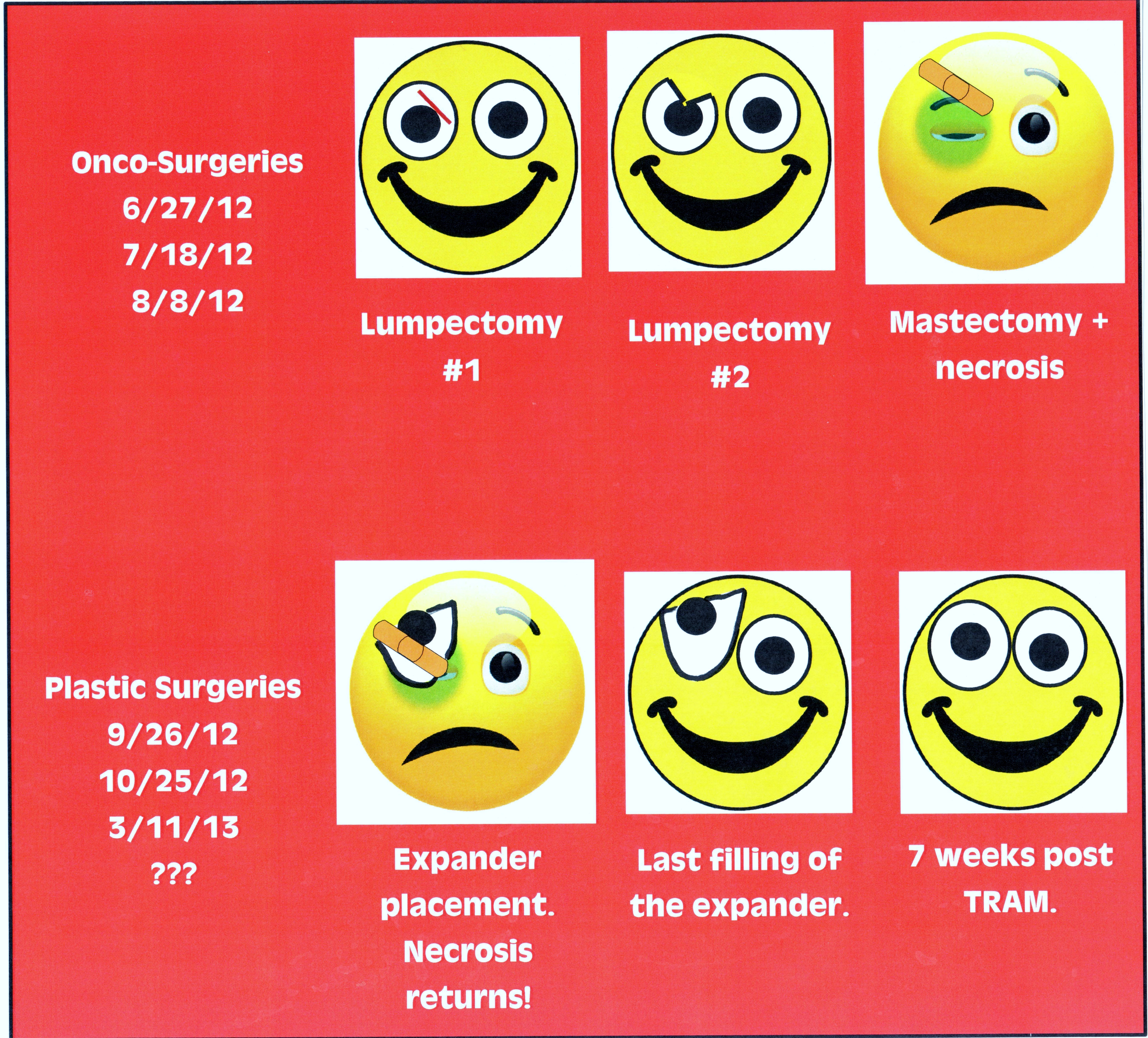
I have had a request or two to see my reconstruction. I’m sorry to say that I am not evolved enough to share more than a photo of my belly button to the blogisphere. However, I have put together a visual showing my surgical process. Although breast cancer isn’t funny, using humor to cope with its threat is serious business.

smiley3


This content is password-protected. To view it, please enter the password below.

Lindbergh High School Reunion '82, '83, '84, '85

Join us this summer for our reunion in Renton, WA!

George Lakoff

George Lakoff has retired as Distinguished Professor of Cognitive Science and Linguistics at the University of California at Berkeley. His newest book "The Neural Mind" is now available.

KomenWatch

Keeping our eyes and ears open.....

4 Times and Counting

Confessions Of A 4 Time Breast Cancer Survivor

Nancy's Point

A blog about breast cancer, loss, and survivorship

After 20 Years

Exploring progress in cancer research from the patient perspective

My Eyes Are Up Here

My life is not just about my chest, despite rumblings to the contrary.

Dglassme's Blog

Wouldn't Wish This On My Worst Enemy

SeasonedSistah

Today is Better Than Yesterday

The Pink Underbelly

A day in the life of a sassy Texas girl dealing with breast cancer and its messy aftermath

The Asymmetry of Matter

Qui vivra verra.

Fab 4th and 5th Grade

Teaching readers, writers, and thinkers

Journeying Beyond Breast Cancer

making sense of the breast cancer experience together

Entering a World of Pink

a male breast cancer blog

Luminous Blue

a mother's and daughter's journey with transformation, cancer, death and love

Fierce is the New Pink

Run to the Bear!

The Sarcastic Boob

Determined to Manage Breast Cancer with the Same Level of Sarcasm with which I Manage Everything Else

FEC-THis

Life after a tango with death & its best friend cancer