Archives for posts with tag: Breast Cancer

Last night I had one of those dreams where the setting kept changing. First, I was in a university marching band, practicing on the football field. Then I was sitting at a desk in a classroom. After that, I was attending a reception on a boat. Even though the setting kept changing, there was a story line that ran throughout the dream. I met Terri Gross, of the interviewing radio show, Fresh Air.

I really like Terri Gross’ interviews so I was excited to meet her. The reason we were meeting is that I had written her about my blog. In the classroom, I was telling the other students what I would say to Terri, if I were to meet her. And then she walked onto the boat with a container full of elegantly decorated cupcakes. Terri explained that she had made them and that they were leftover from a wedding she’d attended earlier that day.

“I got your letter”, she said.

“I read your blog,” she said.

“It’s not funny.”

In my dream, the only part of my blog that existed were my earlier days of blogging, when I was going through the acute phase of breast cancer assessment and treatment. I used a lot of humor in my writing then. Terri was telling me (I could read her mind in my dream) that cancer is not funny.

“I thought it was hysterically absurd”, I explained.

The dream ended with her giving me the last of a special flavor of cupcake, which was nice,  especially since I am unable to eat wheat during my waking hours. The fact that it was a broken piece of cupcake with no frosting shows once again that even in my dreams, my fantasies fall short.

Humor was one of my ways of dealing with a very stressful time in my life. I still use it.  I am typically able to laugh at the ridiculous aspects of life. However, I find myself relatively humorless these days. I am frequently thinking, “That’s not funny.”

Over a year ago, Donald Trump announced his candidacy for President of the United States. A number of friends on social media thought this hilarious because it seemed so preposterous. I wrote, “That’s not funny. That’s terrifying.”

Admittedly, I’ve laughed at a few things, mainly extremely well-done Saturday Night Live skits and late night t.v. bits. But otherwise, I mostly avoided memes, because they weren’t funny to me. Many of them were mean spirited. Donald Trump is an extremely sad, insecure, and cruel person. To nurture my own compassion helps me distance myself from the hate vortex he is stirring up.  I have brought him to mind during meditations, wishing him well, wishing him joy, all with the purpose of cultivating compassion and acceptance. The Christian version of this approach is “Love your enemies.”

It is really really hard to do this but I keep trying. Some weeks ago, I saw a video of the Dalai Lama talking about Donald Trump. He made fun of Trump’s hair! I thought to myself, “That’s not funny.” I have thought back to that film and realized that this is really a mark of how stressful this election has been to a lot of people. Even the Dalai Lama took a cheap shot.

Perhaps having judgmental thoughts about the Dalai Lama’s short-comings in compassion is a good signal to me that I am taking life too seriously, so seriously that I am causing myself suffering on top of real pain.

We are all doing our best in difficult and uncertain times. In about two days, there will be more certainty, one way or another.

Peace,

Elizabeth

P.S. If I have another dream with cupcakes, I am taking a whole cupcake complete with elegant frosting. Hear that, dreaming part of my brain?

Last week at the U.S. Presidential debate, I saw a women interrupted 51 times in 90 minutes by one man. I hate being interrupted. Actually, some interruptions are fun, the kind that you exchange with a friend with whom you share a great deal of empathy and can finish eachother’s sentences. Those interruptions show the strength of connection and intensify it. The interruptions I hate are the ones that change the subject, argue, and contradict. Repeated interruptions are like a salvo of little assaults that compromise one’s ability to share thoughts and feelings.  Interruptions are jarring and for me, they take me away from myself, at least where I was and where I wanted to go.

For many breast cancer patients in the U.S., October, “Breast Cancer Awareness Month” is an unwelcome interruption. Many people are active in advocacy for breast cancer research as well as for increasing access to quality healthcare. These are critically important concerns. Then the pink tsunami comes in and interrupts with new messages, one of using a disease as a marketing tactic and wrapping it in “awareness” a construct, which is vague and inoffensive. For those of us who do think about the word, awareness, thinking, is not enough. Awareness solves nothing once everyone is made aware and nothing else happens.

Breast cancer itself, was a major life interruption. I was 46, going about my middle-aged life assuming that my only health issues were that I was overweight and not exercising enough. Bam! Cancer! There were two years of starts and stops. Cancer treatment brings many interruptions.

Those of you who are regular readers of this blog know that I strive for integrity in my life, the sense that the parts of my life contribute to my whole self, in a way that makes sense. This contributes to a sense of balance. There is a teaching in mindfulness that the past, present, and future are all part of one’s being.

I continue to accept cancer as part of my past, my present, and my future. Even if I never have a recurrence, the knowledge of the possibility is still there.  Cancer is part of me but not all of me.

Watching the debate reminded me that the best way to handle an interruption is to keep going instead of just stopping and let the interruption take over.

Life interrupts, keep moving. You may need to make course corrections but you are still going forward.

On May 25, 2012 I walked into the Swedish Cancer Institute for the very first time.  I had learned of my breast cancer diagnosis the day before and I was there along with my husband and my friend, Nancy, for a consultation with the physician who would perform my first three breast surgeries, two lumpectomies followed by a right-side mastectomy.

I remember a few things from that morning. One of the strongest memories I have is a feeling of surprise when the physician’s assistance asked me to step on the scale for my weight. To me the word, “consultation” meant “talking” and that’s what I had expected. To relieve the tension, I joked, “I have to get weighed? That’s worse than having cancer!”

Granted, I was joking but as you know jokes come from some where. Who among us have not felt defined by a number, our age, our weight, our grades, or our annual income? Most of us have at one point or another, defined ourselves this way.  And the definitions can come with a great deal of negative judgment.

As a researcher and clinician, I also know that numbers can serve as useful data. There are two properties of measures that are important in yielding meaningful data. One property is the validity of the measurement tool. A valid measure actually measures what it is intended to. When I stand in front of the ruler on the wall of the doctor’s office, the ruler actually measures my height. However, not all measures are valid at all. For example, when I walk out the door in the winter time it sometimes “smells like snow”, meaning that I am detecting something in the air that to me is the odor of snow.  This predictive measure, as it turns out is not very accurate. It is not a valid measure of snow potential. I don’t even know what I am perceiving that makes it “smell like snow”.

The scale can be a useful measure. But is it a valid measure of value as a person? No, a scale, a good one anyway, is a valid measure of weight. It is not a valid measure of general health because general health is not defined by just body weight. It can be a factor in health but it is not all-encompassing.

Just like people say, “age is just a number” it can be tempting to deal with the judgment that comes with weight and just conclude that “weight is just a number”. This implies that it has no meaning or usefulness.

My weight has been creeping up steadily over the past year. I am almost to the weight that I was before I lost my last 40 pounds, nearly 4 years ago. Based on the way my clothes fit, I can tell that I am not as large as I was at that time, I assume because I am more muscular than I was then. But I am noticing that I am able to wear less and less of my wardrobe. I’ve gotten noticeably larger.

I did a great deal of work on my body image when I was going through cancer treatment. I learned to appreciate what my body does for me. I have a positive body image. I feel strong. But I also know that having had estrogen and progesterone responsive breast cancer that it is important that I maintain a healthy amount of body fat. Right now, it is clear that I have too much.

I’ve known this for awhile. Behavior change, developing new habits, and re-developing old good habits is really difficult. Every once in awhile I get to a point at which it seems harder to continue doing what I am doing than motivating myself to change. Last week, I asked my husband to start going to Weight Watchers meetings with me. I had been doing their online program  on and off for the last 10 years. Since I have not been following the program for awhile, I thought going back to meetings might be helpful. My husband has been having a lot of back problems and I thought that his losing weight might be a positive for him, as well.

He agreed. We went to our first meeting the next day, which was last Sunday. Three days down, many to go.

Measures can help guide me to follow my intentions and commitments in life. They don’t define my worth.


I have long loved summer, it’s long long days, the clear blue skies, vacations, and mountain views.  2012 was the summer of surgeries, I had three of them, each spaced two weeks apart. I remember watching the Olympic games from my hospital room on the day after my mastectomy. I spent a lot of that sunny Seattle summer scared and indoors. Since that time, summers have been savored the best that I can. I spend a lot of time outdoors and in nature. I take photos of the beauty around me.

This summer, I’ve been doing a lot of canning. I’ve been preserving the bounty of stone fruits in jams and salsa not to mention our wonderful berries and rhubarb. It reminds me of canning peaches and tomatoes with my mom, when I was a girl. There was so much in the garden, so much in the orchards. It was full and sweet and delicious. Canning is not the same as fresh but in the dark days of winter, it provides a bright taste of summer and the hopes of days of longer sunlight up ahead.

Women, traditionally, are the savers of these normal but parts of life. The save food, remember birthdays, keep photo albums of family vacations, and write milestones, the first steps and first words in baby books. Women preserve history of these day to day memories, the events that are not rare, but to be celebrated and appreciated. These are not events recorded in history books.
The summer of 2016 has brought a new event, one that will be preserved in history books. Yesterday, Hillary Rodham Clinton, was the first woman nominated for the presidency of the United States by a major political party. This is more than a big deal. It is something I did not expect to happen in my lifetime.

Like many major societal changes, the good news has been somewhat offset by negative, qualifying, or discounting remarks. I have seen so many women obviously moved by this historical event include a qualification or apology. “Well, I don’t agree with everything Hillary’s done or said,” or “Hey, I still like Bernie Sanders even if I like Hillary.” I have also seen women admonished for their enthusiasm on social media with cautions of, “Well you know that you shouldn’t just vote for her because she’s a woman. You need to vote for the best candidate.”

As if the women of America would be sent into hysteria and forget how to vote responsibly, something we have been doing as a group, since given the right to vote in the U.S. in 1920. And then there are the other objections, the blemishes, the “good but’s”, and just plain old unadulterated misogyny.

But for now, I am working to preserve, the best and sweetest bits of the summer of 2016, and I am savoring them indeed.

DSC05137

I have been focusing on intention in my last few months of mindfulness practice. There are certain practices that I would like to do more of, for example, mindful eating. I have made goals to increase my use of my Weight Watchers tracking since this is a good way for me to make mindful decisions about what I eat throughout the day and checking in with my body more regularly about when I am hungry. (I have a habit of undereating during the day and then snacking a lot after dinner as if the floodgates have been opened.)

Setting an intention has a different emphasis than does goal setting. In the latter, the emphasis is on outcome rather than experience. With intention, the emphasis is on the process, the experience. Honestly, I am often not able to keep this two constructs separate. But that’s where I am right now. I have set the intention to be more mindful of the difference in the course of my daily life.

May and June are typically very busy months for my work. I scheduled even more heavily than usual this year, for financial reasons. I am making some changes in my business model in the upcoming months, which I expect to have a short-term negative impact on my income. Added to that stress is my worry about the U.S. Presidential race. And oh yeah, I have a husband and daughter, who is working to graduate from high school in the next couple of weeks.

When I am feeling a lot of stress, I find myself making lots of goals and not following them. Recently, I have been using the word, “intention” in my mind. I have been walking regularly for almost four years now. There are some periods of ebb and flow in the distance and frequency of my walks. In the past few weeks, I’ve found myself less motivated and having a harder time getting myself to do long distances. It seems that there are pressing issues that I “should” be addressing at work or at home.

Today I was out on my walk. I thought to myself, “I intend to walk four miles.” Then I thought, “Well, maybe just 3 miles. I have a report to write.” I walked for awhile and thought to myself, “If I follow my intent today, I will have an easier time keeping promises to myself.” I walked the four miles and there was no more internal struggle.

As a breast cancer survivor and a person who wants health and peace in my life, following my intentions and commitments to self-care is really important.


Four years ago today, I learned of my breast cancer diagnosis.

Breast cancer will always be part of my life.

It has never been my whole life.

I hope to keep it this way.


Taken at my daughter’s 8th grade graduation, about two weeks after my graduation. Even then, it wasn’t just about cancer.

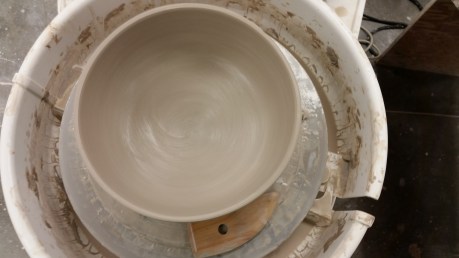
Like all potters, my hands leave marks when I make forms on the pottery wheel. These concentric circles are called, “throwing lines”. Some throwing lines are faint and others much more pronounced, determined by the amount of pressure that I apply, the speed at which I move my hands, and the firmness of the clay. If I apply too much pressure and move my hands too quickly, the throwing lines are so deep and spread out that the form adopts a corkscrew shape. In these cases, it is best to just wire off the clay, dry off the wheel head, and start over with a new lump of clay.

It is possible in the making and finishing of the piece to use tools to remove or minimize the throwing lines. This results in very smooth forms. Personally, I enjoy the look of throwing lines, the ones that show that I used my own hands on the piece but are subtle concentric circles. The circles remind me of the meditative state in which I often find myself looking down at the spinning forms between my hands, working to bring shape to it, bit by bit, with more patience than I typically have, the last being a requirement of a beginning potter. Even at art galleries, I can often see evidence on a hand thrown piece of the artist’s hands. It is part of the art. It leaves the imprint of the process and a reminder that beautiful things do not come into being without work or struggle.

Teva Harrison, an American who lives in Canada, published a memoir of her life so far, as a young woman with stage 4 breast cancer. Teva is an artist and writer. She is a graduate of the Evergreen State College in Olympia, WA, from which famed cartoonists and writers,  Matt Groening and Linda Barry are also graduates. The book, In-Between Days is a marriage of drawings and short expository writings organized thematically into chapters, Diagnosis, Treatment, Side Effects, Marriage, Family, Society, Hopes, Fears, and Dreams.

I had read a number of Teva’s comics as they were published, one by one, in the online publication, The Walrus. They were quite powerful then but I find that reading the book is a more powerful and complete experience. Teva is at times funny at other times raw with great emotional honesty, and at other times, hopeful. Her comics convey a great deal in a small space. Teva’s panel depicting she and her husband learning the news that they will not be able to have children evokes the quiet isolation and grief of infertility.

Teva’s book is making waves in Canada. She is the subject of news stories and interviews. As an acquaintance of hers in the online breast cancer community, I could not be more thrilled for her. There is ongoing controversy in the breast cancer community about whether it is better to be positive or negative about one’s breast cancer experience. Although Teva’s cancer is a horrible reality with which she must deal, the work of her own hands show clearly on the work that is her own life. In a television interview, last month, Teva shared her dreams for her legacy. “I hope that my legacy will be one of enduring kindness.”

Teva, thank you for sharing your beautiful life with us.

20160206_142919


The “new normal” is a term used to describe getting back into a “normal” life after going through cancer treatment. I know a fair number of breast cancer survivors who hate that term. (“Survivor” is also another term with its own controversy, but I digress…) Cancer changes everything. How can anything be normal again?

I understand the complaint but I don’t share it. “Normal” means something different to me, anyway. It just means the mathematical average. (Remember, I am a nerd.) Yes, I grew up in a culture where “normal” means “good” but I was trained out of that in my education and in my clinical work when a kid says, “I just want to be normal” he/she is often really talking about feeling disconnected from others. Teens also want to be unique, special, which would be not being normal. Teens want a sense of an individual identity but they don’t want to be alone.

We are not unlike teens in this regard. They are just navigating a stressful period of growing up so there is drama surrounding the very basic human needs to have a balance between separation and connection.

It is nearly four years since my breast cancer diagnosis. I do feel that I’ve achieved a “new normal”. The new normal is knowing that life can change in a heartbeat, knock me into the air, and down to the ground. I can have up’s and downs and boring aspects of my life. I know that I can grow through grieving. I know that I can cultivate patience. I know that throughout my days so far, I can usually remain connected to my sense of self. I know that the person who is flying in the air is the same person as the one who usually has her feet firmly beneath her.

One of the most powerful lessons of my “new normal” is to take opportunities for joy and happiness when I can.

That’s today’s “new normal”. Tomorrow may be different.

I was walking in my neighborhood last week and I passed two men. One of them had a newborn strapped to his chest in one of those little baby carriers. His baby looked blissfully asleep and his father looked like he was enjoying his time with his son.

This is not an uncommon sight where I live. It was a rather uncommon sight when I was a girl. When I was young, a man changing his own child’s diaper was considered a rarity. Men played with their babies. They were not as involved with the day-to-day caretaking as they are now. Caretaking was considered “woman’s work” and therefore “beneath” a man. It still is, to a certain extent,  but there really has been a significant overall increase in men’s level of involvement in their children’s lives not to mention an increased appreciation for “women’s work”. I have been providing mental health services to families for since 1991. When I started out this meant working with mothers and their children. Father participation was not common. It is far more common now and it is rare that I never meet with a child’s father.

When I saw the man with his infant, I smiled in recognition of what our culture has gained from the women’s movement. There is still sexism. “Feminist” is still a “bad word”. But it is difficult to deny if I REALLY think about it that men’s lives have been improved by feminism. To know your children better and to be a nurturing force in a vulnerable being’s life are gifts. With the loosening of gender roles, I also think it is easier for gay men to be parents together.

Civil rights and social movements are often met with resistance, the resistance that to give up a privilege is an absolute loss. That there is nothing to be gained through change. There is a lack of acceptance.

Loss, perceived or actual, is often a sticking point. It is a place where we hesitate, trip, or in some cases, fall into a deep pit, for which climbing out is virtually impossible.

Honestly, sometimes we want to stay in the pit even if climbing out is a possibility. We struggle. We suffer. We want to be heard, seen, and felt. At other times, we deny that we are in a pit. “What, this isn’t a pit? Everything is fine.” This is another kind of nonacceptance, and it too causes suffering. Denying and suppressing loss and the grief that comes with it, is a short term solution with painful consequences. In the world of cancer and other griefs, I see this acutely.

In the world of cancer and other griefs, I see this acutely. It can be so difficult to find balance. It is so difficult to find the time and space we need to grieve our own losses and come to some kind of peaceful place with them. On top of that, there is no final destination. Grief is an iterative process, one that we must come back to over and over. This is why we can get on with life and yet not ever “be over” a significant loss in our lives.

This weekend, I have been feeling anxious. I had awful nightmares last night. I feel justifiably underappreciated by my family. However, the way my impatience has played out in my behavior is a way that increases my suffering as well as that of my family.

I came back to my well-spring. I did a sitting meditation and I am sitting her with my own thoughts and feelings, writing this post. I can feel myself letting go of hurt and anxiety. I am not quite solidly balanced, but I am getting there. I am nurturing myself and it is radiating within. When I leave this office and rejoin my family, I am hoping to radiate compassion toward them, as well.

As I mentioned in my last post, I let my home office turn into black-hole during my cancer treatment, and it stayed that way until I cleaned it a couple of weeks ago. I found that is was a bit of an archeological site. Everything my former cat, Ollie, had knocked off of the desk onto the floor and then batted way underneath, were still there. Ollie died shortly after I began cancer treatment, coincidentally from metastatic cancer. I thought of the fact that he’d touched the pen caps, binder clips, Post-it notes, and push pins. I thought fondly of him, but I didn’t have trouble getting rid of the pieces that were garbage and putting the rest of it away.

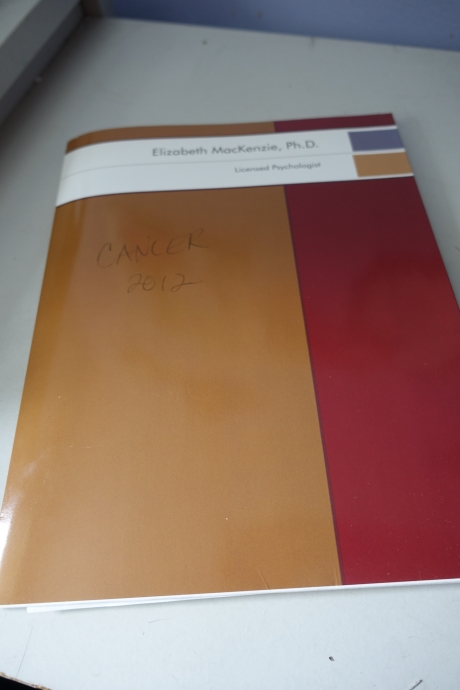
At the bottom of a pile on my desk, I found the folder in which I kept my cancer paperwork, labelled, “Cancer 2012”.

DSC04621


I opened the cover and saw a set of post-surgical instructions. I also saw Explanation of Benefits forms from my insurance. A year ago I many have put it back on the top of my desk thinking I might “need” it some day. That day, however, I threw it into the recycle bin and made a plan to write about it, as I am doing right now.

Another thing I found was the tote bag I was given by the Swedish Cancer Institute with their name and logo on the side. For the first several months of treatment, I carried a binder, also provided by Swedish, containing all of my pathology and blood work reports separated with tab folders, “Initial diagnosis”, “Lumpectomy #1”, “Lumpectomy #2”, “Mastectomy”, “Oncology reports”, etc. I called it, “my big bag of cancer.”  Eventually, I stopped using the bag but continued to use the binder, which was extremely helpful in keeping my treatment organized and making some kind of sense. It was actually a very handy reference guide to take with me to my appointments.

I looked at the bag and considered getting rid of it. I have a ridiculous number of tote bags due my past as an academic researcher. I did a lot of conference travel and typically, the conference catalog and registration materials are put in a tote bag. Some of them are very nice, very sturdy, and have, as a result, never worn out. Clearly, I did not need my cancer bag in order to lug stuff around. Honestly, I don’t need most of them. They just sit around, “just in case” I need them in the future.

However, one of the first thoughts to come to mind when I saw it was a visual memory of my wonderful breast surgeon, Dr. Beatty, carrying a tote bag just like mine, holding the things he needed for that day. He was the first of my many physicians with whom I developed a doctor-patient relationship. He and his staff were wonderful. I felt so taken care of when I went to his office.

The image of being held, not as an embrace, but as being supported and cared for came to mind. I decided that “my big bag of cancer” is a holder of good things. For now, I am keeping it. Next year, who knows?

I am amazed at the significance that objects have taken on through their association with my cancer treatment. Some of the associations are comforting. Some of them are painful. All of them are part of the truth of my experience, an experience that continues to evolve over time. Experience changes; at times, it changes a lot. But the past, the future, and the present all hold their truths and are all part of me. In my mind, this is the string that holds my life together and gives me great comfort.


Lindbergh High School Reunion '82, '83, '84, '85

Join us this summer for our reunion in Renton, WA!

George Lakoff

George Lakoff has retired as Distinguished Professor of Cognitive Science and Linguistics at the University of California at Berkeley. His newest book "The Neural Mind" is now available.

KomenWatch

Keeping our eyes and ears open.....

4 Times and Counting

Confessions Of A 4 Time Breast Cancer Survivor

Nancy's Point

A blog about breast cancer, loss, and survivorship

After 20 Years

Exploring progress in cancer research from the patient perspective

My Eyes Are Up Here

My life is not just about my chest, despite rumblings to the contrary.

Dglassme's Blog

Wouldn't Wish This On My Worst Enemy

SeasonedSistah

Today is Better Than Yesterday

The Pink Underbelly

A day in the life of a sassy Texas girl dealing with breast cancer and its messy aftermath

The Asymmetry of Matter

Qui vivra verra.

Fab 4th and 5th Grade

Teaching readers, writers, and thinkers

Journeying Beyond Breast Cancer

making sense of the breast cancer experience together

Entering a World of Pink

a male breast cancer blog

Luminous Blue

a mother's and daughter's journey with transformation, cancer, death and love

Fierce is the New Pink

Run to the Bear!

The Sarcastic Boob

Determined to Manage Breast Cancer with the Same Level of Sarcasm with which I Manage Everything Else

FEC-THis

Life after a tango with death & its best friend cancer