
Protected: Reminders
Protected: Steady Eddy
My dear friend, Rachel, just posted a comment on Facebook, “I think I’m about to get in trouble on a friend’s page. Best shut my yap.” My response was the following comment: “Do a cost/benefit analysis and then proceed accordingly. I saw my comment in print and thought, “And to think I used to write poetry.”
But when it comes to sticking our necks out and debating, it is probably pretty good advice. As I have described elsewhere, I am naturally argumentative and love a good debate. You may recall from an earlier post that my fellow grad school mate, Penny once described me in her amazingly wonderful Appalachian drawl, “Elizabeth would argue with a post.”
Some of those arguments were transformative and some were just fun. At other times, they were draining, left me in a lingering state of emotional turmoil either because I felt hurt and/or that I felt that I had hurt someone else. I am not a mean person but I am a quick thinker and when hurt or angry, I can use my verbal ability in a very aggressive way. This was particularly true in my teens. One of my high school teachers wrote in my senior year book, “I will miss your acid tongue.” I don’t think he missed it because he ignored my Facebook friend request when I put it out there a couple of years ago. And I could see that he was active on Facebook and friends with other students.
An excellent lesson I learned during the horrible work situation that led to my first of two major depressive episodes was to trust myself and choose my battles carefully. I spent nearly three years at that workplace, surrounded by some amazingly competent and dedicated people and others, well not so much. And since the folks in the “not so much” category were in management, even us amazingly competent and dedicated underlings misbehaved. I spent a lot of time in conflict with managers and coworkers because I felt both personally and professionally attacked and unable to do my job. I was given two managers, with totally different training, and totally different goals. In other words, it was a structural set up for failure. Before I fully realized how futile my situation was I spent a lot of time questioning in my head, “Is it me or is it them?”
Sometimes arguing for me is an intellectual exercise or sport. At other times, it has been a way of seeking reassurance when I am anxious. I did a lot of that kind of arguing at that place of employment. The illogic and chaos of the place was so disorienting. If only I could explain my ideas logically or counter criticisms in a reasonable manner, the universe would become organized again.
The universe didn’t reorganize itself until after I was laid off from the job in a very nasty way. But it was freeing. I got my depression treated. I got my Washington state psychology license and planned to start a small private practice in case my research career, the one I had fought to achieve and maintain over the span of 20 years, wasn’t viable. I wrote a small grant with a software company that designs web-based training, using a rather ingenious curriculum design developed by a professor at mid-west university. The grant was from the U.S. Department of Education to develop a pilot educational program. This was truly exciting as I had been working in computer-based parent education program research and development since my doctoral dissertation. Telehealth was a new, growing, and much needed research area. I live in a metropolitan area but I spent my training years, six years in North Carolina, one year in northern Florida, and two years in southern Indiana, working with rural families with very little access to even the most basic parent education on how to help little kids learn to cope with the difficulties in life in ways other than hitting, kicking, or throwing tantrums.
For my doctoral dissertation, I had carried out an independent project (as opposed to working on a professor’s project) a clinical trial evaluating a parent education program that I developed along with my husband, who is a software engineer. The results of the trial were modest, but positive and statistically significant. Working with an established professor translating parent education to his web-based instructional design meant continuing a line of research using technology as an additional mental health service delivery method.
You know I love writing about context. This is why I am not making a long story short. If you have not yet gotten my message, I was REALLY invested in my line of research. Getting help to under served populations. Preventing the really treatment resistant mental health problems that can develop in folks who don’t get early intervention, many of whom end up being “treated” in our penal system. This may sound overly self-important or idealism bordering on delusion, but I really viewed it as a vocational calling of sorts.
Back to the grant. We spent the $50,000 the government provided very very well. The pilot project was a success and something of which I will always be extremely proud. The parents who used the program loved it and they also provided me with very positive feedback regarding the email-based discussion thread moderation and coaching I provided to them as they completed our little program.
Although I enjoyed working with my co-principal investigator, the Big Time University Professor, I was extremely unhappy with a key staff member at the company, with whom I interacted daily. I think it basically boiled down to his taking a different role on the project than the one that he had been accustomed to, which was being in charge functionally if not officially. In other words, management had been very hands off. He really did not like this and fought me over everything including the program content and learning objectives.
I also disliked managing a project being carried out in the Midwest while I lived in on the west coast. It was time to write the “big grant” the one that was the follow up for the pilot grant (the granting mechanism was defined as a two-stage grant, the little grant followed by the big grant.) If the government were to funded the second grant, it would have been a $250,000 grant, which is not enormous in the research world but it is significant and a huge amount for a researcher at my career level.
I knew people in Seattle with relevant production and project management experience. REALLY GOOD PEOPLE WITH WHOM I’D WORKED WELL IN THE PAST. I’d contacted nationally known researchers, primarily psychologist and they had agreed to serve as consultants on the grant with no financial compensation. (That is standard, by the way. Psychology professors do a lot of stuff for free.) The pool of possible Internet programmers in Seattle was huge compared to a small university town in the Midwest. The professor and I set up a meeting with the company C.E.O. I wanted to request that I hire a Seattle crew to carry out the project, should the grant be funded. Big Time University Professor thought this was a grand idea, in fact I think he was even the one who suggested it.
C.E.O.’s response was a surprisingly loud and angry, “You work with the team you’ve got or we part ways.” I REALLY wanted to write that grant. But I was clear about what I was and was not willing to put myself through in order to get that chance. He had made a bold and seemingly bullying move. I calmly replied, “If the only choices are to keep this team or to part ways, then we will part ways. But I think there are other solutions to this problem. Let’s discuss those.”
I didn’t argue but I stood my ground. The small grant was over. I was back to collecting unemployment. My family needed for me to make an income. It wasn’t just about my idealistic goals or my career. It was about putting food on the table. The meeting ended on an ambiguous note something along the lines of “Let’s keep talking about this.”
My gut told me to get out and that what looked like a wonderful possibility would not be in reality. The C.E.O. was not a bad guy but he was disrespectful and I had no confidence in his ability to treat me like someone with something of value to offer the company. They were also struggling financially, had been through a number of rounds of lay-offs, and a few years later, the company folded. So he was also trying to protect existing staff rather than to expand the company into Seattle.
My husband agreed with me and I declined to write the grant. It was disappointing but felt like the exactly right decision. I ended up getting on research staff at the University of Washington and starting my psychology practice. I ended up loving both jobs, the former as long as it lasted, which was three years.
These days, I keep my arguments with posts (figurative or literal Facebook posts) to a minimum. I try to think about the costs of acting as well as the costs of not acting. I think about what things I will not get to do if I am busy arguing. I think about the fairness and strength of my argument. I consider the other side. I consider other solutions to the problem. I think about whether I am trying to solve the right problem.
Conflict is a fact of life. Some conflict is even necessary for life, especially if one has relationships with at least one other human being. But conflict as a way of life? No, thank you. I’ve got too many other things I want to do with myself.
As a child/adolescent psychologist, I work with a lot of moms. They often express feelings of guilt for their children’s challenges. I often respond by saying, “You have the rest of your life to feel guilty as a mother. Save some for later.” This statement usually gets a laugh and often the guilt although not gone, is small enough for us to move forward in our conversation. It is often, however, not so easy. People get stuck. Even psychologically solid, reasonable parents can get stuck on guilt. Several years ago, I worked with a wonderful mom of a very young child who was showing signs of significant developmental challenges in multiple areas. She had professional experience working with children and was acutely aware that her son may have handicaps that would greatly change the future possibilities in his life.
Although there was no evidence that she had done anything to contribute to her son’s difficulties and further, it was yet unclear as to whether his difficulties would be short-lived or chronic, she felt guilty. She felt guilty and stuck. During one session I asked, “What do you think you are getting out of this guilt?” She looked at me understandably with a confused expression. I went on, “It may sound backward but sometimes people hang onto guilt because it gives them a sense of control in situations in which they feel totally out of control. We cannot have guilt without a sense of power, even if the power we feel is to harm.”
She was dubious but I had planted a seed. She came back a week or two later and basically told me that she had thought what I had said made no sense but upon careful reflection, it actually made sense. It was a turning point in her grief process.
Guilt is blame turned inward. It can also be turned outward. In Atom Egoyan’s 1997 film, The Sweet Hereafter, a town grieves for the loss of a busload of school children in an accident. Ian Holm plays an attorney who travels to the small town to file a class action law suit against the bus company. He has his own grief back story, which is his adult daughter’s drug addiction. Holm’s character tirelessly pursues blame. Someone must be responsible for the tragedy. That someone must pay. Things don’t just happen. They happen for a reason. He was going to find the reason at all costs. I won’t spoil the ending for you but let’s just say that letting go of blame and accepting the loss of control is a major theme of this film.
As for myself, I have had issues with letting go of anger. There is a release that comes with losing my temper and in the moment, it feels good. But because I am at heart a peacemaker and an empathetic person, I feel regret at having hurt other people, especially my husband. My anger is usually rooted in anxiety, anxiety that a problem can’t be controlled or solved. Anxiety that my house will never be an environment that I can control and make a sanctuary. Fears that my cancer will return. Fears for my family, especially my teenaged daughter. I have fears of not being a good enough psychologist when my patients are having particularly treatment-resistant struggles.
Most people would consider me to be a very disciplined person. One exception to this has been my life long struggle to eat healthfully and to exercise regularly. I love food. I am an excellent home cook and I love good restaurants. I love to eat a large amount of food. The act of eating is an amazing, highly enjoyable, sensory experience. It is also a wonderful social experience. And I know when I am overdoing it and often in my life, I just keep eating. And at these times, it seems too hard to put the time into preparing healthy meals. Quick and easy is convenient but not nutritious. The rest of my health suffers and I just don’t feel as good during the non meal parts of the day. It also feels good sometimes, not to exercise. “Ah, I can just sit here and rest.” This is particularly true when I let my work and family life burden me. I work too many hours at work and at home, doing things and worrying about people. I am tired and I feel that I deserve to rest even though I know that I deserve the kind of treatment that promotes good health. But like many caretakers, I put my self-care low on the priority list even though I have counseled countless moms to avoid this. But putting my health at lower priority made my daily to-do list shorter. It made it seem like I was juggling fewer balls in the air. It was a false illusion.
In my 20’s, I gained and lost the same 20 pounds over and over. By my 30’s and 40’s, I have gained and lost the same 40 pounds twice. Right now, I have given up the convenience and the joy of eating to the point of indulgence for healthier foods. Yes, it is work to plan my meals, to make entrees ahead and freeze them in reasonably-sized portions. I take the time to make sure that I always have healthy vegetables on hand. I love vegetables and you know what, eating a large volume of vegetables is actually good for me. And I’ve gotten so that I look forward to my daily 3 mile walks. The key for me was realizing that I was self-employed and could therefore set my own hours! I am better at exercising in the morning and had been trying to add it to the end of long clinic days, which didn’t work at all. So, I just started seeing my first patients at 9:30 am instead of 8:30 am. What a rut I was in to not think of that solution years ago!
Letting go of these things has required patience, which does not come naturally. But I have grown and changed over the years. I have learned to manage my anxiety pretty well and with my mindfulness practice, I am learning to practice acceptance and further, that acceptance is not the same as doing nothing. It is not accepting that can spin me in circles, feeling like I am doing something but getting no where. Endless anxiety and anger can be a trap where you expend so much energy that it feels like you are doing something productive and your are not. And as a person who has been clinically depressed twice in my life, I can tell you that the helplessness and hopelessness of that passive state is one of the loneliest places in the world. I can’t tell you how thankful I am that I have not been near that place for over 10 years.
It can be hard to let go of anger, of grief, of impatience, or anxiety, of sadness, of guilt, at the point when I need to move on. Emotions are vital to our lives, even the “bad” ones. They motivate, protect, and educate us. But they do not always work in a healthy way with our thoughts and behaviors. I know that I will be working and reworking this balance for the rest of my life. I try not to think about how things “should” be in respect to things over which I have little control. I got breast cancer when other people with similar lifestyle and risk factors did not. I got it when people with more risk factors did not. Disease is part of the natural world and it doesn’t make sense to me to be mad at the universe. That just doesn’t work for me and the cost is too high.
We all have to make our own paths in life. In my life, I feel pretty unstuck right now but know that the cost of each day is a different set of gains and losses. Yes, I have lost the illusion of control but I have gained so much. I write this to reflect. I write this to remember the peace I have in my life at this moment.
I let go to gain freedom. I let go to go on.
Just like the Proclaimers, I have something to announce:
Today it is exactly 6 months since I started tracking the amount I walk each day. And today, I passed the 500 mile mark!
And a glorious walk, it was! Sunny with a pleasant wind full of beautiful plants, the sea, and friendly neighborhood dogs.
When faced with cancer or any other serious illness, it is only natural to think about the uncertainty of our futures. Lately, I find myself thinking about this more frequently. A year after diagnosis, I find myself finding more and more room for non-cancer related life, “the new normal” as it is often called.
I find myself thinking that I have no way of knowing whether I have cancer in my body or not. Frankly, this is the truth for everyone with “no evidence of disease.” I don’t know if it will come back. I also know that just like everyone else, I may have a different serious disease or injury in my future. And my family and friends will face illnesses and other hardships. We often think about disease and death as the enemy, but they are part of the natural world, and we will all face them.
By nature, I crave certainty and dislike ambiguity. In my job, I help kids and families reduce the chaos in their lives. I am the family administrator at home. I may have even been described as a “control freak”, maybe just maybe, once or twice in my life.
The last two years have been the most challenging in my life. I been been mired situations that I’d hoped I’d never have to face, full of ambiguities and dire possibilities.
What I have been noticing the most in the last month or so is the fact that I am not freaking out. Even in the scariest, grayest parts of these years, I’ve found a constant. There has always been love. Love from family, love from friends, love from healthcare providers committed to help. And the love I have for others is stronger than ever.
Life can be murky, ambiguous, and downright scary. But love is clear and love is always beautiful.
XOXOXO
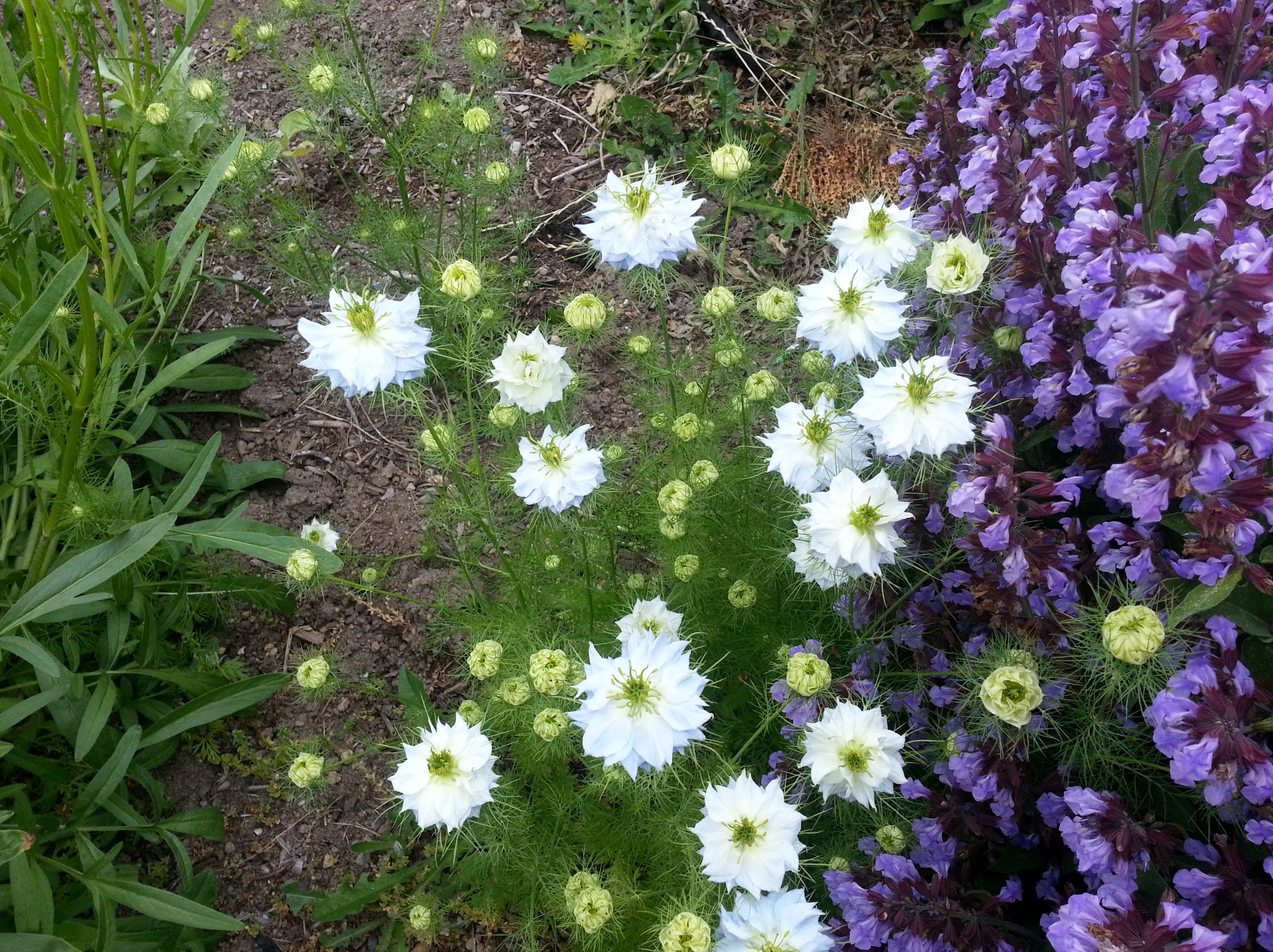
Love-in-a-mist is a lovely but tough flower. If you plant it in your garden, you will have it forever.
Yesterday, on my way to the car after work, I saw a woman in the parking lot. She was perhaps in her late 50’s or early 60’s and was significantly over weight. She was facing away from me, bending over to get a bag out of her car. Since she was wearing quite a flimsy pair of stretchy white pants, I was easily able to ascertain that she was wearing thong style underwear!
Although I had to salute her for the zingy way she was living her life, I must admit that my first thought was, “Eww, is she wearing a thong?” I was also not impressed with the pants or the cellulite that could be seen through them.
Then I felt guilty. I thought, “Look, she’s parked right next to the yoga studio. She’s probably going to a class there. She’s taking good care of herself. You are so very shallow.”
Then I started thinking, “But that is really gross.”
Then I started feeling guilty again.
Then I started to feel guilty because I didn’t feel guilty enough.
Then I started thinking about aesthetics. Why are things, living and non-living, beautiful? One could argue that overweight people are not considered beautiful because being overweight is not healthy. But being overweight is considered attractive in many cultures and in the past was associated with being wealthy, not having to do manual labor, and having ample food to eat.
Now this woman was also older and youthfulness is part of our cultural ideal. Now if I imagine a younger woman, of the same size, in the same outfit, I can’t say I would have been positively impressed.
So instead of offering this woman some of my famous granny panties, or riding on this sling shot of guilt I’ve created for myself, I have one thing to say to this woman.
“Namaste.”
All people are worthy of my respect and this is not contingent on something as trivial as underwear choice.
Today is Good Friday, a particularly good day to meditate on loss and resilience.
I had a wonderful visit with my friend, Mike, a couple of days ago. He and I became friends in our teens. We were in the same woodwind quintet through a high school program at Cornish Institute in Seattle. He played French horn and I played flute. I continued to play through college at the University of Washington but not as a music major. Mike went off to Oberlin Conservatory and then the Julliard School. Our lives after high school diverged though I did see him a couple of times during college, when he came back to visit his parents.
While I was becoming a psychologist, Mike was a professional musician. In particular, he played in the orchestra for a lot of Broadway shows. After about 20 years, he decided to study Chinese medicine and he currently has a practice in New York. Now I see us as doing similar things again; we are both healthcare providers. I think that’s pretty cool.
Mike has been in Seattle for the last few weeks to be with his father during his last days. His father’s funeral was last Saturday. Mike’s mother died several years ago of ALS (Lou Gehrig’s disease). I was relieved to hear that his dad did not suffer horribly like his mom did. Mike has had some really big loses over the past year. Remember that I mentioned that he lives in New York City? Well, like many people in that area, he experienced the devastation of Hurricane Sandy. Mike also traveled around neighborhoods to help people. He inspired me with his FaceBook posts, describing the positive ways in which people were helping each other wade through chaos and fear. He reminded me of the Fred Rogers’ quote that went viral on Facebook after the Sandy Hook tragedy.
When I was a boy and I would see scary things in the news, my mother would say to me, ‘Look for the helpers. You will always find people who are helping.’ To this day, especially in times of ‘disaster,’ I remember my mother’s words, and I am always comforted by realizing that there are still so many helpers–so many caring people in this world.
Mike’s family is incredible. His parents, who were both born in the U.S., were forced to leave their homes during WWII because they were of Japanese ancestry. He and his family have continued to face discrimination as people of color. Mike is one of the most loving and kind people I know. Nonetheless, he and his partner, Dennis have faced discrimination as a gay men.
I know that Mike has experienced many hurts in his life. But I am struck by his grace, resilience, generosity, and optimism. Mike and I have never discussed mindfulness though I know he practices meditation. I believe him to be a very mindful person, someone who does not ignore painful truths but who observes and accepts them. He also accepts the beautiful truths. I think this is what allows people to grow from hurt, instead of remaining stuck.
Why have I been meditating on loss and resilience? Well, in addition to being inspired by and having a great deal of affection for my friend, Mike, I have been trying to sort through this cancer thing. Many positives have resulted from my experience thus far and it’s hard for me to write about it without fearing that I sending a message like, “Cancer is an awesome gift! I’m so lucky! Yippee!”
Cancer is not something I would invite into my life, but I got it whether I wanted it or not. I do have control to a large extent, over how I live each day and how I incorporate these experiences into a meaningful life. There is growth that can come from adversity and as long as I am experience it, I might as well grow.
This C.S. Lewis quote comes close to what I am trying to express:
Hardships often prepare ordinary people for an extraordinary destiny.
I’m not a big believer in destiny as I am not much into the idea of pre-destination. How about the idea that hardships often prepare ordinary people for an extraordinary future? (Note that it says “often” and not “always”; let’s not bring that big old buzz kill, Nietzche into this.) Yeah, I know that it’s pretty nervy of me to mess with a quote from a most highly regarded Christian scholar. And I’m brazen enough to do it on Good Friday, too!

Trillium intertwined with budding bleeding heart. My garden is really cooperating with the theme of my post today.

Trillium ovatum. This trillium is native to our area. It’s three petals and the change in petal color from white to purple is often viewed as symbolic to the Lenten season. Lent and Easter are early this year so mine is still white.

Helleborus orientalis. “Lenten Rose” If you are able to grow this plant in your area, do so as it is not only beautiful, but starts blooming in winter.
Yes, I was looking at swimsuits on the Land’s End website today. I have a complicated history with swimsuits. I have avoided wearing them for the most part. Additionally, swimming bothers my eczema. But my skin is doing much better on this wheat free diet and I have dreams of getting a hot tub in the back yard. By summer, I will have a permanent right breast, too, instead of my empanada-shaped temporary one. Woo hoo!
I know that breast cancer changes a lot of women’s view of their own body. We tend to dwell on the negative aspects of loss. They are real, don’t get me wrong. I have to say, though that I like my new outlook on my belly fat (hey, you are going to be transplanted north in 6 weeks) and the fact that I am kind of looking forward to swim suit season, even though I am unlikely to have a backyard hot tub or go to the tropics any time soon.
It’s just good to be looking forward to another season with all of my surgeries behind me. And I do feel better in my body. I eat well, I exercise, I meditate, and I see all of my wonderful care providers. The fact that I have not been reduced to a pile of tear-soaked rubble makes me feel powerful and strong from the inside out.


 My Eyes Are Up Here