“May you live in interesting times” is said to be a Chinese curse. However, the origins of this saying are according to my Googling, debatable. But let’s go with the message, shall we, despite it’s possible impure origin.

I’m no shrinking violet but I am not a big risk taker or as we say in the biz, a “sensation seeker”.  I like an interesting life but for the most part, I live within the box. I use vibrant colors but I draw within the lines.

By nature, I do not get bored easily. I mean I get bored sometimes, but typically I don’t get bored a lot. Until stupid cancer. The stress, the upside-down sleep habits, the weeks away from work for surgery recovery, and the drug side effects. I can’t believe the fatigue and I didn’t even have chemo.

I had horrible boredom for months. Painful boredom. The kind of boredom that my patients with ADHD grapple with. And if you were to know only one thing about ADHD, know that to a person with it, boredom is extremely painful. That’s where I found myself. BORED. OUT. OF. MY. GOURD.

Yes, having a health crisis bored me out of my gourd. Well, some parts were actually exciting and truthfully, I found them to be times of creativity as well.

But I’ll let you in on a secret. ADHD is not about not being able to pay attention. It’s about not being able to pay attention or to persist on tasks that aren’t interesting. The flip side to this is that interesting tasks can be extremely rewarding. And that’s how I found myself for many months. It was not that I couldn’t pay attention or persist at all, it was that I could not regulate my attention or persistence as I once could. That’s why I’ve written frequently about feeling as though I had functional ADHD during a good part of my cancer treatment.

I am happy to report that my sleep has improved, I continue to heal from the acute stress of cancer as well as the nonstop surgical train. I still need a lot more sleep than I used to need. But when I am alert, I am very alert, very energetic, and my concentration is excellent. I am happy to be able to be more productive in my work. I have taken on my work and my life is, by and large, a lot more interesting.

But there are costs to my workload. I am getting cranky with my family. I find it more challenging to find times to do my daily walks. I am currently walking 5-6 times a week instead of 7 times a week. Five times a week is still really good. Of greater concern, I find that it is harder for me to eat a good diet when I am stressed. I gained weight over the holidays and have not been able to get it off. I am still in the healthy range of weight for my height but just barely. I know this is the way that my weight can creep up on me. You may think this is overreaction on my part but I have lost and gained weight so many times in my life that I know I have to really really be mindful of my dietary and exercise habits.

I am very happy to not feel bored and numb during a good part of my day, as I once did. I am happy to live in interesting times. But interesting times, like boring times, bring their own set of challenges.

This morning it was clear and cold. I considered walking to the beach for my daily exercise but saw that the mountains were clouded in. So after I got my coffee, I walked to Fauntleroy Park. My neighborhood is relatively quiet for an urban area but the street that runs along the park boundary gets a fair bit of traffic. There’s a burst of street noise as I cross it and follow the path into the woods. The first thing I notice is the myriad of greens in the trees, the ferns, the mosses, and the woodland plants. Then I start hearing song birds and crows. The street noises fade as I walk further into the interior until all I can hear is the sounds of the forest and of my own footsteps on the trail.

This morning there was mist rising from the ferns. I could see my breath. I looked at the mist as it rose upwards, felt my breathing slow, and noticed that I was smiling, as I often do when I am surrounded by nature. I felt immediately transported, like ice to steam, and that my spirit was rising above the nests in the trees and above the canopy. I stayed in that blissful state as I walked along. Then I looked down and noticed something.

I was off the trail. I had meandered with my eyes on the trees and the new plants growing and had not noticed that I’d lost the trail. I knew that if I walked down hill, I’d eventually find the trail. But it did make me reflect on the way that we live in multiple worlds and both worlds are necessary.

I think this is one of the reasons I don’t like a lot of pithy inspirational sayings. They seem dreamy and overly ethereal. There’s not enough reality to provide ballast. And I also think that it may be one of the reasons that a number of people with cancer do not like to be referred to using idealistic terms like “hero”, “inspirational” or “brave”. Those terms live up in the Heavens. Cancer is isolating and I know for myself, I want to be very much seen as a real human being. I want to be able to connect with other people.

Then there are the attitudes that are all ballast. Those are the stigmatizing attitudes, the view of cancer as a death sentence, the fears that keep our friends away from us because they fear our death as well as their own.

What matters to me more right now than if I am brave, inspirational, or a hero, is that I am still carrying the sounds, sights, and smells of the forest in my heart as I go about my daily chores and consider life’s obstacles and joys in the past, the present and the future.

20140312_101044


The trilliums are starting to bloom! This is our native trillium ovatum

The trilliums are starting to bloom! This is our native trillium ovatum


The fiddlehead ferns are unfurling. They are edible at this stage.

The fiddlehead ferns are unfurling. They are edible at this stage.


This content is password-protected. To view it, please enter the password below.

My 30th high school reunion is this summer. One of my classmates, Brad, wanted to do a charity event as part of the weekend. Something that would raise money for Cancer Lifeline, an organization that provides counseling services, classes, and support groups for people with cancer and their families. My friend, Nancy, a psychologist and breast cancer survivor worked there for four years. It is a terrific organization. The original idea for a fundraiser is not panning out.

I know that some of you do work in charity fundraising, PR, and the like. What are some ideas you have for a fun event with a social component that would raise about $10,000?

I am so excited to be involved in this effort. Brad is a wonderful guy who is also married to one of my very best childhood friends. He is really motivated to raise money for a worthy charity that does not necessarily have the highest profile. This amount of money could go a long way for Cancer Lifeline.

Thanks!!

When I walk in the forest, I see many dead trees and other plants. Sometimes even dead animals. Although everything that grows in the forest dies, none of it is lifeless.

That’s my meditation for the day.

20140226_111708

20140226_11450320140221_111948


20140216_141616


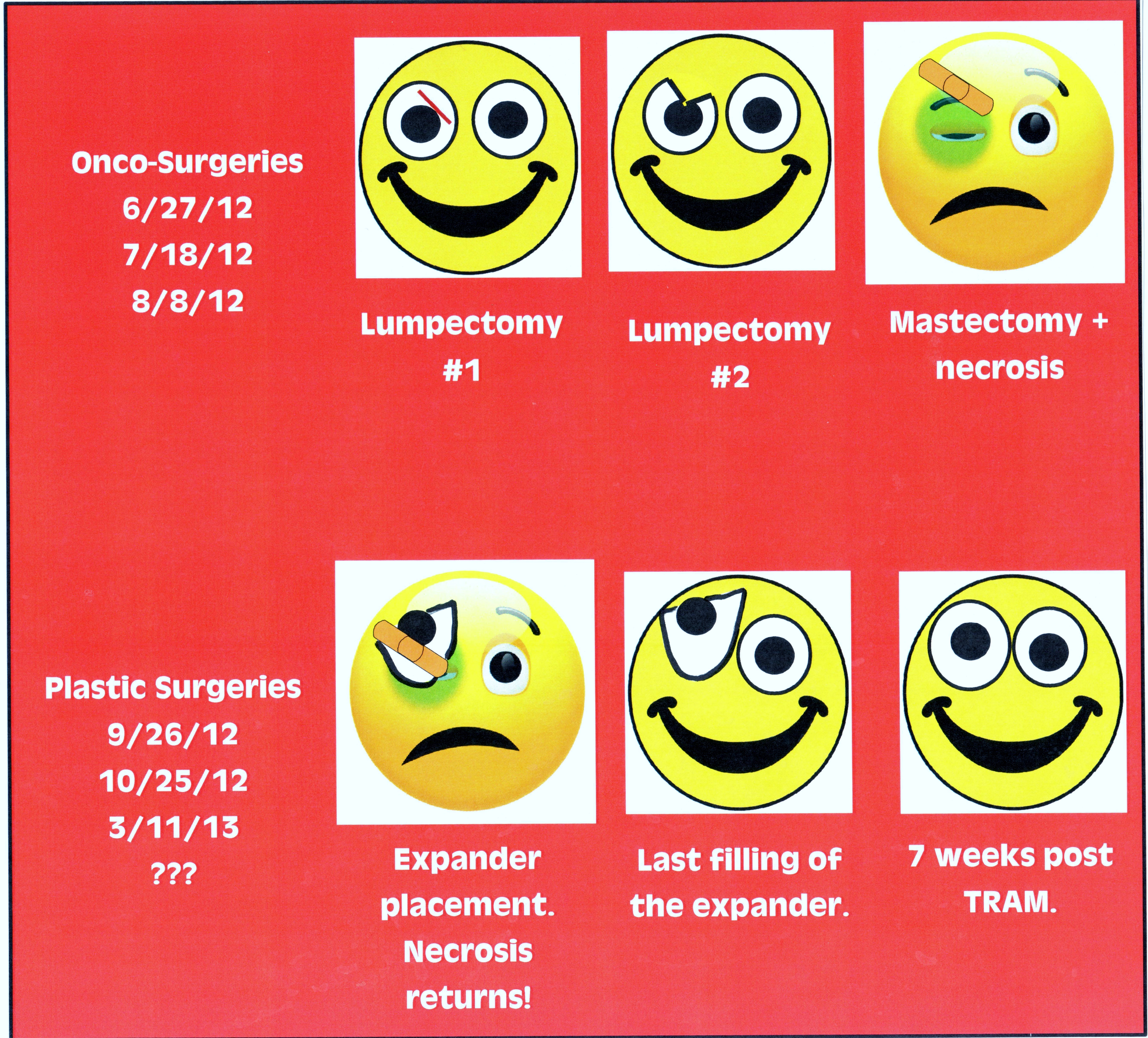
My last surgery, TRAM reconstruction, was on March 11th, 2013. It was the day after my 23rd wedding anniversary. I’d had quite a number of surgeries in a small number of months, which I chronicled in my humorous salute to women who post actual photos of the stages of their surgery:

smiley3

The last smiley was smiley represents healing at seven weeks post TRAM. Although the right googly eye is slightly smaller than it was, the overall effect is the same. And if you ask the reasonable question as to why a surgeon would purposely make a reconstructed breast bigger than the natural breast, my understanding is that they do that in case there is tissue necrosis and they need to remove some of the tissue. I had no difficulty with necrosis following the TRAM leaving me with the current va va VOOM effect.

I met with my plastic surgeon last Thursday. We discussed the next possible options for my reconstruction. I decided to go ahead with two procedures, to be done on the same day (March 19th) in an office visit. “VOOM” will get a little reduction and “va va” will get a 200 cc fat injection harvested from my thighs via liposuction. If, like me, you don’t think in terms of cubic centimeters, here is a beaker filled with 200 cc of milk. (Yes, I own a set of small beakers.)

20140223_143927

200 cc’s is not a lot so I am hoping I’ll heal quickly from the surgery. But, who knows? This will be my 8th (technically 8th and 9th) surgery so I know that whatever happens will happen and I’ll deal with whatever comes my way.

There are no other planned surgeries after this. I have no crystal ball but these could be my last breast surgeries. That’s kind of a nice thought.

I know that a lot of you have experienced great hardship this winter. Some of you have lost loved ones, some of you are sick or have been sick. And then there are the terrifying weather events that are getting increasingly common, most recently the impact of the polar vortex on a substantial portion of North America.

I made all of you a little film of a portion of my walk today along with some of the thoughts I have when I am in the woods. I am hoping this is an encouraging experience and if not, you get to see some very pretty trees and hear some crows having quite a conversation in the woods.

It’s funny to me because although I am surrounded by earth forms and plants so much larger than me when I am in the woods, It’s okay to be small. We don’t need to be big. We can just be.

A large part of my training as a Ph.D. student in clinical psychology at the University of North Carolina-Chapel Hill was completed at a state psychiatric hospital in Butner, NC. The hospital, which has been since closed down was located amid tobacco fields, a federal prison, two orphanages (segregated by race even in the 90’s), a “training school” (jail for kids), a residential center for people with severe developmental disabilities, and a drug and alcohol treatment center. It was like this small tobacco town had taken up the industry of institutionalization. It was odd.

The hospital building had previously belonged to the federal government as World War II Army barracks. The federal government sold the buildings to the state of NC for $1. There were no interior signs in the hospital. All of the walls were blank. I have a poor sense of direction. I felt a great deal of empathy for the patients in the hospital, many of whom had trouble getting through the simplest of daily tasks.

I spent five semesters, spread over four years in that hospital. For an entire school year, I spent 16 hours a week there. I remember before I first started training there in the spring of my first year of graduate school, worrying about accidentally hurting someone there emotionally because I was unsure of what I was doing. I thought of psychiatric patients as extremely fragile and vulnerable people.

But then I had a thought. I realized that I would try my best to be kind and compassionate, to try to understand and to listen. I thought of all of the things these individuals had been through. Most of the patients had been farmers. Most of them were dirt poor. Most of them had been subjected to some of the worst imaginable life circumstances. If they had survived their lives up to this point, I figured that they could survive me, a sincere but inexperienced first year graduate student.

We all survived. It was not easy. The hospital environment itself was somewhat of a trial. Smoking in hospitals was still legal in NC during my first years there and then became illegal. During the first couple of years, the hospital was veiled in cigarette smoke (not great for my asthma, by the way) and always smelled at least lightly of urine. When I worked full days at the hospital, I noted that as the day wore on, I was more likely to encounter patients emerging naked from the showers. Many of us who have spent time in hospitals know that privacy is in short supply. Someone is always peering, prodding, or poking at us. But some psychiatric patients lost their boundaries around privacy. They don’t make sure that they are dressed before entering a public area. For many, there is a general disorientation either due to a general numbing or a disconnect with what most of us call real life.

The life stories of many of these patients were those that made soap operas plots sound like the dictionary. I mostly did assessments. But I did have one long term psychotherapy patient. She was 58 years old and it was her 30th hospitalization in as many years. My job was to help her interact in a somewhat normal way. When I first met her, she kept asking me if she was dying and tried to take all of her clothes off. I brought her tea and a deck of cards twice a week. I engaged her in conversation. She told me about being a mother. She was proud of herself as a mom. I knew from her background history that she had been a horrible mother. She shared a bed with her husband while he raped their daughter, night after night and year after year. I knew that this patient, as low functioning as she was would never be able to appreciate the horrors that they inflicted on their now adult daughter. So I just tried to help her interact in a pleasant fashion with another adult and that adult was me.

One would think that this hospital was an extremely depressing place. And yes, the hospital itself was kind of a downer. And the patients, by and large, were very very ill. But I was perpetually amazed by their resilience. The fact that even thought they were in the hospital because they could not care for themselves and many were suicidal, most days they wanted to live. This to me was a testament to the resilience of the human spirit. I found it both humbling and inspiring.

As you know, I often take walks in the forest. Yesterday, I walked in nearby Fauntleroy Park and I was reminded of the resilience of life. Stately maple trees have bulges, also known as galls, looking like tumors along their trunks. They are caused by a number of factors including fungi and injury. They ultimately, shorten the life of the tree. I see trees that have been nearly uprooted by storms continue to grow at unbelievable angles.

People, like trees can be very resilient. They can adapt to severe diseases at times and continue to live. But what I am reminded of in the woods is that there are degrees of resilience ranging from the barest of survival to lush and abundant thriving. But for all resilience does not mean unmarked or unaffected.

I took a couple of films in the woods of examples of resilience in the woods. I find it helpful to make these comparisons. If you do also, you might appreciate the films. Also, the trees are PRETTY.


As you may have heard a thousand times by now, my hometown’s professional football team, the Seattle Seahawks won the Superbowl. It was very exciting. It was a major achievement. There was a parade in downtown Seattle. 700,000 fans came to the parade. Seattle’s population is about 620,000. More than a whole city’s worth of people were crammed into the space of a few city blocks on a relatively cold day. That’s how excited people were.

There were also a number of media articles and FB posts excitedly declaring that the Superbowl win was the first major sports championship for Seattle in 35 years. I remember that championship. It was the Seattle Sonics basketball team when they were coached by Lennie Wilkenson. I was an avid Sonics fan at they time. It was really exciting when we won that championship. But something else has happened in the intervening 35 years. The Seattle Storm, a team in the WNBA has won the national championship. Actually, they’ve won it twice. Given the age of the WNBA, it is particularly impressive. The Storm play in the same arena in which the Seattle Sonics used to play, before the Sonics left Seattle in a huff because most tax payers didn’t want to pay for a third new sports stadium in a small number of years.

Someone from high school posted on Facebook about how excited he was that the Superbowl win was the first major championship for Seattle in 35 years. One of his friends reminded him that he has daughters and that the Storm has won two championships. His reply? “No really, that doesn’t count.”

I am not an angry person but I get angry about injustice. Women and girls are discriminated against in this world. It is a fact and a quite obvious one. This is why it is so important to keep working for equality and also to celebrate the accomplishments of girls and women.

Everybody’s had a woman or a girl in their life, right? Mothers, teachers, sisters, daughters, friends, wives, girlfriends. And one would think that if I were to share a non-political post on Facebook like, “Hey, it’s Marie Curie’s birthday!” that I would get “likes” from both men and women. I rarely get “likes” from men on any kind of so called “women’s issue” posts. Seriously? Marie Curie? What’s not to like? Even when my daughter dressed up as Eleanor Roosevelt for Famous Persons’ day in elementary school. Zero “likes” from men. Come on! How adorable and cool is that?

Social media is powerful. It has changed culture in some meaningful ways. Men, how about paying some attention to these human issues posts? They are not just about women. They affect all of us directly and indirectly.

Still not convinced, men? Still not motivated to take action? I have an exercise for you. Close your eyes. Imagine an argument that would convince you to “like” and or positively comment on posts celebrating the achievement of female human beings or calling attention to civil rights issues affecting female human beings. Now imagine that I have made this argument and you are successfully convinced.

Look, gentleman we are just asking you to “like” us not “like like” us, as the kids say. You would be helping everyone. Thank you.

In my job as a psychologist and a diagnostic specialist, I am asked to answer questions and make recommendations. Answering diagnostic questions can be really hard, especially in my areas of specialty. I sift through multiple data sources, try to find patterns of behavior, and predict how behaviors change across settings and over time. Meanwhile, I have to remember that diagnoses do not define children and that their functioning at school, home, and in the community vary as a function of many many other individuals and environmental factors.

Often however just asking the question is harder than answering it. Yesterday, I received the following email:

We have a 13 year old son who is struggling in school. His main challenge is executive functioning and spacing out in class. We are not interested in assessments or medications but do want to understand how to get at the root cause of the lack of motivation. Do you think this is something you can help us with?

This email was obviously written by a very loving parent. The parent has also done some reading, I suspect given the terminology used in this letter and the reference to medication. But it is hard for me to help when I am asked to help solve a problem without finding out what it is. Asking the question, “Is there something wrong with my child?” is sometimes even more frightening than asking, “Is there something wrong with me?” Parenting hits us in the tender places in our heart. For many of us the two questions are really the same question, “Am I a bad person who is passing off my inherent badness to my child?” Some of the variations of this question are less severe but it boils down to fear of coming up short in some very critical way.

Fear of asking the question, “What is wrong” can lead to all kinds of odd little dances. So often, people try to solve problems without knowing what they are. Some people even try to solve problems without admitting that there are even problems. This sounds silly but problems have real consequences with which we are left to cope. You can’t make a problem go away by not believing in it.

Parents often feel responsible for their children’s issues. And honestly, as parents we are responsible for a lot. But we aren’t responsible for every part of our child’s reality. It is particularly hard for people who appear to be successful and high functioning on the outside but fear being exposed for the horrible people they fear themselves to be. I have met many parents who think, deep down, that they are awful people. And you know what? They are never horrible people. And some of them are quite wonderful people who nonetheless feel fundamentally flawed.

The saddest part is that when people refuse the help I can give them because they fear themselves, it perpetuates bad decision-making and bad problem solving. Then they just feel like really bad people and are even less likely to seek help for themselves and their children.

I believe that I am a worthwhile person, a good wife, and a good mother. I believe I am good at my job. But like everyone else, I am deeply flawed. I am a kind person but I hurt people and sometimes I do it on purpose. I am a loving person but sometimes feel contempt for others. I am a generous person but at times act with keen selfishness. It has never been easy in my life to engage in constructive self-reflection. At times, I have sought professional help but with great difficulty. At other times, it was not so hard. It was pretty easy to be open to seeing a psychologist after my cancer diagnosis. After all, who am I to begrudge myself support for CANCER? But I have seen psychologists multiple times in my life for individual, parenting, and marital purposes. I am happy for all of the experiences. They were extremely valuable. I did it because I felt like I owed it to myself and my family to be a well-adjusted person. Because truthfully, unhappy people are hard to live with, especially when a very unhappy person resides in your own heart.

I will keep working on myself and I wish all of you the happiness that comes from seeing yourself, the good and the bad, working on things knowing that things can get better but not perfect, and being okay with that. Self-acceptance is an amazing power and I have been happy to have gotten more and more glimpses of it as I continue through life as a beautiful and flawed human being.

Lindbergh High School Reunion '82, '83, '84, '85

Join us this summer for our reunion in Renton, WA!

George Lakoff

George Lakoff has retired as Distinguished Professor of Cognitive Science and Linguistics at the University of California at Berkeley. His newest book "The Neural Mind" is now available.

KomenWatch

Keeping our eyes and ears open.....

4 Times and Counting

Confessions Of A 4 Time Breast Cancer Survivor

Nancy's Point

A blog about breast cancer, loss, and survivorship

After 20 Years

Exploring progress in cancer research from the patient perspective

My Eyes Are Up Here

My life is not just about my chest, despite rumblings to the contrary.

Dglassme's Blog

Wouldn't Wish This On My Worst Enemy

SeasonedSistah

Today is Better Than Yesterday

The Pink Underbelly

A day in the life of a sassy Texas girl dealing with breast cancer and its messy aftermath

The Asymmetry of Matter

Qui vivra verra.

Fab 4th and 5th Grade

Teaching readers, writers, and thinkers

Journeying Beyond Breast Cancer

making sense of the breast cancer experience together

Entering a World of Pink

a male breast cancer blog

Luminous Blue

a mother's and daughter's journey with transformation, cancer, death and love

Fierce is the New Pink

Run to the Bear!

The Sarcastic Boob

Determined to Manage Breast Cancer with the Same Level of Sarcasm with which I Manage Everything Else

FEC-THis

Life after a tango with death & its best friend cancer