We are always on the verge of something. Sometimes, we are on the verge of great things. Other times, the verge of collapse. Still other times, the verge of sameness. There is always a future, just up ahead, which cannot be known until it gets here. In the mean time, we make our best predictions.

I have been working hard to move my business to another location. Yesterday, a large package arrived containing two small chairs. My new office is smaller than my current one and I’m needing to downsize some of my furniture. The package arrived just as I was leaving the house for work. I decided to carry the package down my front steps, which are concrete.

The box was not heavy but it was large and it blocked my view of my feet, which were at the time, shod in high heels. I missed the step and felt myself falling forward toward our front walk, which is also concrete. In that split second, I knew that I was on the verge of being hurt but I did not yet know how badly.

Fortunately, I was able to stand up right away afterwards. I looked down at the 3 by 6 inch scrape starting on my right knee and could see that I was on the verge of bleeding. So I walked into the house, cleaned myself up, and three Band-aid’s later, stopped the leaking.

Today, I am sore. I twisted my left ankle, which was painful during the night, but I was able to go on my walk today. It hurt a little but I could also tell that walking was stretching my muscles a bit in a good way. Phew! My big scrape may elicit comments from my patients tomorrow (yes, I know it is winter but it is not yet cold enough to wear pantyhose or tights with my dresses) but I appear to have suffered no lasting damage.

Most of the time our lives on the verge are this way. Most of the time, we avert crises. Most of the time, really horrible things don’t happen to most people, at least in this part of the world. And yes, I know that lots of bad things, too many bad things, happen in the U.S., but remember, these bad things are considered news. There’s a reason for that. They don’t happen most of the time.

When really bad and scary things happen, it hurts our foundation of security. It puts us on watch. It puts us feeling on the verge of calamity a lot more often than is realistic. And the thing about anxiety is that it is reinforced when we fret and the bad thing doesn’t happen. Phew, that fretting was so effective at averting crisis! Anxiety is also increased when we fret and the bad thing DOES happen. See, I told you a bad thing was going to happen.

It is no wonder that anxiety problems are so common. And it is no wonder that they are so tenacious for those of us who have had trauma in our lives. Lately, I have been feeling not in the front of my mind but in the back of it, on the verge of something bad happening. I have worries for my family and for my friends.

There are some bad things I can head off at the pass. There are others I cannot. There are others, like cancer, that sneak in like a thief, stealing more and more every day without my knowing. I do my best to choose to live my life, all of my life. I choose to believe that I can be on the verge of many things, many of them joyful and loving.

And if I were on the verge of something awful, wouldn’t it be a waste not to enjoy this short time of calm security?


I am kind of a beast in the kitchen. I am absorbed with cooking and getting things done. Focused on these goals I can sometimes miss dangers. This is why I often burn myself and even more often, put bruises on my hips by not taking care around the sharp corners of counters. I typically notice these injuries for only a short time and keep going. Later I might feel pain and wonder, “What happened?”

Breast cancer treatment requires a lot of corner cutting when it comes to the rest of life. There are things that fall by the wayside. I think this is a significant part of the reason that recovery takes so long. Not only does it take time for strength to return (assuming that it does at all) but even after returned we find ourselves with a lot more work to do.

There’s no such thing as cutting corners without a consequence. Work accumulates. As for myself, I have a huge amount of filing that did not get done for the last almost three years. And then there’s the relationship attention that did not occur. Spouses and children who got short shrift.

You know those people in our lives that missed out or are still missing out on us? They are also feeling ripped off. They want their due. They want restitution for the extra work that they do. And like people, they look to other people for that restitution. They want more of us. We want more of them.

Cancer, you deserve the lion’s share of the blame. But you are scary and abstract. You are deadly. You will never change on your own volition. Blaming you is so very unsatisfying. You don’t love us. Our friends and family do. So, it makes so much more sense to expect more of them, right?

Or does it?

There have been a number of “three words” posts. I think this is an excellent exercise for each of us to really think about what is most important right now to have a better now and a better future. As you may have read previously, I have my own three words that came to me years ago at a time I was at an all time low and needing to get myself off of the ground to rally for my own health and happiness. The words that popped into my mind were, “patience, persistence, and peace.” The first two words are means and peace was the goal. Peace, I suspect, will always be a goal of mine, on all possible levels.

After reading a couple of the three word essays, I find that there is only one word that comes to mind for my life at this present moment. The word is “balance”. I know, this is not a new concept for women. We’ve read all kinds of writings about the difficulty in achieving balance between work and family, for example. I’m talking about emotional balance. I’m talking about intellectual balance. I am talking about using my emotional depth and my reasoning in concert.

It is so easy to use fear to avoid doing what I need to do. It is easy to let fear lead me to not set reasonable boundaries with people and to end up helping too much. Fear can also lead to my too often seeking reassurance by being clingy or naggy. Fear can lead me to set too hard boundaries, to avoid people and to lose my temper.

One might think that reason and intellect are the answer. But reason can be invalidating. “I shouldn’t feel this way.” Or it can be deluding when I rationalize decisions that are not in keeping with my own values of kindness and compassion. “I can act this way because so and so did such and such to me and deserves this!”

One of the mindfulness concepts I am learning in my six month class is “wise mind”. Wise mind accepts and validates emotion. Wise mind uses reason. Wise mind uses emotion and reason in tandem, in a way that promotes health and reduces suffering. When emotion mind meets reasonable mind, it is like the Wonder Twins! They are no longer the sum of their parts. They are wise mind. With wise mind, comes balance and calm. So I would like to increase the balance in my life through increasing my use of wise mind.

Balance. Wise. Mind.

I guess I had three words after all.

A big part of my work as a child psychologist is working with parents. I help them make goals and plans. I teach them skills to help carry out those plans. And then they leave my office. This process is repeated over the course of treatment.

Sometimes parents do not put their plans into action. They might say, “I was too busy.” They might say, “I didn’t do it because it was too hard.” They might say, “I tried it once and it didn’t work so I didn’t try it again.” They may even say, “I didn’t do that because I knew that it wasn’t going to work.” Sometimes I need to re-explain the rationale, the skill, or the fact that the skills are not magic tricks that produce instant success. Sometimes we set smaller goals that are easier to implement.

Sometimes, we do not get any where, week after week. An interesting observation I have made over the years is that even when parents are aware that they have not put plans into place as recommended, they still expect positive change to result because they made the plans and are doing SOMETHING. They are coming to therapy and paying money for it. They are talking about problems. And if it is believed that the skill is too hard to implement, there is often an implicit assumption that if one has a good excuse for not carrying out a recommendation that there will be no negative consequences for having not doing so. They think their child should improve, anyway.  As psychologists go, I am on the frank side. I try to be as sensitive as I can be and communicate clearly. Parents tell me, “I can’t do that. That’s too hard. I can’t be expected to do that.”  I empathize with the difficulty of parenting, the severity of their children’s challenges, but also say, “Yes, it is very hard and it is harder than what most parents have to do. But just because it’s difficult, doesn’t mean that it is not necessary for your child. What can we do to make this more possible?”

In the good case scenarios, the parents either start rallying and planning during the session, or upon thinking about it later, start re-adjusting their priorities and making things possible. They are able to get past “parenting shouldn’t be that hard” to the reality of their situation. Most of the time, this is what occurs. But sometimes it doesn’t and there is a seemingly endless spinning of wheels, complaining, and expressions of distress and despair. I respect that many of the parents with whom I work are going through a grief process of having a child with chronic difficulties. But some of them can get really really stuck.

There’s nothing wrong with New Year’s resolutions in and of themselves. They are a starting point. The problem is when we don’t implement them. Another problem is when we use them as an opportunity to beat up on ourselves about not having carried them out. Or we think carrying them out is too hard.

I have been working on changing a habit that has a negative impact on my family and on myself. I have been working on it as part of the 6 month long class my family is taking. One of the things each of us did was to write a little pros and cons list for the behavior we wanted to eliminate as well as for the behavior we want to replace it with. Then we were told to choose three of the pros and/or cons that we most important to us and to memorize them as a little script. The habit I chose is one I’ve been trying to modify for decades. For the first time, I am making progress on it and not only that, experiencing positive benefits.

Wishing you a happy and motivated New Year!


As I’ve mentioned in the past, I grew up in a semi-rural area, which was really the suburbs. But my parents had acreage and our neighbors had horses, goats, cows, and of course there was Louie who had 200 pigeons. Ourselves, we had a lot of animals, too. I remember when we got our first kittens, Tom, George, and Fred. Tom was an orange tabby who grew up to be a true alpha tom cat. He got into fights and was often bruised. Bumping into one of Tom’s sores was the shortest way to getting assaulted by his razor sharp claws. I’m not exaggerating, either. He once drew blood when he scratched my arm while I was wearing a winter coat. George was a cute gray cat and that’s all I remember.

Fred, as I recall was a black and white cat. One of the early discoveries about Fred was that she was female. Kitties, even litter mates, live a soap opera existence. And our cats were not spayed or neutered. To make a long story short, before long our tribe of three cats expanded to a family tree with may inbred branches. My mom may deny this in the comments’ section but at the highest number, we had 21 cats. You might ask how this could happen but these were outdoor cats and we lived in the woods. Cats go back to being feral really fast.

I remember one of our feral females who had litters and litters of kittens. We called her appropriately enough, “Mama Cat”. Mama Cat would have her kittens in the woods or behind the wood pile. If she had them behind the wood pile, we had a chance. A kitten behind the wood pile might be tamed. We used yarn hanging from the end of a stick. We would throw the yarn to the back of the pile and then pull it out gently as the kitten snagged it with his/her claws. Repeat 150 times and we had ourselves a pet! If not tamed while a kitten, the cat would just be a feral creature who could only be lured into close proximity with the sound of a bag of Little Friskies cat food being hauled from the front door to the feeding trough (a metal baking pan) next to our barn. But even so, those cats would eat but would not socialize with us. They were truly wild animals.

When our daughter was three, we found a sweet little stray adolescent tabby kitten. We tried but were unable to find the owner. Given that he was a stray in eastern Washington, he was probably abandoned there. Ollie became part of our family. And then when he was three years old, he went kind of nutty and paranoid. For whatever reason, his whole world view changed. He was  like a cat returning from a tour of duty in the middle east who had PTSD. Ollie was aggressive to visitors and responded to the many cats who roamed our neighborhood by marking our house. And he did this for years, despite the behavioral interventions and his medication. (He took fluoxetine, the generic form of Prozac, for the record. I joked at home that I was going to write an autobiography, And Even the Cat Took Prozac.)

Ollie got really nervous at times and he was unpredictable. The only thing we knew is that if anyone outside of the immediate family was visiting, he might have one of his paranoid anxiety attacks with hissing, biting, and scratching. He could be scary. Ollie was also an alpha tom, or would have been, had we let him be an outdoor cat. He was enormous. There were a couple of folks who fancied themselves “cat whisperers” and tried to get in his face, despite our warnings not to do so. They got hissed at and scratched. When Ollie was panicked like this, even we couldn’t touch him.

After he had settled down a little, I could help him calm down more by placing my nose on his. This is a calming behavior for cats as long as they are not freaking out. They can be soothed by this very close contact if they are just a bit on edge. It is important to know the signs of cat anxiety and arousal before going nose to nose with a cat, especially an unfortunately mentally ill one like our Ollie. (And by the way, the veterinarians still talk about him, even the ones who never saw him as a patient. His legend lives on at the Lien Animal Clinic.)

It occurred to me the other day that dealing with negative emotions the ones that roil and churn in our guts and our hearts is a tricky business. Sometimes we can’t go nose to nose with then until we calm the Hell down a little. Focusing on them can become a rumination, a hopeless, helpless funk, or a tirade. At those times, we need a little distance. But if we distance ourselves from our painful emotions for too long, they take on a life of their own. They become feral and seemingly impossible to tame. And they are truly painful, especially at first, to confront after a long absence of distraction and denial.

Cats give signals when they need space. Their tails twitch. They climb onto high surfaces to make themselves bigger. If you miss those cues, they will up the volume by sending a low hiss and standing their fur on end. And they will flatten their ears. Do not go nose to nose with a cat with these signals! Give them some time.

We all have our own signals and as for myself, I have used life experience and more recently, mindfulness to identify times when I am too raw to go nose to nose with my thoughts and feelings and need to do something to get myself back into control like deep breathing, walking, or getting myself into the woods. Then I can start going nose to nose with myself. And I can stand myself and my feelings at these times.

I may never be a cat whisperer but I have gone many years without getting scratched going nose to nose with a kitty. Maybe I can keep learning how to do the same getting up close and personal with myself.

Ollie, sunning himself on the deck. He was pretty sick and weak by this time, but still finding enjoyment.

Ollie, sunning himself on the deck. He was pretty sick and weak by this time, but still finding enjoyment. He died a few weeks after this photo was taken. He was a beautiful boy and we loved him.

You may have heard that it rains a lot in Seattle. It does rain more than average, there’s no getting around it. But there are a lot of much rainier cities. We don’t even make the top 10 rainiest U.S. cities, by a long shot. The entire eastern seaboard of the U.S. gets more annual rainfall than Seattle. Here’s the deal, though. We get primarily light rain. And it’s spread over many many days. While a significant portion of the nation has the rainiest time of the year in the summer, we have our rainiest time in the winter. Here, up north, it’s really dark, too. Seattle knows how to pile on the dreary during winter.

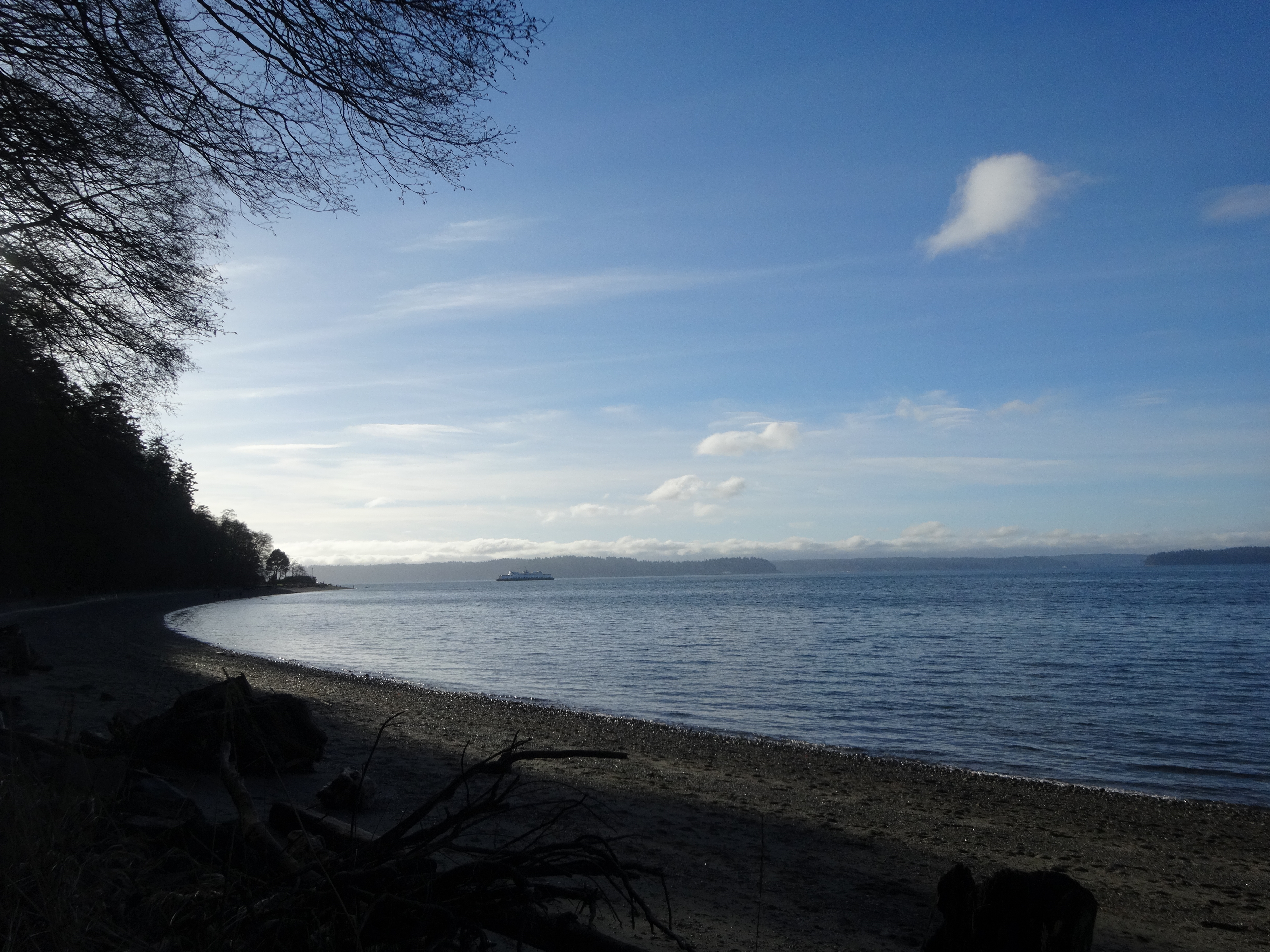
But even in winter, there are beautiful days. Yesterday, Christmas Day, was one of them. My husband and I walked down to the beach. The wind was gentle and the sky was blue. I spent a good bit of the walk stripped down to a short sleeved t-shirt. Granted, I had a Lupron shot last month and the furnace usually kicks in about this time but still, I was walking on a Seattle beach during winter in a t-shirt. What a glorious day.

I happen to think that the contrast between how our city looks on a sunny day versus a cloudy or rainy day is one of the reasons that we have a reputation for being a wetter city than we actually are. It’s disappointing to visit Seattle after seeing all of the glorious photos of the mountains and the sea only to be drizzled upon. But I don’t visit here. I live here. I know that the sun will come out again and that I will see it.

People in my city, especially natives, such as myself, often remark that our part of the world would not be so beautiful without the rain. This is true. We have some of the most beautiful summer weather I have ever experienced. And there is so much sunlight with very long days. Without the rainy, dreary days, though we would not have the abundant greens, the trees, bushes, mosses, and lichens. Winter is a time when plants focus their energy below the ground. The rain is essential for root growth, the foundation of plant life. Without precipitation, there is no snow on the mountains. We are so lucky to live in a city bound by two snow-capped mountain ranges. The winter snow on our mountains is also our water supply for the dry months of the year.

We need the wet and dreary days for life. It’s not just that the bad weather makes us appreciate the sunny days more because of the contrast. We actually require it. I’ve been thinking of this a lot in terms of how it relates to life, in general. Are sadness, disappointment, grief, and other painful emotions and experiences necessary for life? More so, do they enhance our lives?

I don’t know. I am pretty sure that seeking out suffering is a bad idea. Let’s not look for trouble. And denying suffering in oneself or others is invalidating. I am working a lot on acceptance of the things in my life that weigh on me heavily on a daily basis and are sometimes terrifying. Okay, it’s not “things”, it’s a thing. The thing is parenting my 16 year-old brilliant fireball. A few weeks ago, I had an epiphany followed by some meaningful adjustments in my behavior.

I realized on a deep and visceral level that I can’t protect her from the world or from the consequences of poor judgements that she makes. I didn’t abdicate responsibility but I relinquished the fantasy of control. I am still as busy parenting as I’ve ever been but my efforts are less frenzied and whirling. This acceptance was also accompanied by deep sadness. But the sadness was grounding instead of frenetic and anxious. I’m not going to kid myself and announce that acceptance is my new permanent state of being. My state of being, especially as a parent, will continue fluctuate. But this is an important shift.

I don’t know the future so I really don’t know how to end this post. What I do know is that every sunny time is to be celebrated and that the dreariest times cannot be wished away. I am learning more and more not to manufacture suffering; why would I want more of that? I am learning more and more to accept this as how life should be simply because that’s the way life is.

Christmas at the beach.

Christmas at the beach.

As I’ve written about previously, when I was a college student, I worked as a research assistant for an orthopedic surgeon who was completing a research fellowship at the University of Washington working in the Biomechanics Lab at Harborview Medical Center. He was doing a study on the use of an oscilloscope in assessing fracture healing in tibiae. He had a device that made a little thump on the skin over the tibia, thereby making it vibrate. A couple of readings were taken and recorded.

I have long maintained that it is not fair to expect smart people to automatically have professional skills with which they’ve had little or no training. So, I am not putting down the medical profession when I note that an M.D. is not a research degree and it was very clear that this very skilled and compassionate physician, did not always know what he was doing from a research methods standpoint.

One day, he and I were taking readings. There were some he didn’t like. He said, “Those a spurious.” And then he deleted them. I was shocked and said, “You can’t do that!” He repeated his rationale and looked mighty nonplussed for someone who had just DESTROYED DATA. It is true that most things in life are not normally distributed and even when they are, there will be outliers. But outliers count. They can’t just be dismissed. They are still part of the sample, the sample that is designed to represent a larger group.

We spend a lot of time defining what is normal, what is average. An average, or mean, is a measure of central tendency. It measures the middle. But sometimes the mean does not reflect the middle. Take home prices. Have you ever noticed that people talk about median, not mean, home prices? That’s because wealthy people tend to live in much more expensive homes, with prices outlying the general distribution. These outliers, or extreme scores, are described to exert too much leverage on the mean. Extreme scores can count for more than the rest of the group.

Let’s say that all of the houses in your neighborhood are worth $200,000-$300,000 except for one, which is worth $2 million. The mean is going to end up being higher than the price of all but one of the homes and is going to be substantially lower than the highest one. The mean is ghux not very meaningful so a median, the actual middle point of the distribution is used instead. Now the outlier house is not meaningless. There’s some meaning around someone having a lot more than everyone else. That says something. And the majority of the house prices mean something, too. One cannot get a complete picture without looking at both the norm and the exceptions.

If you are still with me on this statistics post, you know that I’m going to apply this to something else. You would be right. There is a lot of discussion in the breast cancer community about what words and experiences best represent us as a group. Sometimes we are talking about educating and changing our culture. We talk about the implications of words for funding, physician/patient relationships, and societal support for individuals with breast cancer. These conversations are very important.

Then there are the times we apply the mean to ourselves as individuals. Sometimes that fits and sometimes it doesn’t. Sometimes we apply our individual experiences to the group. Sometimes that fits and sometimes it doesn’t. Sometimes we want to be the average. Sometimes we want to be the outlier. I had a kind of breast cancer that has a good prognosis based on the type, stage, estimated aggressiveness, and the results of genetic testing. I am hoping very much to be an average breast cancer patient. I don’t want to be an outlier. My friends with metastatic cancer most commonly want to be outliers. They want to live longer and with a higher quality of life than the typical patient.

Some of the more controversial writings and interviews on breast cancer have occurred when an outlier case is treated as the typical case. Melissa Etheridge comes to mind. She is entitled to her own individual opinion about what caused her cancer and what will keep her healthy. She has freedom of speech, even as a famous person, and I have the freedom to think that she is living her life on a foundation of likely erroneous beliefs. But it is her life. Good journalism is supposed to present a story in context. When an individual expresses an outlier belief about the prevention and treatment of a deadly disease, there is a responsibility to present other view points, in particular, to interview an expert in the field. That provides context and a representative story.

Stories about individuals are often more interesting because they are less abstract. They seem so much more real than statistics. But as real as individual anecdotes are they often do not represent the group.

Breast cancer is not always interesting. Some of us are suffering in a way that is not good for print or t.v. Not all of us feel like “survivors” or “warriors” or “fierce”. Some of us do, some of us do not. Some of us believe in the power of prayer, the power of positive thinking, and some do not. For some, mastectomy feels like an amputation, for others not. We all deal with this disease in our own way. We feel losses in our own way.

It is unrealistic to expect all cancer patients to understand the complexities of these diseases, to cope with them, and also to EDUCATE the public. Some people are able to do this, but others are not. Some people argue that public figures have a responsibility to the public to educate because they are influential. I agree that they are influential but this argument is based on the assumption that they also have the skills necessary to educate. It is, however, realistic to expect people whose profession it is to provide health information to do so, and the blur between news and entertainment as well as news and disease commercialization, troubles me greatly.

We may be the mean. We may be outliers.

Every one of us is real.

We are all part of the group.

I am taking a six month class in skills designed, basically, to help me keep my emotional shit together. Unsurprisingly, the first unit is on mindfulness. I got into the class thinking, “Mindfulness, I’ve been doing this for over two years. This will be easy peasy lemon squeezy.”

I am here to tell you that week two has not lived up to it lemon squeezy potential. I have a lot of practice in observing without judgment. I also have a lot of experience describing my feeling states and being somewhat non judgmental about that.

Apparently, there’s other stuff. One of those things is doing things effectively. This has to do with thinking about my goals, at least that’s what I understand so far.

The instructor explained the whole thing. Meanwhile, I can tell you using my describing skills that I felt confused followed by elucidated followed by the realization that I was elucidated and not just confused, but in a different way. Then I think I got it but we will see on Wednesday when I check in about my homework.

And you know that I practiced on hubby. I can go through an interaction with my husband thinking, “Hm, that hurt my feelings and I don’t think John meant to do that. But wow, I am hurt and angry.”

That sounds good, doesn’t it?

Except that often what comes out of my mouth is, “Why did you say that?”

I am here to tell you that asking someone “Why did you say that” or “Why did you do that” when you are hurt, angry, or scared, will get you no where good, fast.

And yet I find myself saying this over and over. It is utterly not in keeping with my goals to be a peaceful loving wife who communicates well with John, whom I love dearly.

Another thing I might do is say nothing and think to myself, “This is not a big deal. Don’t start a fight.”

But in that case I did not accomplish my goal of communicating a hurt that was important to me and I risk getting resentful about it.

So I tried something new. John did something I didn’t like. And I said, “Honey, I am not trying to punish you or fight with you. But I am feeling anxious and angry about x and wondering if we might talk about it?”

It was not the easiest conversation but it was much easier and it was not a fight. But then I got very hurt and angry about something else. In time, he apologized for what he said and sincerely, but I found that I was still hurt and angry. I couldn’t let it drop. But it took me awhile to understand why I couldn’t let it drop. He had said something that might not upset someone else but because of who I am and what is important to me, it hurt. I was still upset because what he’d said had surprised me and I wanted to know that he understood why it was upsetting. I wanted reassurance that he still knew me and what is important to me. I said, “I’m sorry, I am still really hurt about this. I am sorry that I can’t let it drop. I need you to say, x, y, and z.” And then he said those things and he said them sincerely. We had been stuck in one of the arguments that go around and around. And then I felt so much better.  We had a very nice evening after what had been a tense couple of days.

The best thing about this class? I got confused because I encountered some new ideas and skills. That means there are more tools out there for me to learn. This is very reassuring to me.

I like my hair. It is long, with soft curls, and dyed an appealing shade of reddish brown. I am in the last year of my 40’s and my hair is longer than it has ever been in my life. Even including the time in the 70’s, when I wore my long hair tied back with one of those over-sized yarn pony tail holders. Back then, I used to run around barefoot and spent a good deal of time climbing trees. For many years, my feet were very calloused and my hair consisted of a neighborhood of knots and tangles. I just used to brush the top layer of hair to provide a presentable appearance. Every once in a while, I would have to sit in a chair while my mom painstakingly separated the tangles and the knots. Ow! Ow! Ow!

By the time I was 12 or 13, I was convinced that I had “bad hair”. In the 8th grade, I got a stylish feather cut. I used a curling iron religiously. I kept that cut for a number of years. It looked pretty good. By college, I shortened my hair even more and by the time I was 20, I had a pixie cut, which I loved. I kept my hair short for many years, no longer than a bob. By the end of college, I stopped using a curling iron.

I was still convinced that if I were to wear my hair long, it would be ugly, the way I remembered it being as a young adolescent. Then I got pregnant. I was 31 years old and my hair was growing very fast. I decided that it was time to see what hair longer than a pixie cut would look like.

After a few years, I discovered that my long hair was pretty. Also, I discovered that it was much curlier than it had been when I was younger. I didn’t have bad hair, after all. When my hair went gray, I decided to color treat it. Curly hair tends to be dry. Color dries it out more, especially the do-it-yourself stuff. I realized that if I were to keep my hair long, it would need professional help. I get my hair colored, cut, and deep conditioned every seven weeks.

When I was diagnosed with breast cancer 2 1/2 years ago, I started growing my hair even longer because I could and I wasn’t sure how much longer I would have long hair. I figured that if I had chemo and lost it all, I would never grow it back to long again. It would take years and years and at that point, not be “age appropriate”.

When chemotherapy was not recommended for me, I kept it growing. I have not stopped letting my hair grow except for a light trim, since my diagnosis. When straight, my hair now falls to the middle of my back. For the record, I believe that it has officially entered the realm of “not age appropriate”. I find that for the record, I don’t give a rat’s ass. I like my hair. It may not be with me in the future but now it’s here. It’s mine and I like it.

There are a lot of breast cancer writings about hair, what it means to a woman, and what it means when it is lost. A bald head is a dramatic difference in a person’s appearance. But hair carries so much significance, even if still remaining on one’s head.

How important is it to have good hair?

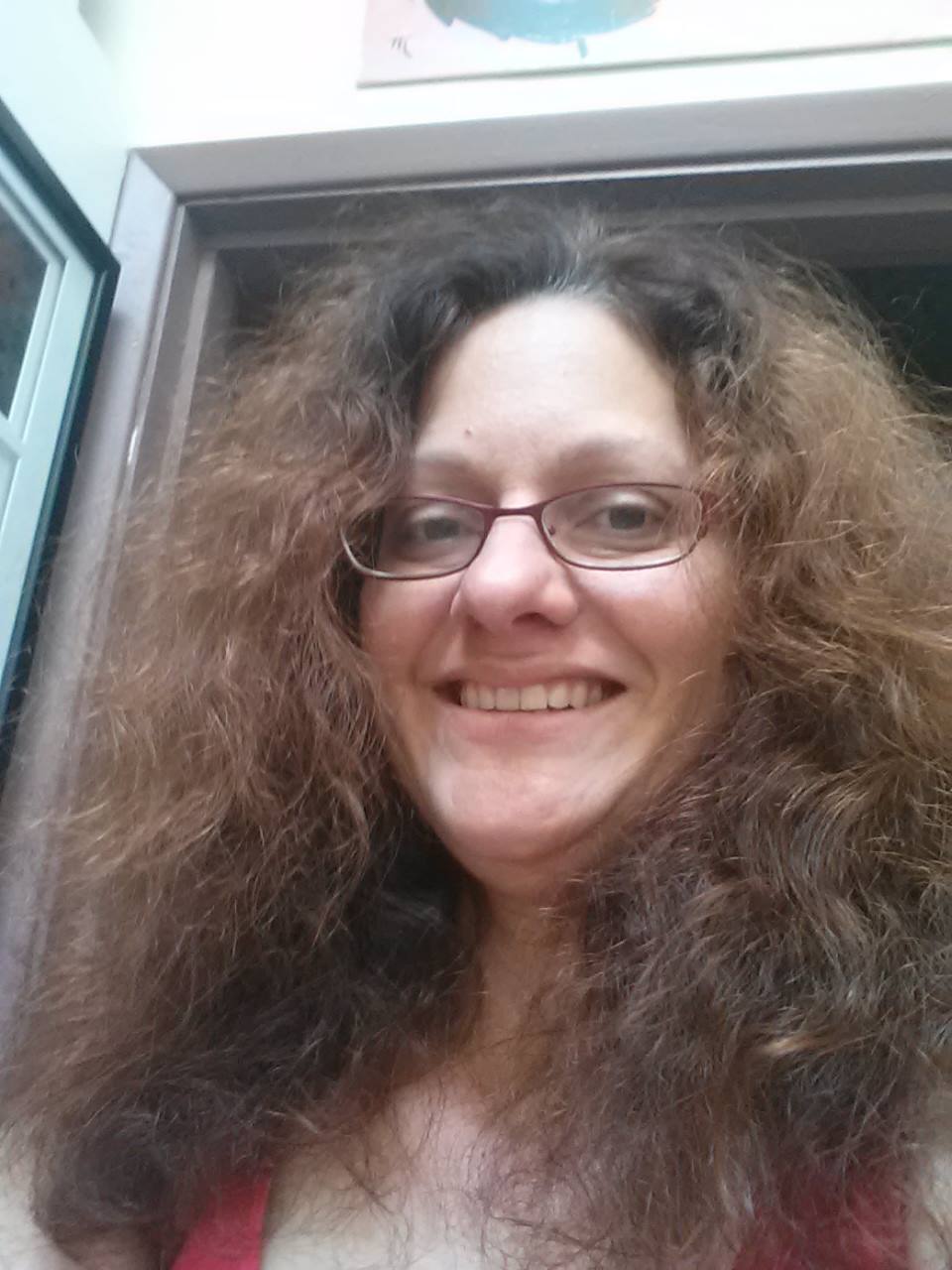
When my daughter asks my husband, “Dad, how does my hair look,” he sometimes replies, “It looks good but it would look better if you brushed it.” At this point, my daughter and I give each other knowing glances. She has curly hair, too. Brushing or combing curly hair while it’s dry breaks up the curl and to most eyes, does not look attractive. The only time I brush my hair when it is dry is to remove the tangles prior to straightening it with a flat iron. The last time I did this was a couple of months ago. My hair looked crazy and I thought it might make for a funny Facebook selfie, a kind of public service announcement explaining why curly hair is not dry brushed.

Curly tops: Don't try this at home.

Curly tops: Don’t try this at home.

How important is hair to people?

You would not believe the amount of advice this photo elicited about how to better care for my hair. It was pretty funny. But then I realized that the people commenting had seen MANY photos of me and my hair. It had never looked like this. Perhaps I am exaggerating, but it made me wonder if the sight of a woman with “bad hair” was so surprising that people forgot how I normally look and jumped straight into an urgent mode to save me from my split ends. Suggestions of coconut oil, olive oil, etc.

Hair is really important to a lot of women. I don’t want to lose mine, I know that for sure. Maybe it SHOULDN’T be that important. But it is. And one of the lessons I am learning in my life is that lots of things “should be” a certain way but they are not. We can only work with the way things are.

So please, please, please when one of your loved ones or even yourself loses hair as a result of chemo and is feeling sad about it, think twice before saying, “This shouldn’t bother you.”

If it bothers you, it bothers you. If it doesn’t, it doesn’t. What should be is not relevant to this particular situation.

My husband recently complimented me by noting that in a crisis, I am good at quickly figuring out what needs to be done, assembling resources, and doing it. This is true, in a number of respects, and I am grateful to have the skill and drive to carry it off.

There are some aspects of my life when this is hard and unfortunately, it is related to my physical health. I have a difficult time maintaining a healthy diet and exercise routine. I had coincidentally rejoined Weightwatchers a few weeks before my cancer diagnosis and had already started losing weight. I added walking at least 5 times a week a few months later, and I’ve been walking nearly every day for over two years. Since I started logging my miles on 12/2/12, I’ve walked close to 2000 miles.

I started tracking my miles as a way to help maintain my exercise program. That, combined with my renewed interest in nature photography, has helped me maintain the habit. Admittedly, I am having a little trouble transitioning to the damp part of the year but I’ve gotten out in some rather cold weather and enjoyed the sights and sounds of the outdoors. I know that I am getting my groove back.

My diet is another matter, altogether. I don’t eat a lot of sweets except around the holidays. And my gluten allergy means that I can’t eat most prepared foods anyway. However, I have been eating a lot of fruit, A LOT, and probably too much. I know that sounds silly but it has a lot of sugar in it. Finally, I know that my portion sizes are too big. I have gained nearly 20 pounds over my goal.

This all started when I decided to stop tracking what I ate every day. I stopped following Weight Watchers, basically. I was in a groove. I was ten pounds below my goal weight and walking a lot. I was really fit. I don’t know why I let myself do this. THIS IS HOW I’VE REGAINED WEIGHT EVERY TIME!

I keep restarting Weight Watchers for a couple of days but I have not yet gotten it to stick. Really, I am hoping that by writing this, I will get myself back into the long game, especially since we are in the holiday season.

I usually don’t end my blog posts with questions, but I have some. How do you help keep yourself motivated to maintain a healthy lifestyle?

Lindbergh High School Reunion '82, '83, '84, '85

Join us this summer for our reunion in Renton, WA!

George Lakoff

George Lakoff has retired as Distinguished Professor of Cognitive Science and Linguistics at the University of California at Berkeley. His newest book "The Neural Mind" is now available.

KomenWatch

Keeping our eyes and ears open.....

4 Times and Counting

Confessions Of A 4 Time Breast Cancer Survivor

Nancy's Point

A blog about breast cancer, loss, and survivorship

After 20 Years

Exploring progress in cancer research from the patient perspective

My Eyes Are Up Here

My life is not just about my chest, despite rumblings to the contrary.

Dglassme's Blog

Wouldn't Wish This On My Worst Enemy

SeasonedSistah

Today is Better Than Yesterday

The Pink Underbelly

A day in the life of a sassy Texas girl dealing with breast cancer and its messy aftermath

The Asymmetry of Matter

Qui vivra verra.

Fab 4th and 5th Grade

Teaching readers, writers, and thinkers

Journeying Beyond Breast Cancer

making sense of the breast cancer experience together

Entering a World of Pink

a male breast cancer blog

Luminous Blue

a mother's and daughter's journey with transformation, cancer, death and love

Fierce is the New Pink

Run to the Bear!

The Sarcastic Boob

Determined to Manage Breast Cancer with the Same Level of Sarcasm with which I Manage Everything Else

FEC-THis

Life after a tango with death & its best friend cancer